Asia Ultra-High-Net-Worth Individuals Lifestyle Research Report 2025
Prepared by Pridebay
Leading Research Institution for Ultra-High-Net-Worth Individuals’ Lifestyle in Asia
Executive Summary
Asia’s ultra-high-net-worth individuals (UHNWIs), defined as those with a net worth of at least USD 30 million in investable assets (excluding primary residences and collectibles), have become the most dynamic and influential wealth group in the global economy. As of 2026, Asia is home to more than 347,000 UHNWIs, accounting for 41% of the world’s total UHNWI population, with a combined wealth of USD 21.5 trillion. Over the past five years, the compound annual growth rate (CAGR) of Asia’s UHNWI population reached 12.8%, significantly outpacing the global average of 9.3%, making the region the core engine of global wealth creation.
This report, based on Pridebay’s one-year tracking research, big data analysis, in-depth interviews with more than 1,200 UHNWIs, family office principals, and wealth management experts across 10 major Asian markets, systematically reveals the demographic characteristics, wealth sources, income structure, consumption power, lifestyle preferences, and asset allocation logic of Asian UHNWIs. The report focuses on country-by-country comparative analysis to present a panoramic view of the lifestyle and wealth logic of Asia’s elite group, providing authoritative references for global luxury brands, financial institutions, real estate developers, and high-end service providers.
Key conclusions of this report:
- Wealth creation in Asia is shifting from traditional industries such as real estate and manufacturing to technology, new energy, biomedicine, and digital economy;
- The consumption logic of UHNWIs has changed from conspicuous luxury to experiential, healthy, and low-key luxury, with health management and private travel becoming the top two consumption directions;
- Geographic distribution presents a "dual-core leading, multi-node rise" pattern, with China and India as the core, and Singapore, Hong Kong (China), Japan, and South Korea as important hubs;
- Asset allocation tends to be globalized and diversified, with alternative investments, safe-haven assets, and sustainable investment products becoming new allocation trends;
- The intergenerational inheritance of wealth and the rise of the new elite have reshaped the lifestyle and consumption orientation of Asian UHNWIs.
1. Overall Profile of Asian UHNWIs
1.1 Definition and Statistical Criteria
In this report, UHNWIs refer to individuals with net investable assets ≥ USD 30 million (excluding primary residences, art collections, luxury cars, yachts, and other consumer assets). The statistical scope covers 10 major economies in Asia: Chinese mainland, India, Japan, Singapore, Hong Kong (China), South Korea, Malaysia, Indonesia, Thailand, and Australia, which together account for 89% of Asia’s total UHNWI population and 92% of total wealth.
1.2 Population Scale and Geographic Distribution
In 2026, the total number of UHNWIs in Asia exceeded 347,000, with a year-on-year growth rate of 14.2%. The regional distribution is highly concentrated, showing significant differences in growth rate and wealth structure among countries.
|
Country/Region |
UHNWI Population (2026) |
YoY Growth (2025–2026) |
Total Wealth (USD Billion) |
Core Wealth Hubs |
|
Chinese Mainland |
142,000 |
15.3% |
8,620 |
Beijing, Shanghai, Shenzhen, Guangzhou, Hangzhou |
|
India |
58,700 |
21.7% |
3,280 |
Mumbai, Delhi, Bengaluru, Hyderabad |
|
Japan |
36,400 |
7.2% |
2,850 |
Tokyo, Osaka, Kyoto, Nagoya |
|
Singapore |
12,800 |
18.9% |
1,460 |
Central Area, Sentosa Cove, Marina Bay |
|
Hong Kong (China) |
10,500 |
12.4% |
1,240 |
Central, Wan Chai, Kowloon Tong, Peak |
|
South Korea |
9,200 |
14.1% |
980 |
Seoul Gangnam, Busan Haeundae, Seongnam |
|
Malaysia |
6,800 |
16.5% |
690 |
Kuala Lumpur City Centre, Penang, Langkawi |
|
Indonesia |
5,300 |
19.2% |
570 |
Jakarta Sudirman, Bali Seminyak, Surabaya |
|
Thailand |
4,100 |
13.8% |
440 |
Bangkok Sukhumvit, Phuket, Koh Samui |
|
Australia |
3,900 |
10.7% |
410 |
Sydney, Melbourne, Gold Coast, Perth |
1.3 Demographic Characteristics
The average age of Asian UHNWIs is 42 years old, 5 years younger than the global average. Among them, the new elite under the age of 45 accounts for 60%, and the proportion of female UHNWIs has increased to 45%, showing a younger and feminized trend. In terms of occupation, entrepreneurs account for 58%, corporate executives 22%, professional investors 12%, and heirs of family businesses 8%. Family offices have become the standard configuration for UHNWIs with assets exceeding USD 100 million, and the penetration rate in Asia has reached 73%.
2. Wealth Sources and Income Structure of Asian UHNWIs
2.1 Core Wealth Sources
The wealth sources of Asian UHNWIs have undergone major structural changes. Traditional real estate and manufacturing have declined, while technology innovation, industrial upgrading, and capital operations have become the main drivers of new wealth creation.
- Tech entrepreneurship and innovation (38%): AI, semiconductors, new energy vehicles, fintech, and biomedicine are the most wealth-creating fields;
- Corporate operation and dividends (24%): Large conglomerates, listed companies, and global industrial chain leaders;
- Investment income (21%): Secondary market, private equity, venture capital, real estate investment;
- Family inheritance (10%): Intergenerational transmission of old wealthy families;
- Other industries (7%): Luxury goods, tourism, medical treatment, entertainment, etc.
2.2 Annual Income Structure
The average annual disposable income of Asian UHNWIs is USD 4.7 million, with a stable and diversified income structure:
- Investment income: 32%
- Corporate dividends: 28%
- Salary and performance incentives: 21%
- Rental and asset income: 12%
- Inheritance and consulting income: 7%
2.3 Country-Specific Wealth Sources
Chinese Mainland
Wealth mainly comes from hard technology, new energy, digital economy, and high-end manufacturing. The proportion of wealth from real estate has dropped from 35% in 2021 to 18% in 2026. First-tier cities and new first-tier cities are the core gathering places, and the wealth growth rate of entrepreneurs in the Yangtze River Delta and Pearl River Delta is the highest.
India
Wealth sources are digital economy, resource industries, pharmaceutical manufacturing, and financial services. Startups in Bengaluru and Mumbai have created a large number of new UHNWIs, and the wealth growth rate of the new economy is far higher than that of traditional family businesses.
Japan
Wealth is dominated by old manufacturing groups, precision technology, and financial investment. The wealth structure is stable, with a high proportion of inherited wealth, and the growth rate is relatively gentle. UHNWIs focus on asset preservation and long-term stable returns.
Singapore
As an international wealth hub, wealth sources are global cross-border investment, family office management, financial services, and high-end trade. More than 70% of UHNWIs are transnational entrepreneurs or global investors, with highly globalized assets.
Hong Kong (China)
Wealth mainly comes from financial services, cross-border investment, luxury retail, and real estate finance. It is an important platform for connecting Chinese mainland and global capital, and family offices and asset management are the core industries.
South Korea
Wealth is concentrated in semiconductors, electronics, K-culture industry, and biopharmaceuticals. Chaebol groups and technology startups jointly promote wealth growth, and the proportion of stock assets in total wealth is the highest in Asia.
Malaysia
Wealth sources are plantation resources, real estate, Islamic finance, and tourism. Ethnic Chinese entrepreneurs account for nearly 30% of UHNWIs, and cross-border investment with Singapore is frequent.
Indonesia
Wealth comes from mining resources, digital economy, real estate, and agricultural products. The UHNWI group is young, and the wealth growth rate driven by the Jakarta digital economy and consumer Internet ranks among the top in Southeast Asia.
Thailand
Wealth is dominated by tourism, real estate, food processing, and cross-border trade. The luxury tourism and medical beauty industries have driven the growth of high-end groups, and Bangkok and Phuket are dual-core hubs.
Australia
Wealth sources are mining resources, renewable energy, financial technology, and high-end services. The wealth of resource giants and technology entrepreneurs has grown rapidly, and the Asia-Pacific investment layout is the core strategy.
3. Consumption Power and Lifestyle of Asian UHNWIs
3.1 Overall Consumption Scale and Characteristics
The average annual discretionary consumption of Asian UHNWIs is USD 1.8 million, and the total annual consumption scale exceeds USD 620 billion. Consumption presents three core trends:
- From conspicuous consumption to experiential consumption: Travel, wellness, and private customization account for 68% of total consumption;
- From international big brands to low-key luxury: Understated, high-quality, and customized brands replace logo-display luxury;
- Health first: Health management, anti-aging, and private medical treatment have become the largest single consumption item.
3.2 Core Consumption Categories
- Private travel and vacation (31%): Private jets, yachts, exclusive custom trips, top resort villas;
- Health and wellness (27%): Precision medical treatment, anti-aging management, private doctors, wellness retreats;
- High-end real estate (18%): Global luxury residences, holiday villas, commercial core assets;
- Luxury goods and customized services (12%): High-end clothing, watches, jewelry, private customization;
- Education and culture (8%): Children’s international education, art collection, private clubs;
- Other consumption (4%): High-end dining, pets, social interaction, etc.
3.3 Country-Specific Consumption Patterns
Chinese Mainland
- Consumption focus: Domestic high-end tourism, health management, new energy luxury cars, and family education;
- Real estate: Prefer core city apartments and global holiday properties, with an average luxury residence value of USD 4.2 million;
- Travel: Sanya, Yunnan, Xinjiang and other domestic high-end destinations are popular, and private jet travel accounts for 42%;
- Consumption characteristics: Pay attention to privacy and customization, and the acceptance of domestic high-end brands is rising rapidly.
India
- Consumption focus: Luxury real estate, grand family events, international education, and luxury cars;
- Wedding consumption: The average cost exceeds USD 2.8 million, and overseas destination weddings are popular;
- Real estate: 32% of wealth is allocated to residential real estate, and luxury projects in Mumbai and Delhi are the most sought-after;
- Consumption characteristics: Strong family-oriented consumption, and high attention to social identity display.
Japan
- Consumption focus: Stable luxury goods, preventive medical treatment, traditional culture experience, and asset preservation;
- Health consumption: 98% of UHNWIs have long-term private health management plans, focusing on longevity and functional medicine;
- Luxury consumption: Prefer traditional top brands and Japanese local high-end handicrafts, low-key and restrained;
- Consumption characteristics: Pragmatic, stable, and pay attention to quality and connotation rather than external display.
Singapore
- Consumption focus: Global private travel, yacht life, family office services, and cross-border asset allocation;
- Luxury residence: The average price of core area residences exceeds USD 6 million, and Sentosa yacht residences are scarce assets;
- Identity planning: 89% of UHNWIs hold multiple passports, and cross-border mobility and tax planning are core demands;
- Consumption characteristics: Internationalization, privacy, and high-end professional services are the top priorities.
Hong Kong (China)
- Consumption focus: Global luxury shopping, private medical treatment, art collection, and cross-border travel;
- Luxury consumption: Per capita luxury consumption is 2.5 times the Asian average, and Art Basel Hong Kong is a core social scene;
- Real estate: The luxury residential market in the Peak and Central ranks among the top in the world in terms of unit price;
- Consumption characteristics: Highly international, fashion-sensitive, and pay attention to wealth inheritance and asset security.
South Korea
- Consumption focus: Semiconductor and technology industry-related social networking, high-end medical beauty, private aviation, and luxury cars;
- Asset consumption: Stock-related consumption and investment are closely linked, and the proportion of luxury car and private jet consumption is the highest in Asia;
- Health consumption: Medical beauty and preventive care account for 32% of health expenditure;
- Consumption characteristics: Fashion-forward, pursue cutting-edge technology and high-end beauty services.
Malaysia
- Consumption focus: Family-centric vacation, tropical luxury life, Islamic wealth management, and medical tourism;
- Holiday consumption: Langkawi yachting, Penang high-end vacation, and golf social networking are mainstream;
- Consumption characteristics: Moderate and low-key, attach importance to family stability and cross-border wealth security.
Indonesia
- Consumption focus: Jakarta luxury real estate, Bali vacation villas, private jets, and gold consumption;
- Age characteristics: More than 52% of UHNWIs are under 45 years old, with active consumption and strong demand for emerging luxury goods;
- Asset preference: Gold allocation and consumption account for 18%, which is a traditional wealth reserve method.
Thailand
- Consumption focus: Luxury tourism, spa wellness, high-end medical treatment, and beach real estate;
- Vacation consumption: 40% of discretionary consumption is used for travel and wellness, and Phuket private villas are standard equipment;
- Education and medical treatment: High expenditure on international schools and top private hospitals in Bangkok.
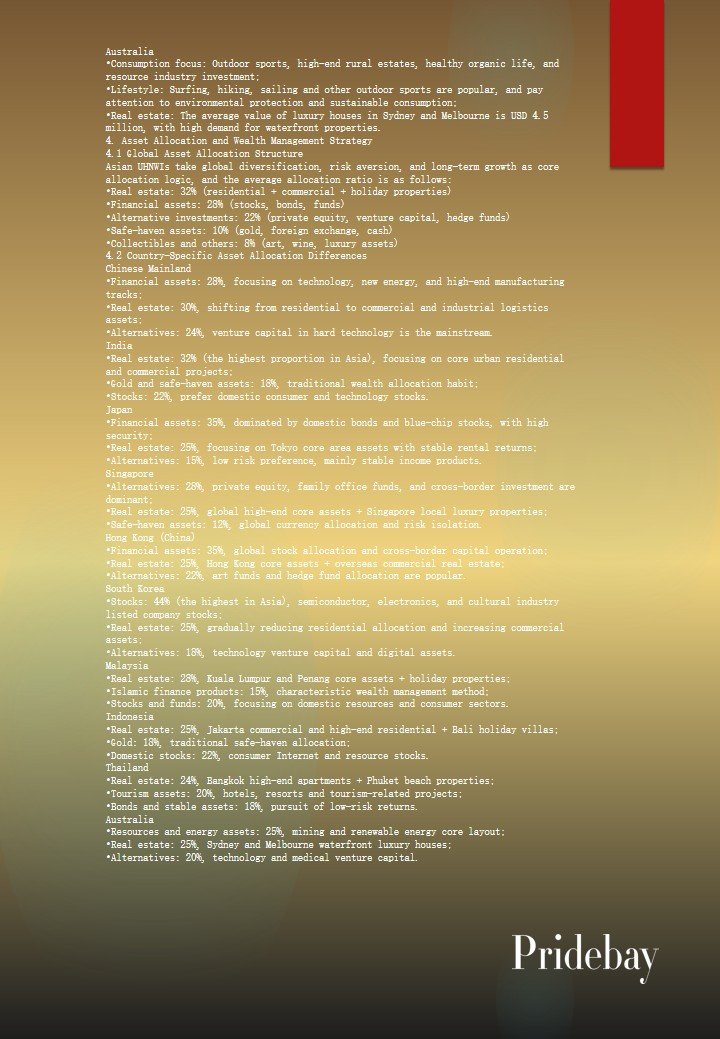
Australia
- Consumption focus: Outdoor sports, high-end rural estates, healthy organic life, and resource industry investment;
- Lifestyle: Surfing, hiking, sailing and other outdoor sports are popular, and pay attention to environmental protection and sustainable consumption;
- Real estate: The average value of luxury houses in Sydney and Melbourne is USD 4.5 million, with high demand for waterfront properties.
4. Asset Allocation and Wealth Management Strategy
4.1 Global Asset Allocation Structure
Asian UHNWIs take global diversification, risk aversion, and long-term growth as core allocation logic, and the average allocation ratio is as follows:
- Real estate: 32% (residential + commercial + holiday properties)
- Financial assets: 28% (stocks, bonds, funds)
- Alternative investments: 22% (private equity, venture capital, hedge funds)
- Safe-haven assets: 10% (gold, foreign exchange, cash)
- Collectibles and others: 8% (art, wine, luxury assets)
4.2 Country-Specific Asset Allocation Differences
Chinese Mainland
- Financial assets: 28%, focusing on technology, new energy, and high-end manufacturing tracks;
- Real estate: 30%, shifting from residential to commercial and industrial logistics assets;
- Alternatives: 24%, venture capital in hard technology is the mainstream.
India
- Real estate: 32% (the highest proportion in Asia), focusing on core urban residential and commercial projects;
- Gold and safe-haven assets: 18%, traditional wealth allocation habit;
- Stocks: 22%, prefer domestic consumer and technology stocks.
Japan
- Financial assets: 35%, dominated by domestic bonds and blue-chip stocks, with high security;
- Real estate: 25%, focusing on Tokyo core area assets with stable rental returns;
- Alternatives: 15%, low risk preference, mainly stable income products.
Singapore
- Alternatives: 28%, private equity, family office funds, and cross-border investment are dominant;
- Real estate: 25%, global high-end core assets + Singapore local luxury properties;
- Safe-haven assets: 12%, global currency allocation and risk isolation.
Hong Kong (China)
- Financial assets: 35%, global stock allocation and cross-border capital operation;
- Real estate: 25%, Hong Kong core assets + overseas commercial real estate;
- Alternatives: 22%, art funds and hedge fund allocation are popular.
South Korea
- Stocks: 44% (the highest in Asia), semiconductor, electronics, and cultural industry listed company stocks;
- Real estate: 25%, gradually reducing residential allocation and increasing commercial assets;
- Alternatives: 18%, technology venture capital and digital assets.
Malaysia
- Real estate: 28%, Kuala Lumpur and Penang core assets + holiday properties;
- Islamic finance products: 15%, characteristic wealth management method;
- Stocks and funds: 20%, focusing on domestic resources and consumer sectors.
Indonesia
- Real estate: 25%, Jakarta commercial and high-end residential + Bali holiday villas;
- Gold: 18%, traditional safe-haven allocation;
- Domestic stocks: 22%, consumer Internet and resource stocks.
Thailand
- Real estate: 24%, Bangkok high-end apartments + Phuket beach properties;
- Tourism assets: 20%, hotels, resorts and tourism-related projects;
- Bonds and stable assets: 18%, pursuit of low-risk returns.
Australia
- Resources and energy assets: 25%, mining and renewable energy core layout;
- Real estate: 25%, Sydney and Melbourne waterfront luxury houses;
- Alternatives: 20%, technology and medical venture capital.
5. Future Trends of Asian UHNWIs’ Lifestyle and Wealth
Based on Pridebay’s forward-looking research, the lifestyle and wealth logic of Asian UHNWIs will show five major trends in the next three years (2026–2029):
- Technology-driven wealth will continue to grow: AI, commercial aerospace, quantum technology, and synthetic biology will become new tracks for wealth creation;
- Consumption will be more healthy and sustainable: ESG consumption, green luxury, and zero-carbon lifestyle will become mainstream choices;
- Global asset allocation will be more refined: Family offices will develop in the direction of specialization, digitalization, and privacy;
- Intergenerational inheritance will accelerate: The new elite will master wealth dominance, and digital assets and innovative investment will become new allocation directions;
- Regional consumption rise: Domestic high-end brands and localized luxury services will replace part of international big-brand demand.
Conclusion
As the world’s largest and fastest-growing UHNWI gathering area, Asia’s ultra-high-net-worth individuals have completed the transformation from "wealth creation" to "wealth operation and lifestyle upgrading". Their consumption logic, asset allocation, and lifestyle choices not only reflect the economic vitality and cultural characteristics of various Asian countries but also lead the development direction of the global high-end market.
In the future, with the further deepening of technological innovation and economic integration in Asia, the scale of UHNWIs will continue to expand, and their lifestyle will be more diversified, personalized, and globalized. Pridebay will continue to focus on the research of Asian UHNWIs’ lifestyle and wealth trends, and provide the most professional and forward-looking decision-making support for global high-end industries.