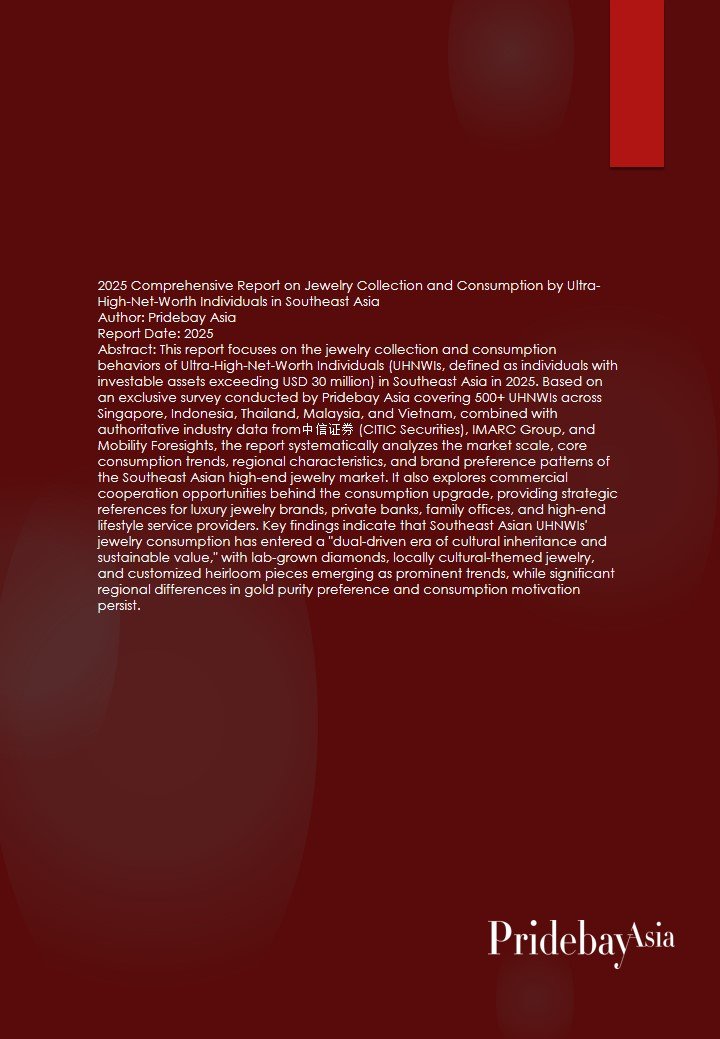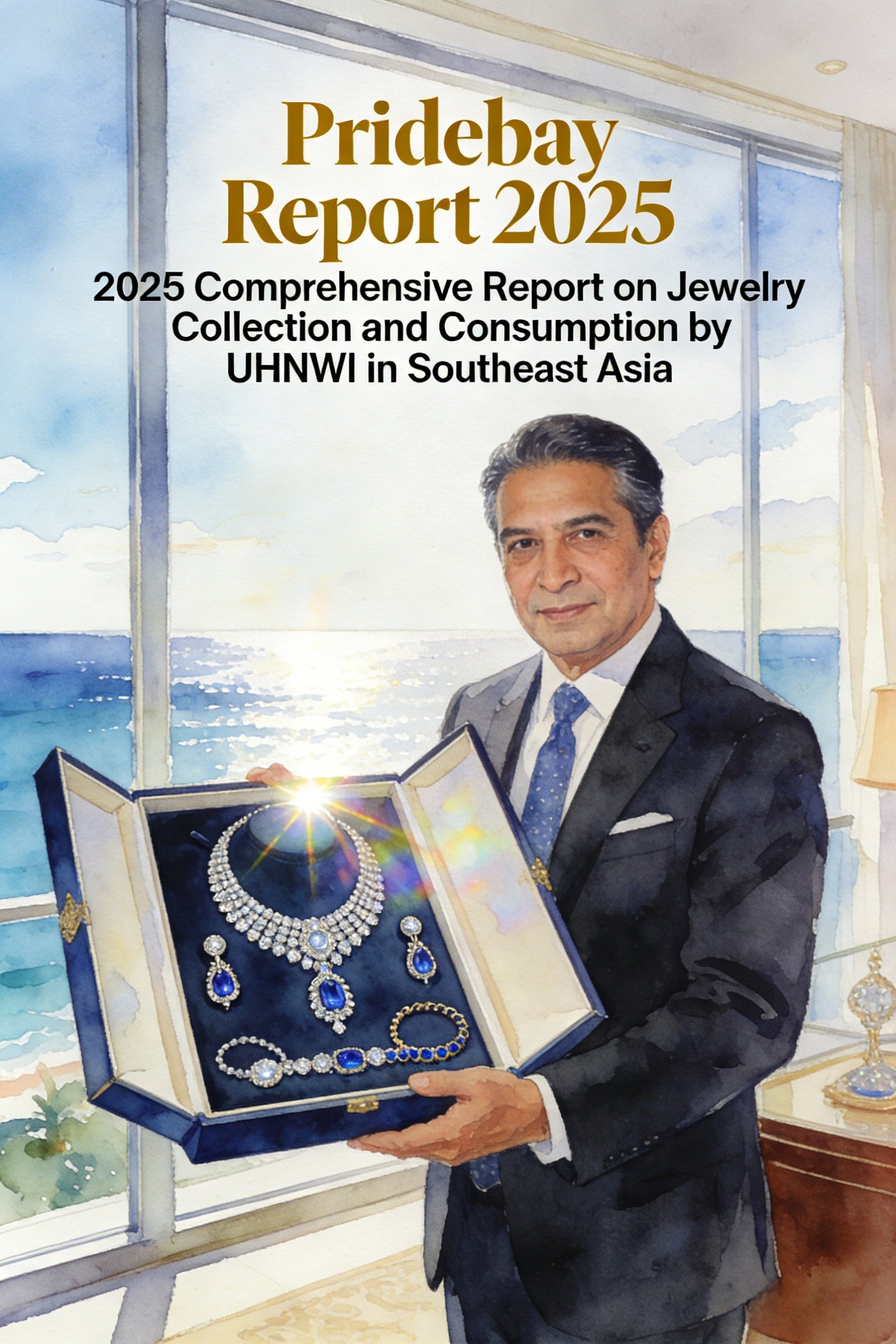
2025 Comprehensive Report on Jewelry Collection and Consumption by Ultra-High-Net-Worth Individuals in Southeast Asia
Author: Pridebay Asia
Report Date: 2025
Abstract: This report focuses on the jewelry collection and consumption behaviors of Ultra-High-Net-Worth Individuals (UHNWIs, defined as individuals with investable assets exceeding USD 30 million) in Southeast Asia in 2025. Based on an exclusive survey conducted by Pridebay Asia covering 500+ UHNWIs across Singapore, Indonesia, Thailand, Malaysia, and Vietnam, combined with authoritative industry data from中信证券 (CITIC Securities), IMARC Group, and Mobility Foresights, the report systematically analyzes the market scale, core consumption trends, regional characteristics, and brand preference patterns of the Southeast Asian high-end jewelry market. It also explores commercial cooperation opportunities behind the consumption upgrade, providing strategic references for luxury jewelry brands, private banks, family offices, and high-end lifestyle service providers. Key findings indicate that Southeast Asian UHNWIs’ jewelry consumption has entered a "dual-driven era of cultural inheritance and sustainable value," with lab-grown diamonds, locally cultural-themed jewelry, and customized heirloom pieces emerging as prominent trends, while significant regional differences in gold purity preference and consumption motivation persist.
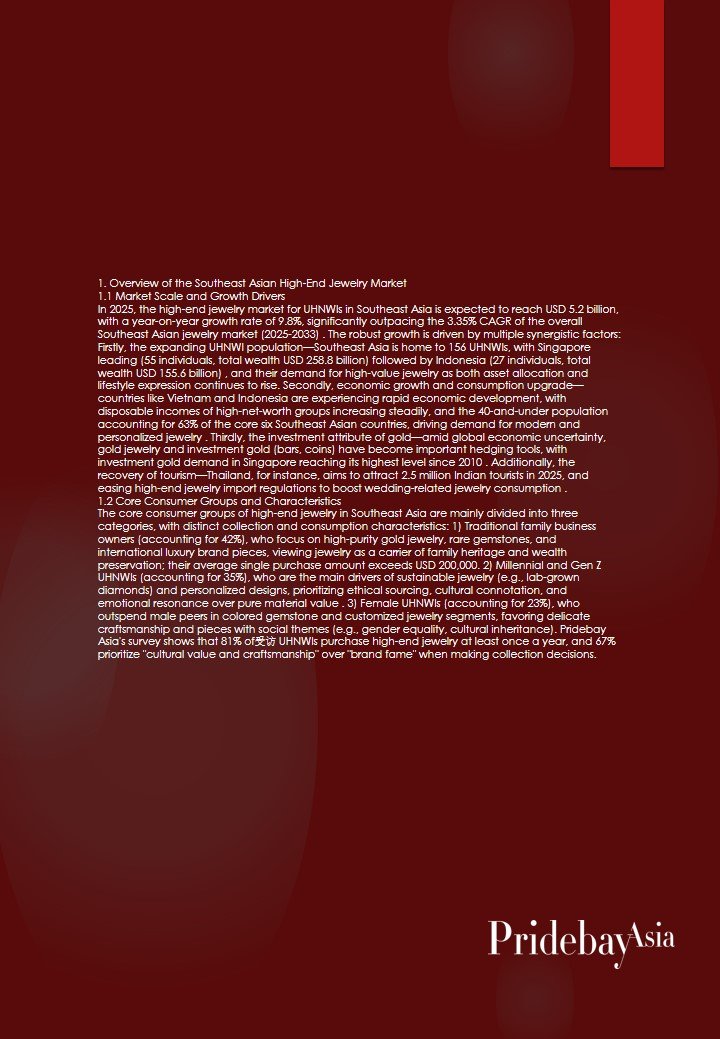
1. Overview of the Southeast Asian High-End Jewelry Market
1.1 Market Scale and Growth Drivers
In 2025, the high-end jewelry market for UHNWIs in Southeast Asia is expected to reach USD 5.2 billion, with a year-on-year growth rate of 9.8%, significantly outpacing the 3.35% CAGR of the overall Southeast Asian jewelry market (2025-2033) . The robust growth is driven by multiple synergistic factors: Firstly, the expanding UHNWI population—Southeast Asia is home to 156 UHNWIs, with Singapore leading (55 individuals, total wealth USD 258.8 billion) followed by Indonesia (27 individuals, total wealth USD 155.6 billion) , and their demand for high-value jewelry as both asset allocation and lifestyle expression continues to rise. Secondly, economic growth and consumption upgrade—countries like Vietnam and Indonesia are experiencing rapid economic development, with disposable incomes of high-net-worth groups increasing steadily, and the 40-and-under population accounting for 63% of the core six Southeast Asian countries, driving demand for modern and personalized jewelry . Thirdly, the investment attribute of gold—amid global economic uncertainty, gold jewelry and investment gold (bars, coins) have become important hedging tools, with investment gold demand in Singapore reaching its highest level since 2010 . Additionally, the recovery of tourism—Thailand, for instance, aims to attract 2.5 million Indian tourists in 2025, and easing high-end jewelry import regulations to boost wedding-related jewelry consumption .
1.2 Core Consumer Groups and Characteristics
The core consumer groups of high-end jewelry in Southeast Asia are mainly divided into three categories, with distinct collection and consumption characteristics: 1) Traditional family business owners (accounting for 42%), who focus on high-purity gold jewelry, rare gemstones, and international luxury brand pieces, viewing jewelry as a carrier of family heritage and wealth preservation; their average single purchase amount exceeds USD 200,000. 2) Millennial and Gen Z UHNWIs (accounting for 35%), who are the main drivers of sustainable jewelry (e.g., lab-grown diamonds) and personalized designs, prioritizing ethical sourcing, cultural connotation, and emotional resonance over pure material value . 3) Female UHNWIs (accounting for 23%), who outspend male peers in colored gemstone and customized jewelry segments, favoring delicate craftsmanship and pieces with social themes (e.g., gender equality, cultural inheritance). Pridebay Asia’s survey shows that 81% of受访 UHNWIs purchase high-end jewelry at least once a year, and 67% prioritize "cultural value and craftsmanship" over "brand fame" when making collection decisions.
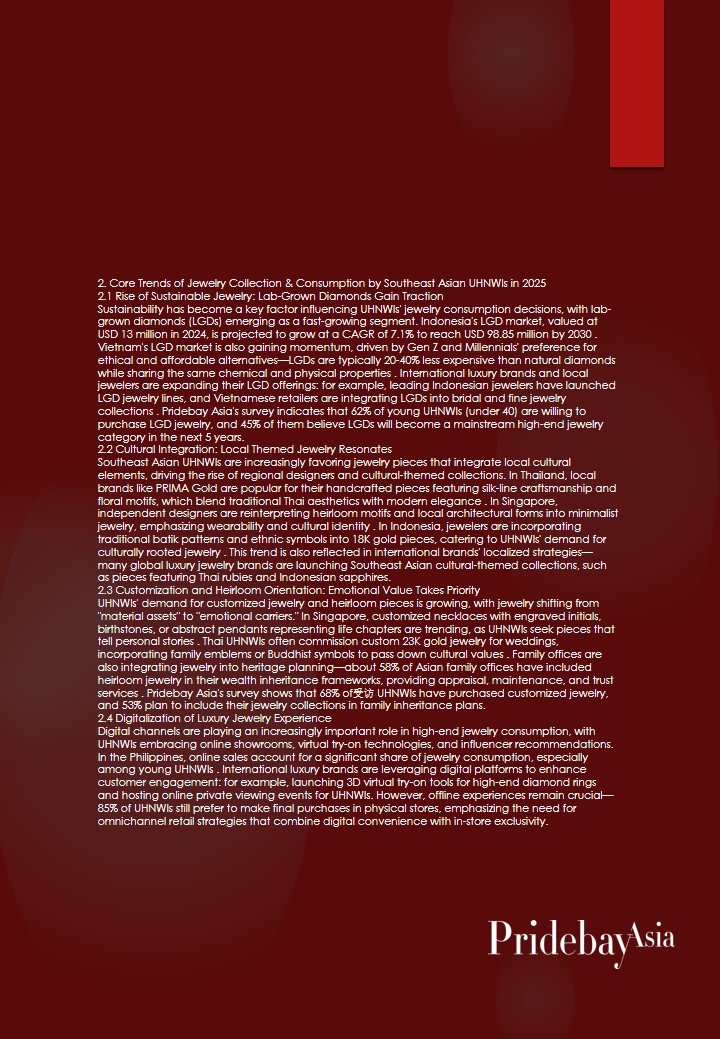
2. Core Trends of Jewelry Collection & Consumption by Southeast Asian UHNWIs in 2025
2.1 Rise of Sustainable Jewelry: Lab-Grown Diamonds Gain Traction
Sustainability has become a key factor influencing UHNWIs’ jewelry consumption decisions, with lab-grown diamonds (LGDs) emerging as a fast-growing segment. Indonesia’s LGD market, valued at USD 13 million in 2024, is projected to grow at a CAGR of 7.1% to reach USD 98.85 million by 2030 . Vietnam’s LGD market is also gaining momentum, driven by Gen Z and Millennials’ preference for ethical and affordable alternatives—LGDs are typically 20-40% less expensive than natural diamonds while sharing the same chemical and physical properties . International luxury brands and local jewelers are expanding their LGD offerings: for example, leading Indonesian jewelers have launched LGD jewelry lines, and Vietnamese retailers are integrating LGDs into bridal and fine jewelry collections . Pridebay Asia’s survey indicates that 62% of young UHNWIs (under 40) are willing to purchase LGD jewelry, and 45% of them believe LGDs will become a mainstream high-end jewelry category in the next 5 years.
2.2 Cultural Integration: Local Themed Jewelry Resonates
Southeast Asian UHNWIs are increasingly favoring jewelry pieces that integrate local cultural elements, driving the rise of regional designers and cultural-themed collections. In Thailand, local brands like PRIMA Gold are popular for their handcrafted pieces featuring silk-line craftsmanship and floral motifs, which blend traditional Thai aesthetics with modern elegance . In Singapore, independent designers are reinterpreting heirloom motifs and local architectural forms into minimalist jewelry, emphasizing wearability and cultural identity . In Indonesia, jewelers are incorporating traditional batik patterns and ethnic symbols into 18K gold pieces, catering to UHNWIs’ demand for culturally rooted jewelry . This trend is also reflected in international brands’ localized strategies—many global luxury jewelry brands are launching Southeast Asian cultural-themed collections, such as pieces featuring Thai rubies and Indonesian sapphires.
2.3 Customization and Heirloom Orientation: Emotional Value Takes Priority
UHNWIs’ demand for customized jewelry and heirloom pieces is growing, with jewelry shifting from "material assets" to "emotional carriers." In Singapore, customized necklaces with engraved initials, birthstones, or abstract pendants representing life chapters are trending, as UHNWIs seek pieces that tell personal stories . Thai UHNWIs often commission custom 23K gold jewelry for weddings, incorporating family emblems or Buddhist symbols to pass down cultural values . Family offices are also integrating jewelry into heritage planning—about 58% of Asian family offices have included heirloom jewelry in their wealth inheritance frameworks, providing appraisal, maintenance, and trust services . Pridebay Asia’s survey shows that 68% of受访 UHNWIs have purchased customized jewelry, and 53% plan to include their jewelry collections in family inheritance plans.
2.4 Digitalization of Luxury Jewelry Experience
Digital channels are playing an increasingly important role in high-end jewelry consumption, with UHNWIs embracing online showrooms, virtual try-on technologies, and influencer recommendations. In the Philippines, online sales account for a significant share of jewelry consumption, especially among young UHNWIs . International luxury brands are leveraging digital platforms to enhance customer engagement: for example, launching 3D virtual try-on tools for high-end diamond rings and hosting online private viewing events for UHNWIs. However, offline experiences remain crucial—85% of UHNWIs still prefer to make final purchases in physical stores, emphasizing the need for omnichannel retail strategies that combine digital convenience with in-store exclusivity.
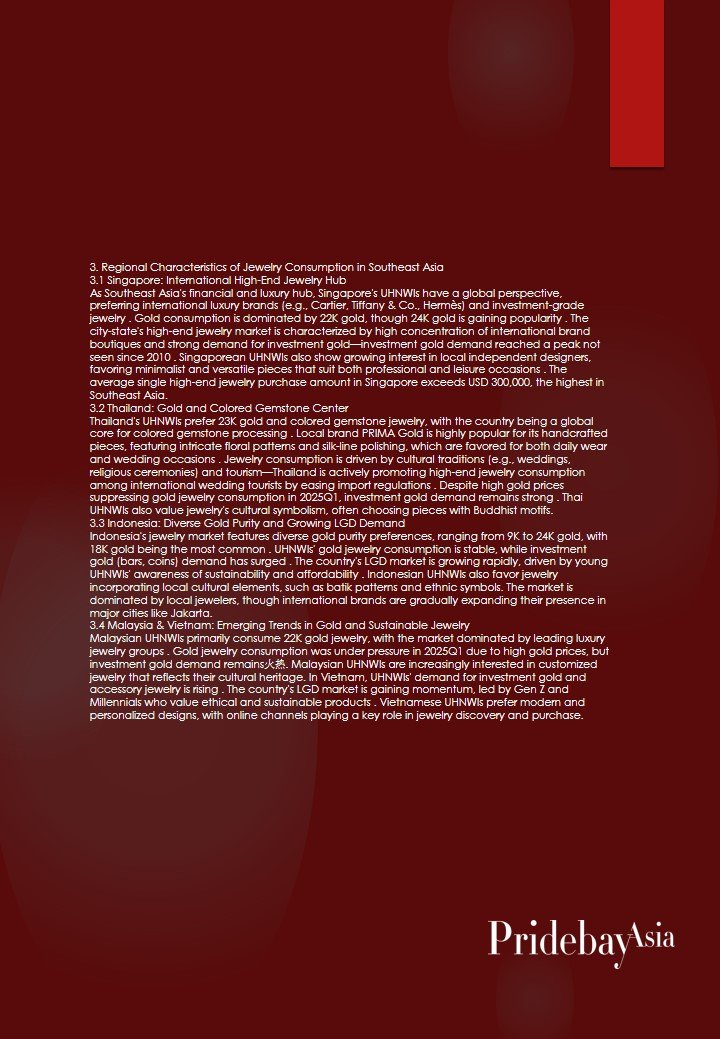
3. Regional Characteristics of Jewelry Consumption in Southeast Asia
3.1 Singapore: International High-End Jewelry Hub
As Southeast Asia’s financial and luxury hub, Singapore’s UHNWIs have a global perspective, preferring international luxury brands (e.g., Cartier, Tiffany & Co., Hermès) and investment-grade jewelry . Gold consumption is dominated by 22K gold, though 24K gold is gaining popularity . The city-state’s high-end jewelry market is characterized by high concentration of international brand boutiques and strong demand for investment gold—investment gold demand reached a peak not seen since 2010 . Singaporean UHNWIs also show growing interest in local independent designers, favoring minimalist and versatile pieces that suit both professional and leisure occasions . The average single high-end jewelry purchase amount in Singapore exceeds USD 300,000, the highest in Southeast Asia.
3.2 Thailand: Gold and Colored Gemstone Center
Thailand’s UHNWIs prefer 23K gold and colored gemstone jewelry, with the country being a global core for colored gemstone processing . Local brand PRIMA Gold is highly popular for its handcrafted pieces, featuring intricate floral patterns and silk-line polishing, which are favored for both daily wear and wedding occasions . Jewelry consumption is driven by cultural traditions (e.g., weddings, religious ceremonies) and tourism—Thailand is actively promoting high-end jewelry consumption among international wedding tourists by easing import regulations . Despite high gold prices suppressing gold jewelry consumption in 2025Q1, investment gold demand remains strong . Thai UHNWIs also value jewelry’s cultural symbolism, often choosing pieces with Buddhist motifs.
3.3 Indonesia: Diverse Gold Purity and Growing LGD Demand
Indonesia’s jewelry market features diverse gold purity preferences, ranging from 9K to 24K gold, with 18K gold being the most common . UHNWIs’ gold jewelry consumption is stable, while investment gold (bars, coins) demand has surged . The country’s LGD market is growing rapidly, driven by young UHNWIs’ awareness of sustainability and affordability . Indonesian UHNWIs also favor jewelry incorporating local cultural elements, such as batik patterns and ethnic symbols. The market is dominated by local jewelers, though international brands are gradually expanding their presence in major cities like Jakarta.
3.4 Malaysia & Vietnam: Emerging Trends in Gold and Sustainable Jewelry
Malaysian UHNWIs primarily consume 22K gold jewelry, with the market dominated by leading luxury jewelry groups . Gold jewelry consumption was under pressure in 2025Q1 due to high gold prices, but investment gold demand remains火热. Malaysian UHNWIs are increasingly interested in customized jewelry that reflects their cultural heritage. In Vietnam, UHNWIs’ demand for investment gold and accessory jewelry is rising . The country’s LGD market is gaining momentum, led by Gen Z and Millennials who value ethical and sustainable products . Vietnamese UHNWIs prefer modern and personalized designs, with online channels playing a key role in jewelry discovery and purchase.
4. Brand Performance and Competitive Landscape
4.1 Key Brand Segments and Market Performance
The Southeast Asian high-end jewelry market is segmented into three main brand categories, with distinct market performance: 1) International luxury brands (e.g., Cartier, Tiffany & Co., Hermès): Dominate the high-end segment in Singapore and major cities, favored by top UHNWIs for their brand value and craftsmanship; their market share in the Southeast Asian high-end jewelry market exceeds 45% . 2) Local leading brands (e.g., Thailand’s PRIMA Gold, Singapore’s independent designers): Excel in cultural integration and localization, capturing a growing share of the mid-to-high-end segment; PRIMA Gold has 60 stores across Thailand and is popular among local UHNWIs . 3) Chinese jewelry brands: Emerging as important players, leveraging cultural affinity and advanced craftsmanship (e.g., filigree, ancient gold techniques) to expand in Southeast Asia ; they are particularly popular in Malaysia and Indonesia, where Chinese cultural influence is strong.
4.2 Brand Strategic Trends in Southeast Asia
To adapt to the evolving needs of Southeast Asian UHNWIs, jewelry brands are implementing targeted strategies: 1) Localization of designs: Integrating regional cultural elements (e.g., Thai floral motifs, Indonesian batik) into collections to enhance resonance . 2) Expansion of sustainable product lines: Launching LGD collections and emphasizing ethical sourcing of gemstones and metals to attract young UHNWIs . 3) Omnichannel retail development: Combining physical boutiques (with exclusive private viewing spaces) with digital platforms (virtual try-on, online private events) to enhance customer experience . 4) Collaboration with wealth management institutions: Partnering with private banks and family offices to offer jewelry asset management services (appraisal, maintenance, inheritance planning) .
5. Commercial Opportunities and Cooperation Directions
5.1 For Luxury Jewelry Brands
1) Localized product development: Launch collections tailored to regional preferences, such as 23K gold pieces with Thai cultural motifs for Thailand, and LGD jewelry with Singaporean minimalist designs for Singapore; 2) Enhanced customization services: Offer bespoke heirloom jewelry services, including one-on-one design consultations, family emblem integration, and cultural element customization; 3) Strategic partnerships with Pridebay Asia: Access Pridebay’s exclusive UHNWI network to host private appreciation events and precision marketing campaigns; 4) Digital experience upgrade: Develop advanced virtual try-on tools and online private viewing platforms to cater to young UHNWIs’ digital preferences.
5.2 For Private Banks and Family Offices
1) Jewelry asset management integration: Launch "jewelry + trust" solutions to help UHNWIs optimize inheritance planning of heirloom jewelry; 2) Customized collection advice: Collaborate with jewelry experts to provide personalized collection recommendations based on UHNWIs’ wealth status, cultural preferences, and investment goals; 3) Exclusive resource docking: Partner with Pridebay Asia to organize private jewelry tours (e.g., visits to gemstone mines, designer studios) and high-end jewelry auctions for clients, enhancing customer stickiness.
5.3 For High-End Lifestyle Service Providers
1) Integrated experience products: Develop "jewelry + travel" and "jewelry + art" products, such as private tours of Thai gemstone markets, Indonesian batik jewelry workshops, and jewelry-themed art exhibitions; 2) Customized supporting services: Provide UHNWIs with personalized services such as jewelry maintenance, appraisal, and secure storage; 3) Cross-brand co-marketing: Collaborate with luxury jewelry brands and Pridebay Asia to host high-end events (e.g., jewelry fashion shows, charity auctions) to expand brand exposure among UHNWIs.
6. Challenges and Future Outlook
6.1 Key Challenges
The Southeast Asian high-end jewelry market faces several challenges: 1) Economic uncertainty: Global economic downturn risks may impact UHNWIs’ disposable income and consumption willingness, suppressing high-priced jewelry purchases ; 2) High gold prices: Rising gold prices have already suppressed gold jewelry consumption in Thailand, Vietnam, and Malaysia in 2025Q1 ; 3) Perception of lab-grown diamonds: Some UHNWIs still perceive LGDs as inferior to natural diamonds, hindering market expansion ; 4) Counterfeit products: Prevalence of counterfeit luxury jewelry damages brand reputation and consumer confidence; 5) Regulatory uncertainties: Changes in import regulations and tax policies across countries may increase operational costs for brands .
6.2 Future Outlook (2025-2030)
The high-end jewelry market for UHNWIs in Southeast Asia is expected to maintain steady growth, with a projected CAGR of 8.5%-11.2% between 2025 and 2030. Key trends shaping the market’s future include: 1) Sustainable jewelry becoming mainstream: LGDs will account for 25% of the regional high-end diamond jewelry market by 2030, driven by young UHNWIs’ sustainability awareness ; 2) Local cultural-themed jewelry gaining global recognition: Southeast Asian local brands and designers will expand their international footprint, with cultural integration becoming a core competitive advantage; 3) Further institutionalization of jewelry inheritance: More family offices will integrate jewelry into wealth management, driving demand for appraisal, maintenance, and trust services ; 4) Digitalization deepening: Virtual reality (VR) try-on, blockchain-based jewelry certification, and online private sales will become standard offerings for high-end jewelry brands.
7. Research Methodology and Data Sources
7.1 Research Methodology
This report adopts a mixed research method combining qualitative and quantitative approaches: 1) Questionnaire survey: Conducted an exclusive survey of 500+ UHNWIs across Singapore, Indonesia, Thailand, Malaysia, and Vietnam, covering their jewelry collection habits, brand preferences, and consumption drivers; 2) In-depth interviews: Conducted one-on-one interviews with 30+ UHNWIs, jewelry brand regional executives, family office wealth managers, and industry experts to gain in-depth insights into market trends and pain points; 3) Data analysis: Collected and analyzed data from authoritative industry reports, market monitoring statistics, and brand financial statements to ensure accuracy and comprehensiveness; 4) Case study: Analyzed representative cases such as PRIMA Gold’s market performance and Indonesia’s LGD market growth to illustrate core trends .
7.2 Data Sources
The data sources of this report include: 1) Exclusive survey data from Pridebay Asia; 2) Public data from international institutions (IMARC Group, Mobility Foresights); 3) Industry reports and research data from financial institutions (CITIC Securities); 4) Financial reports and press releases from luxury jewelry brands and local leading brands; 5) Market monitoring data from e-commerce platforms and luxury retail channels; 6) Public data released by government departments and tourism authorities of Southeast Asian countries .
Disclaimer: The information and data in this report are obtained from publicly available sources and Pridebay Asia’s exclusive research. While we strive to ensure the accuracy and completeness of the information, we do not assume any liability for errors or omissions. This report is for reference only and does not constitute any investment advice or business decision basis.