Thailand Elite Education Research Report
1. Private Elite Schools: The New Standard for Affluent Families
Definition: Thailand’s top-tier private schools offering premium curricula (e.g., IB, Cambridge), bilingual instruction, and exclusive facilities tailored to ultra-high-net-worth (UHNW) families.
Key Facts & Trends:
- Demand Surge: Enrollment in elite schools like Shrewsbury International School Bangkok and St. Andrews International School has grown 15% YoY, driven by Thai and expat elites seeking global readiness for their children.
- Price Points: Annual tuition ranges from ฿350,000–฿800,000 (~9,500–9,500–22,000), with additional costs for extracurriculars (e.g., horseback riding, coding labs).
- Infrastructure: Schools now offer AI-powered classrooms, Olympic-standard sports complexes, and partnerships with Ivy League institutions for early admission pipelines.
Debates:
- Elitism vs. Accessibility: Critics argue these schools exacerbate social inequality, while proponents claim they prepare students for global competitiveness.
- Quality Gaps: Some institutions prioritize branding over pedagogy, leading to inconsistent academic outcomes despite high fees.
2. International Education Expansion: Bridging Thailand to the Global Elite
Definition: Growth of international schools and universities offering Western-style curricula (IB, A-Levels) or dual-degree programs with U.S./U.K. institutions.
Key Facts & Trends:
- Market Growth: Thailand hosts 168 international schools (2025), a 12% increase since 2022, per the Council of International Schools (CIS).
- University Partnerships: Programs like Mahidol University’s dual MBAs with Harvard and Chulalongkorn’s joint engineering degrees with MIT attract UHNW families.
- Boarding Options: Elite Thai families increasingly opt for international boarding schools (e.g., KIS International School), with 40% of students enrolled in full-time residential programs.
Debates:
- Cultural Erosion: Concerns that English-centric education dilutes Thai identity, sparking debates over balancing global fluency with local heritage.
- Cost vs. ROI: High fees ($200,000+ for K-12) face scrutiny as some graduates return to Thailand for careers in family businesses, questioning the necessity of Western degrees.
3. Study Abroad Trends: Thailand’s Elite Pursuing Global Pedigrees
Definition: Thai UHNW families investing in overseas higher education, particularly in the U.S., U.K., and China, to secure elite networks and credentials.
Key Facts & Trends:
- Destination Shifts:
- U.S./U.K.: 65% of elite families still prefer Ivy League/Oxbridge for perceived prestige.
- China: Rising interest in Tsinghua and Peking University (20% YoY growth) due to China’s economic influence and scholarships.
- Costs: Annual expenses for U.S. study exceed **70,000∗∗,includingprivatetutorsand“strategicadmissionsconsultants”(avg.70,000∗∗,includingprivatetutorsand“strategicadmissionsconsultants”(avg.25,000 fee).
- Post-Grad Migration: 50% of Thai elite students remain abroad post-graduation, prompting family succession concerns.
Debates:
- Brain Drain vs. Global Networks: Families debate whether studying abroad strengthens international business ties or weakens domestic talent pools.
- Admissions Scandals: Thai elites increasingly leverage “donor admissions” and legacy preferences, raising ethical questions.
4. Revival of Mandarin & Sino-Centric Education
Definition: Resurgence in Mandarin language training and China-focused curricula among Thai elites, driven by economic pragmatism and cultural ties.
Key Facts & Trends:
- Demand Drivers:
- Business Necessity: 70% of Thai conglomerates (e.g., Charoen Pokphand Group) require Mandarin proficiency for leadership roles.
- Government Incentives: Thailand’s Ministry of Education allocated ฿1.2 billion (2025) to expand Mandarin programs in top schools.
- Institutions: Confucius Institutes at Chulalongkorn and Thammasat Universities now offer executive Mandarin courses for UHNW executives.
- Private Tutoring: Elite families hire Beijing-trained tutors at 100–100–300/hour to prepare children for China’s Gaokao.
Debates:
- Cultural Identity: Fears of “Sinicization” clash with Thailand’s Buddhist traditions, particularly among older generations.
- Quality Control: Many Mandarin programs lack native speakers or standardized certifications, undermining effectiveness.
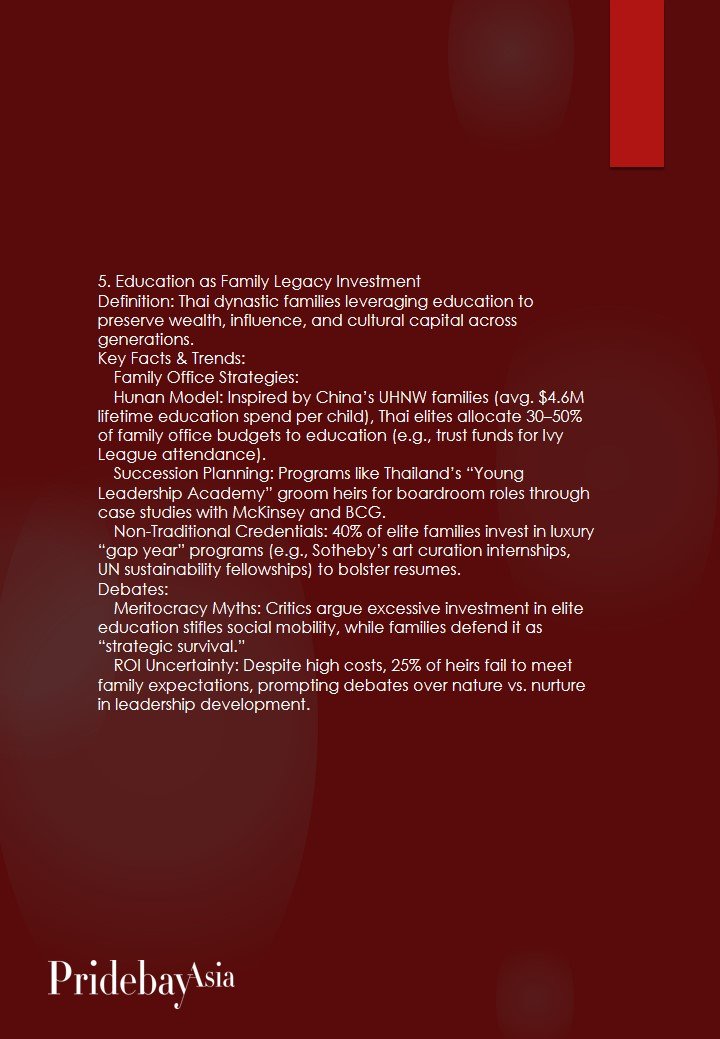
5. Education as Family Legacy Investment
Definition: Thai dynastic families leveraging education to preserve wealth, influence, and cultural capital across generations.
Key Facts & Trends:
- Family Office Strategies:
- Hunan Model: Inspired by China’s UHNW families (avg. $4.6M lifetime education spend per child), Thai elites allocate 30–50% of family office budgets to education (e.g., trust funds for Ivy League attendance).
- Succession Planning: Programs like Thailand’s “Young Leadership Academy” groom heirs for boardroom roles through case studies with McKinsey and BCG.
- Non-Traditional Credentials: 40% of elite families invest in luxury “gap year” programs (e.g., Sotheby’s art curation internships, UN sustainability fellowships) to bolster resumes.
Debates:
- Meritocracy Myths: Critics argue excessive investment in elite education stifles social mobility, while families defend it as “strategic survival.”
- ROI Uncertainty: Despite high costs, 25% of heirs fail to meet family expectations, prompting debates over nature vs. nurture in leadership development.
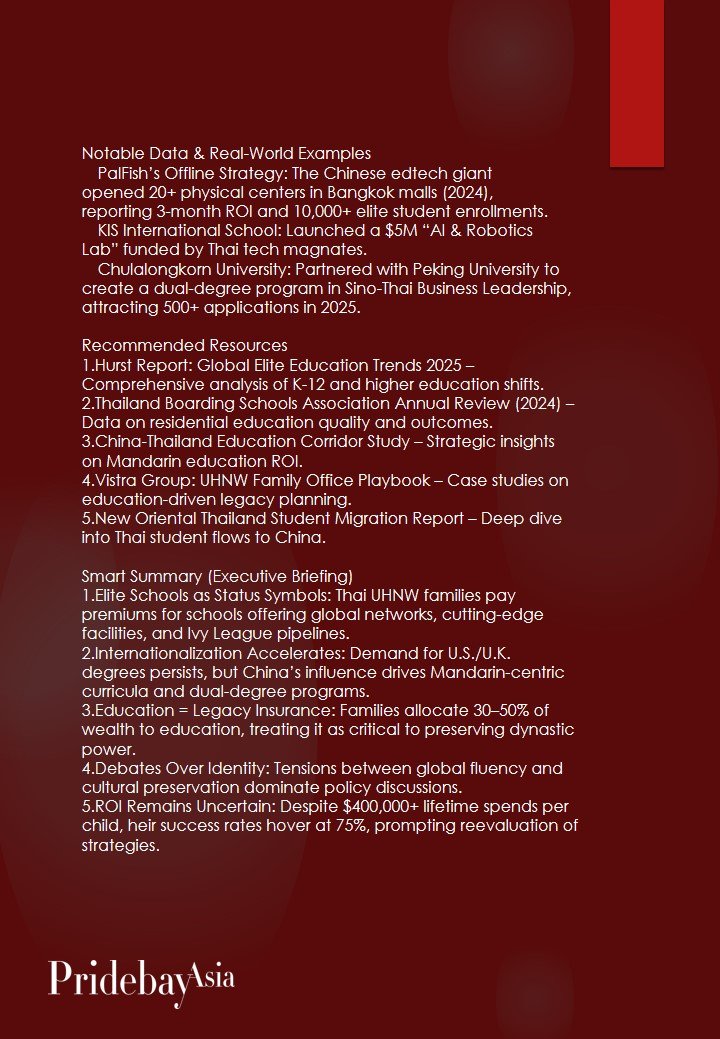
Notable Data & Real-World Examples
- PalFish’s Offline Strategy: The Chinese edtech giant opened 20+ physical centers in Bangkok malls (2024), reporting 3-month ROI and 10,000+ elite student enrollments.
- KIS International School: Launched a $5M “AI & Robotics Lab” funded by Thai tech magnates.
- Chulalongkorn University: Partnered with Peking University to create a dual-degree program in Sino-Thai Business Leadership, attracting 500+ applications in 2025.
Recommended Resources
- Hurst Report: Global Elite Education Trends 2025 – Comprehensive analysis of K-12 and higher education shifts.
- Thailand Boarding Schools Association Annual Review (2024) – Data on residential education quality and outcomes.
- China-Thailand Education Corridor Study – Strategic insights on Mandarin education ROI.
- Vistra Group: UHNW Family Office Playbook – Case studies on education-driven legacy planning.
- New Oriental Thailand Student Migration Report – Deep dive into Thai student flows to China.
Smart Summary (Executive Briefing)
- Elite Schools as Status Symbols: Thai UHNW families pay premiums for schools offering global networks, cutting-edge facilities, and Ivy League pipelines.
- Internationalization Accelerates: Demand for U.S./U.K. degrees persists, but China’s influence drives Mandarin-centric curricula and dual-degree programs.
- Education = Legacy Insurance: Families allocate 30–50% of wealth to education, treating it as critical to preserving dynastic power.
- Debates Over Identity: Tensions between global fluency and cultural preservation dominate policy discussions.
- ROI Remains Uncertain: Despite $400,000+ lifetime spends per child, heir success rates hover at 75%, prompting reevaluation of strategies.