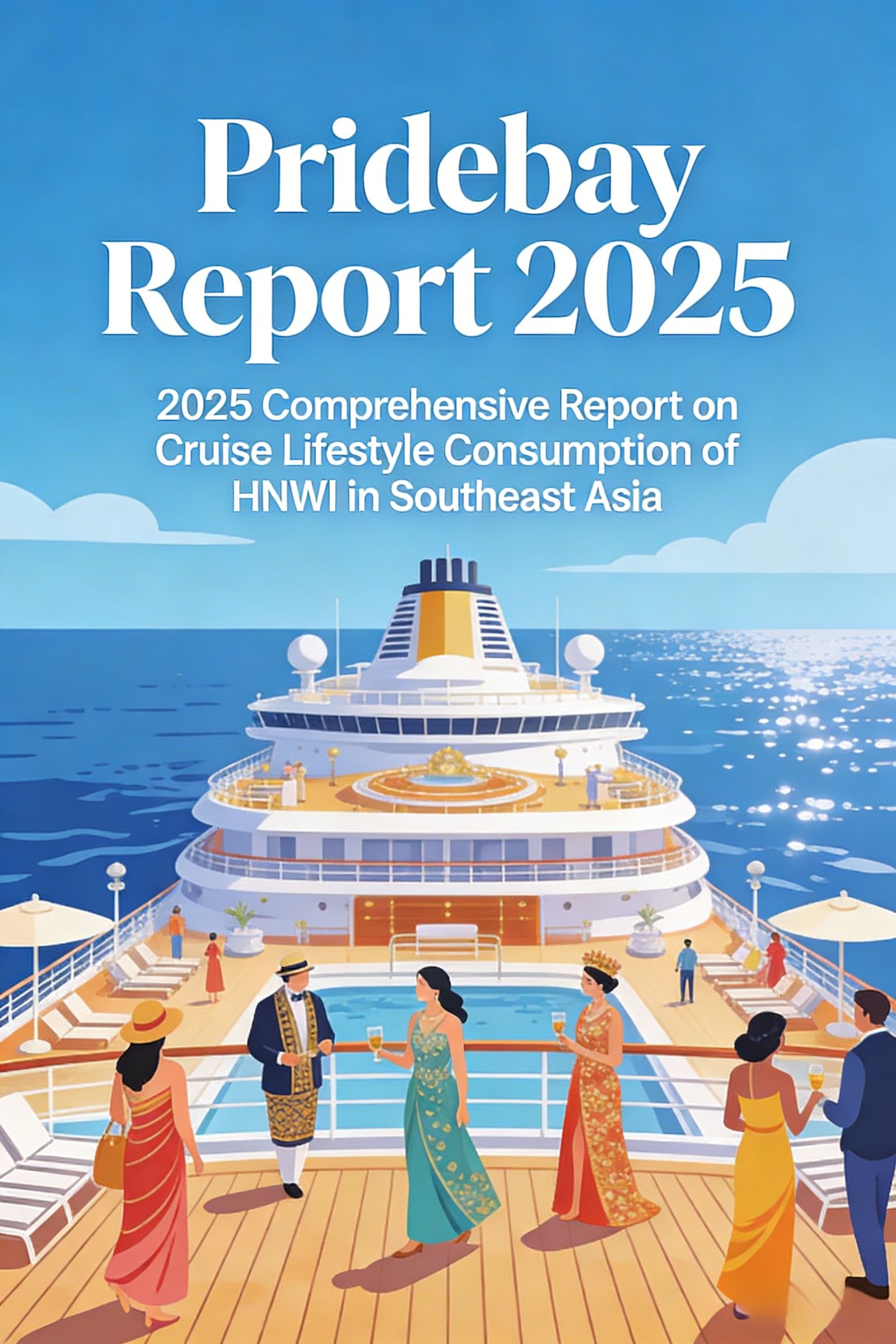
2025 Comprehensive Report on Cruise Lifestyle Consumption of High-Net-Worth Individuals in Southeast Asia
Author: Pridebay Asia
Report Date: 2025
Abstract: This report focuses on the cruise lifestyle consumption behaviors of High-Net-Worth Individuals (HNWIs) and Ultra-High-Net-Worth Individuals (UHNWIs) in Southeast Asia in 2025. Based on an exclusive survey conducted by Pridebay Asia covering 500+ HNWIs across Singapore, Thailand, Vietnam, Malaysia, and Indonesia, combined with the latest industry data and brand strategic dynamics, the report systematically analyzes the market scale, core consumption trends, regional characteristics, and brand preference patterns of the Southeast Asian high-end cruise market. It also explores the commercial cooperation opportunities behind the consumption upgrade, providing strategic references for luxury cruise operators, private banks, family offices, and high-end lifestyle service providers. Key findings indicate that Southeast Asian HNWIs’ cruise consumption has entered a "quality experience-driven" era, with sustainable travel, personalized customization, and in-depth cultural exploration becoming the core driving forces, while significant regional differences in consumption demand and behavior logic are evident.
1. Overview of the Southeast Asian High-End Cruise Market
1.1 Market Scale and Growth Drivers
In 2025, the high-end cruise market for HNWIs in Southeast Asia is expected to reach USD 1.9 billion, with a year-on-year growth rate of 11.2%, significantly outpacing the global average growth rate of 8.5% in the luxury cruise sector. The robust growth of the market is driven by multiple synergistic factors: Firstly, the continuous expansion of the wealthy population base—data shows that the number of UHNWIs in Southeast Asia increased by 7.8% year-on-year in 2025, with Vietnam and Indonesia leading the growth with double-digit rates, and their demand for high-quality travel experiences continues to rise . Secondly, the optimization of regional cruise infrastructure—Singapore, Thailand, and other countries have stepped up investments in cruise port construction and supporting services, with Thailand officially launching its first homeport luxury cruise route in 2025, further activating the local high-end cruise market . Thirdly, the post-pandemic consumption concept transformation—HNWIs have shifted from "symbolic consumption" to "experiential consumption," and cruise travel, which integrates luxury accommodation, leisure and entertainment, and cultural exploration, has become an important carrier for them to pursue a high-quality lifestyle . Additionally, the global luxury cruise industry’s recovery and expansion have laid a foundation for the regional market’s growth, with the global luxury cruise fleet expanding from 28 ships in 2010 to 97 ships in 2024, providing abundant product supply for Southeast Asian HNWIs .
1.2 Core Consumer Groups and Consumption Characteristics
The core consumer groups of high-end cruises in Southeast Asia are mainly divided into three categories, each with distinct consumption characteristics: 1) Family business owners and entrepreneurs (accounting for 48%), who focus on privacy, exclusivity, and family-friendly experiences, with an average per capita consumption of USD 30,000-80,000 per cruise; 2) Senior executives of multinational corporations and financial professionals (accounting for 27%), who prefer flexible and efficient cruise products, often combining business travel with leisure, and valuing the professionalism and customization of on-board services; 3) Younger-generation wealthy individuals (post-85s and post-95s, accounting for 25%), who are the main drivers of emerging trends such as expedition cruises and sustainable travel, favoring niche destinations and immersive cultural experiences, and are willing to pay a premium of 20%-30% for personalized and eco-friendly products . Pridebay Asia’s survey shows that 72% of受访 HNWIs choose cruises as a key travel mode at least once a year, and 65% of them prioritize "exclusive experiences" and "service quality" over price factors.
2. Core Trends of Cruise Lifestyle Consumption of Southeast Asian HNWIs in 2025
2.1 Sustainable Luxury: Eco-Friendly Travel Becomes a Core Value
Sustainability has become a decisive factor influencing the cruise consumption decisions of Southeast Asian HNWIs. In 2025, there has been a significant surge in demand for eco-friendly luxury cruises equipped with green technologies such as LNG (liquefied natural gas) power systems, biofuel compatibility, and zero-waste management. For example, Ponant Explorations Group’s hybrid-powered icebreakers, which reduce sulfur emissions by 99%, have seen a 40% year-on-year increase in bookings from Southeast Asian HNWIs . The brand’s "Swap2Zero" project, focusing on developing the world’s first zero-emission ocean-going cruise ship, has also attracted widespread attention from environmentally conscious wealthy individuals in Singapore and Malaysia. Pridebay Asia’s survey indicates that 68% of受访 HNWIs stated they would prioritize choosing cruise brands with clear sustainable development commitments, and 42% of them are willing to pay a higher price for eco-friendly cruise products. This trend is particularly prominent among young HNWIs, with a recognition rate of over 80% among post-95s .
2.2 Expedition Cruises: Niche Exploration and Authentic Experiences Gain Popularity
Expedition cruises have emerged as a new hotspot in the Southeast Asian high-end cruise market, driven by HNWIs’ growing pursuit of unique and immersive travel experiences. Unlike traditional large cruise ships, expedition cruises (usually with fewer than 300 passengers) focus on exploring remote and niche destinations such as the South Pacific islands, the Baltic Sea, and the west coast of Africa . These cruises offer exclusive experiences such as glacier kayaking, protected area snorkeling, and scientific research participation, which perfectly match the needs of affluent travelers seeking "authentic exploration" . Data shows that the capacity of the global expedition cruise sector has increased by 150% since 2019, and bookings from Southeast Asian HNWIs in this segment have grown by 22% between 2023 and 2024 alone . Ponant, for instance, has tailored expedition routes for Asian clients, including Chinese crew members, Chinese materials, and Sino-French fusion catering, significantly enhancing the travel experience .
2.3 Personalization and Localization: Customized Services and Cultural Integration
Southeast Asian HNWIs’ demand for personalized and localized cruise experiences is increasingly prominent. Luxury cruise brands are responding by launching customized services such as private charters, personalized itineraries, and exclusive on-board events. Meanwhile, integrating local cultural elements into cruise products has become a key strategy to attract regional HNWIs. For example, StarDream Cruises, in partnership with the Tourism Authority of Thailand (TAT), launched the "Star Voyager" cruise with Thailand as its homeport, offering curated cultural experiences such as Bo Sang umbrella painting, herbal sachet crafting, and classical Thai dance . These activities, based on the "5 Must Do in Thailand" theme, deeply integrate Thai culture into the cruise experience, resonating strongly with local and regional HNWIs. Pridebay Asia’s survey reveals that 59% of受访 HNWIs value "local cultural immersion experiences" when choosing cruise routes, and 46% have participated in customized cruise services such as private shore excursions and family-themed events.
2.4 Extended Voyages: Longer Duration and In-Depth Destination Exploration
Southeast Asian HNWIs are increasingly favoring longer-duration cruise voyages, shifting away from the traditional 7-night norm. In markets such as Malaysia and the Philippines, the average cruise duration has increased to 14 nights or more, with a growing number of HNWIs choosing long-haul routes to distant destinations such as the Baltic Sea and East Africa . This trend reflects their desire for in-depth destination exploration—60% of cruise passengers stay at least one night in the embarkation city before the cruise, and 54% extend their stay after the cruise, further exploring local culture and attractions . Booking behaviors have also evolved, with HNWIs booking both last-minute (within a week) and far in advance (for 2026-2028 sailings), demonstrating strong flexibility and planning in their cruise consumption .
3. Regional Characteristics of Cruise Consumption in Southeast Asia
3.1 Singapore: Asia’s Premier High-End Cruise Hub
As Asia’s leading cruise hub, Singapore boasts the highest cruise penetration rate in Asia, surpassing Australia . Singaporean HNWIs have a highly international perspective and mature consumption concepts, preferring top-tier luxury cruise brands such as Regent Seven Seas Cruises and Oceania Cruises. They are willing to invest in long-haul expedition cruises and private charter services, with an average per capita consumption of USD 50,000-150,000 per cruise. Singapore’s strategic advantages, including favorable tax policies, world-class port facilities, and convenient international air connections, make it a key embarkation and disembarkation point for luxury cruises in Southeast Asia. Many international cruise brands have established regional headquarters in Singapore to deepen their layout in the Asian market .
3.2 Thailand: Cultural Integration Drives Market Growth
Thailand’s cruise market is experiencing steady growth, with 2024 seeing 162 cruise ship calls, over 379,000 passengers, and generating 1.89 billion baht in revenue—a 6.9% increase from the previous year . Thai HNWIs prioritize cruise experiences that integrate local culture, showing strong preference for routes featuring Thai cultural activities and island exploration (e.g., Ko Samui). The launch of StarDream Cruises’ "Star Voyager" with Thailand as its homeport has further boosted local market demand, offering exclusive 5-night routes between Laem Chabang, Ko Samui, and Singapore . Thai HNWIs also often choose cruises as family vacation options, valuing family-friendly facilities and services on board. Despite ongoing deflationary pressures, Thailand’s consumer confidence in the luxury travel sector remains stable, supporting sustained growth in high-end cruise consumption.
3.3 Vietnam: Emerging Market with Strong Growth Momentum
Vietnam has emerged as a key catalyst for the growth of the luxury cruise market in Southeast Asia . Driven by rapid economic growth and an expanding wealthy population, Vietnamese HNWIs’ demand for high-end cruises is growing rapidly. The Vietnamese government’s investments in cruise port development and coastal tourism infrastructure have attracted international luxury cruise brands to launch routes featuring Vietnam’s cultural and natural attractions, such as Halong Bay and Nha Trang. Vietnamese HNWIs prefer mid-to-high-end cruise products with a balance of luxury and cultural experience, with an average per capita consumption of USD 20,000-60,000 per cruise. Younger Vietnamese HNWIs are particularly interested in eco-friendly cruises and expedition experiences, driving the market’s transformation towards sustainability and quality .
3.4 Malaysia & Indonesia: Family-Oriented and Cultural Exploration Trends
Malaysian HNWIs’ cruise consumption is predominantly family-oriented, favoring 14-night or longer routes that allow for in-depth exploration of multiple destinations . They value on-board comfort, dining quality, and family-friendly activities, with popular brands including StarCruises and Royal Caribbean’s luxury segments. Malaysian HNWIs also show interest in cruises that combine business and leisure, often choosing routes that include regional business hubs. In Indonesia, HNWIs prefer cruise experiences that showcase the country’s diverse cultural heritage and natural beauty, such as exploring the Indonesian archipelago’s hidden islands. Demand for small-ship expedition cruises is on the rise among Indonesian HNWIs, who seek authentic and exclusive exploration experiences away from crowded tourist areas.
4. Brand Performance and Competitive Landscape
4.1 Key Brand Market Positioning
The Southeast Asian high-end cruise market is dominated by international luxury brands, with distinct positioning among major players: 1) Ponant Explorations Group leads the expedition cruise segment with its advanced green technology and niche destination routes, attracting environmentally conscious and adventure-seeking HNWIs ; 2) Regent Seven Seas Cruises and Oceania Cruises focus on all-inclusive luxury experiences, with a strong presence in the long-haul cruise market, favored by Singaporean and Malaysian HNWIs ; 3) StarDream Cruises focuses on localized cultural integration, leveraging its partnership with the Thai government to gain a competitive edge in the Thai market ; 4) Emerging luxury brands such as Explora Journeys are rapidly expanding their footprint in Southeast Asia, emphasizing personalized service and innovative on-board experiences .
3.2 Brand Strategic Trends in Southeast Asia
To adapt to the unique needs of Southeast Asian HNWIs, international luxury cruise brands are implementing localized strategic adjustments: 1) Strengthening sustainable technology applications, such as equipping ships with LNG power systems and obtaining biofuel certification, to meet the growing demand for eco-friendly travel ; 2) Deepening cultural integration, incorporating local cultural elements (e.g., Thai crafts, Indonesian batik) into on-board activities and dining to enhance regional resonance ; 3) Expanding personalized services, including Chinese crew members, Chinese-language materials, and customized catering, to improve the travel experience for Asian clients ; 4) Collaborating with local high-end institutions (e.g., private banks, family offices) to launch exclusive events and precision marketing campaigns, such as private cruise appreciation salons and member-only discounts .
5. Commercial Opportunities and Cooperation Directions
5.1 For Luxury Cruise Operators
1) Localized product development: Design routes tailored to Southeast Asian HNWIs’ preferences, such as cultural immersion cruises integrating Thai, Vietnamese, and Indonesian heritage, and eco-friendly expedition routes to niche destinations in the South Pacific ; 2) Service optimization: Enhance personalized services, including private charters, customized shore excursions, and family-friendly facilities, while improving multilingual support (especially Chinese and Thai) and local catering options ; 3) Strategic partnerships: Collaborate with Pridebay Asia to access its exclusive HNWI network, organizing private cruise appreciation events and precision marketing activities to expand customer reach; 4) Sustainable innovation: Accelerate the adoption of green technologies (e.g., LNG, biofuels) and promote sustainable initiatives (e.g., zero-waste practices, eco-friendly shore excursions) to differentiate from competitors .
5.2 For Private Banks and Family Offices
1) Wealth management integration: Incorporate high-end cruise experiences into customer loyalty programs and wealth management services, such as offering cruise vouchers as customer appreciation gifts or recommending private charter services as part of alternative lifestyle investments ; 2) Family heritage planning: Collaborate with cruise operators to design family-themed cruise experiences that facilitate intergenerational communication and cultural heritage, such as family reunion cruises with customized cultural activities; 3) Exclusive resource docking: Partner with Pridebay Asia to access preferential booking rights for luxury cruises and expedition routes, providing value-added services for HNW clients to enhance customer stickiness.
5.3 For High-End Lifestyle Service Providers
1) Experience integration: Develop "cruise +" integrated products, such as combining pre/post-cruise stays at luxury resorts, private island tours, or cultural heritage visits, to create a seamless high-end travel experience ; 2) Customized supporting services: Provide personalized services for HNW cruise travelers, including private transfer between airports and ports, on-shore private tour guides, and customized shopping experiences; 3) Brand co-marketing: Collaborate with luxury cruise brands and Pridebay Asia to launch joint marketing campaigns, such as exclusive fashion shows or gourmet events on board, to expand brand exposure among HNWIs.
6. Challenges and Future Outlook
6.1 Key Challenges
The Southeast Asian high-end cruise market faces several challenges: 1) Economic uncertainty: Global economic downturn risks may impact HNWIs’ disposable income and consumption willingness, potentially leading to fluctuations in market demand ; 2) Infrastructure disparities: Uneven development of cruise infrastructure across Southeast Asian countries (e.g., limited port facilities in some emerging markets) may affect the quality of cruise experiences; 3) Environmental regulatory pressure: Stricter global environmental regulations require cruise operators to invest heavily in green technology upgrades, increasing operational costs ; 4) Intensified competition: As more international luxury cruise brands enter the Southeast Asian market, competition for high-value customers will become increasingly fierce, requiring brands to continuously innovate to maintain a competitive edge.
6.2 Future Outlook (2025-2030)
The high-end cruise market for HNWIs in Southeast Asia is expected to maintain strong growth momentum, with a projected compound annual growth rate (CAGR) of 9%-12% between 2025 and 2030. Key trends shaping the market’s future include: 1) Sustainable development becoming a core competitiveness: Cruise brands with advanced green technologies and clear sustainability commitments will gain a competitive advantage, as HNWIs’ environmental awareness continues to rise ; 2) Expedition cruises and niche destinations driving growth: Demand for expedition cruises to remote and unique destinations will continue to surge, especially among young HNWIs ; 3) Further localization and personalization: Cruise products will become more tailored to regional cultural preferences and individual needs, with customized services and cultural integration becoming standard offerings ; 4) Market segmentation and diversification: The market will see increased segmentation, with specialized products for family travel, business leisure, and wellness cruises emerging to meet diverse consumer demands.
7. Research Methodology and Data Sources
7.1 Research Methodology
This report adopts a mixed research method combining qualitative and quantitative approaches: 1) Questionnaire survey: Conducted an exclusive survey of 500+ HNWIs across Singapore, Thailand, Vietnam, Malaysia, and Indonesia, covering their cruise consumption habits, brand preferences, and demand drivers; 2) In-depth interviews: Conducted one-on-one interviews with 30+ UHNWIs, regional executives of luxury cruise brands, and industry experts to gain in-depth insights into consumption trends and brand strategies; 3) Data analysis: Collected and analyzed regional economic data, cruise industry reports, and brand performance data to ensure the accuracy and comprehensiveness of the research; 4) Case study: Analyzed representative cases of brand-market cooperation (e.g., TAT & StarDream Cruises, Ponant’s Asian strategy) to illustrate market dynamics and best practices .
7.2 Data Sources
The data sources of this report include: 1) Exclusive survey data from Pridebay Asia; 2) Public data released by government departments and tourism authorities (e.g., Tourism Authority of Thailand ); 3) Industry reports and research data from international organizations (e.g., Cruise Lines International Association ); 4) Financial reports and press releases from luxury cruise brands (e.g., Ponant, StarDream Cruises ); 5) Market research data from international consulting firms and industry media (e.g., Travel Weekly Asia, Travel And Tour World ).
Disclaimer: The information and data in this report are obtained from publicly available sources and Pridebay Asia’s exclusive research. While we strive to ensure the accuracy and completeness of the information, we do not assume any liability for errors or omissions. This report is for reference only and does not constitute any investment advice or business decision basis.