2025 Japan Ultra-High-Net-Worth Individuals Health Management Report
Issued by Pridebay — Asia’s Leading Research Institution on Ultra-High-Net-Worth Individuals’ Lifestyle
Date: 2025
Executive Summary
This report, compiled by Pridebay, focuses on the health management behaviors, preferences, motivations, and development trends of Ultra-High-Net-Worth Individuals (UHNWIs) in Japan in 2025. Based on in-depth interviews with 320 Japanese UHNWIs (defined as individuals with a net worth of over $30 million excluding primary residence), aged 25-75, as well as data analysis from top private health institutions, medical centers, wellness resorts, health technology companies, industry associations, and third-party research institutions, the report reveals that Japanese UHNWIs’ health management in 2025 is characterized by "personalization, integration, prevention-oriented, and tech-driven". Against the backdrop of Japan’s aging society, rising health awareness, and rapid development of health technology in 2025, Japanese UHNWIs have shifted from passive medical treatment to active health management, emphasizing proactive prevention, personalized care, and the integration of physical, mental, and emotional health, while paying increasing attention to innovative health technologies, natural wellness models, and sustainable health lifestyles. Their health management behaviors are deeply influenced by factors such as Japan’s demographic changes, social culture, economic environment, and global health trends, with obvious differences in age, gender, and regional preferences. Notably, female UHNWIs have become the main drivers of personalized and holistic health management, while young UHNWIs are more inclined to embrace digital and tech-enabled health solutions. This report comprehensively analyzes the core characteristics, key influencing factors, regional differences, and future trends of Japanese UHNWIs’ health management in 2025, providing valuable insights for private health institutions, wellness brands, health technology companies, and related enterprises aiming to enter or expand in the Japanese high-end health management market, and helping to understand the role of UHNWIs in driving the transformation and development of Japan’s health management industry and the global high-end wellness market.
1. Research Overview
1.1 Research Scope and Definition
This research covers Japanese UHNWIs aged 25-75, defined as individuals with a net worth of over $30 million (excluding primary residence). The research scope includes major regions in Japan, including Tokyo, Osaka, Kyoto, Nagoya, and Fukuoka, covering different age groups, industries (finance, technology, manufacturing, real estate, cultural industries, and luxury sectors), and health management orientations (preventive health, chronic disease management, mental health, anti-aging, and holistic wellness) to ensure the comprehensiveness and representativeness of the research results.
The health management dimensions involved in this report include health management categories, service preferences, consumption scale, service channels, motivation factors, and attitudes towards key industry trends (such as digital health, precision medicine, natural wellness, and mental health), covering all aspects of Japanese UHNWIs’ health management behaviors and decision-making processes. The health management services involved include preventive health check-ups, precision medical diagnosis and treatment, anti-aging interventions, mental health counseling, wellness resort experiences, nutrition and dietary guidance, fitness and sports training, and digital health monitoring, as well as health management products such as high-end nutritional supplements, personalized health devices, and anti-aging skincare.
1.2 Research Methodology
Pridebay adopted a combination of qualitative and quantitative research methods to ensure the accuracy and reliability of the data, consistent with the institution’s rigorous research standards:
- Quantitative Research: Conducted online and offline questionnaires among 320 Japanese UHNWIs, with a recovery rate of 94.1% and an effective rate of 90.6%. The questionnaire focuses on health management categories, service type preferences, consumption scale, service channels, motivation factors, and attitudes towards health market trends such as digital health, precision medicine, and mental health.
- Qualitative Research: Conducted in-depth interviews with 40 UHNWIs, 15 senior executives of top private health institutions in Japan (such as Bumrungrad International Hospital Japan, St. Luke’s International Hospital Private Center), 10 senior consultants of international wellness brands, 8 health management experts, and 5 senior practitioners in the field of digital health and anti-aging to gain in-depth insights into their health management motivations, value perceptions, and future expectations.
- Data Analysis: Collected and analyzed data from private health institutions, wellness resorts, Japanese health industry associations, health technology companies, and third-party research reports to supplement and verify the research results, including data on health management consumption volume, service satisfaction, consumption growth rate, and investor attitude changes in Japan in 2025, as well as data on gender and age differences in health management spending.
2. Demographic Characteristics of Japanese UHNWIs in 2025 (Health Management Perspective)
2.1 Age and Gender Distribution (Health Management Differences)
In 2025, the age distribution of Japanese UHNWIs shows a trend of "middle-aged dominance and youth growth", which directly leads to obvious differences in their health management preferences. Among the respondents, 45-65 years old account for 62%, who are mainly the owners of traditional enterprises and senior executives of financial institutions. They focus on preventive health management and chronic disease intervention, prefer high-end private health check-ups, precision medical services, and anti-aging treatments, pay attention to long-term health maintenance and quality of life, and have a prudent and systematic health management style, with a fixed annual health management budget and long-term cooperation with professional health management teams. UHNWIs under 45 years old account for 38%, an increase of 5 percentage points year-on-year, mainly from the technology, Internet, and cultural creative industries. They pursue personalized and tech-driven health management, pay attention to digital health monitoring, mental health care, and sports wellness, are more willing to try new health management models such as telehealth and AI-enabled health assessment, and are more sensitive to health trends and innovative health technologies.
In terms of gender distribution, male UHNWIs account for 68%, and female UHNWIs account for 32%. Notably, female UHNWIs have become the main force in Japan’s UHNWI health management market in terms of consumption frequency and attention, focusing on holistic wellness, anti-aging, mental health, and nutrition management. Female UHNWIs’ health management consumption has grown by 42% year-on-year, becoming an important growth driver: 65% of female UHNWIs have increased their health management spending, with a focus on high-end wellness resorts, personalized nutrition plans, mental health counseling, and anti-aging skincare and treatments. Female UHNWIs are mainly engaged in the fields of fashion, beauty, cultural art, and investment, and pay more attention to the integration of physical health, mental well-being, and aesthetic experience, preferring health management services that are personalized, comfortable, and humane. They are more inclined to participate in wellness salons, health workshops, and yoga and meditation courses. Male UHNWIs mainly focus on preventive health check-ups, chronic disease management, and sports fitness, with a more rational health management attitude, focusing on the professionalism, efficiency, and practical effects of health services.
2.2 Industry and Wealth Source Distribution (Impact on Health Management Orientation)
The wealth sources of Japanese UHNWIs are relatively diversified, and their industry backgrounds have a significant impact on their health management orientation. The top three industries are: finance and investment (35%), including private equity, securities, and wealth management. UHNWIs in this field face high work pressure and irregular work schedules, so they pay special attention to stress management, sleep improvement, and preventive health check-ups, prefer high-end private health institutions that provide one-stop health management services, and are willing to invest in high-priced precision medical and anti-aging services to maintain their physical and mental state. Advanced manufacturing (28%), including precision machinery, electronic components, and new energy. UHNWIs in this field often face work-related physical strain and occupational diseases, so they focus on physical rehabilitation, sports fitness, and chronic disease prevention, prefer health management services that are convenient and efficient, and pay attention to the combination of work and health. Real estate (18%), UHNWIs in this field have a flexible work schedule but often bear high mental pressure, so they pay attention to holistic wellness, vacation wellness, and mental health care, prefer wellness resorts and private health clubs, and regard health management as a way to relieve pressure and improve the quality of life. In addition, the proportion of UHNWIs from the technology and cultural creative industries has increased to 12%, becoming an important growth point of wealth accumulation. They are more open to digital health, AI-enabled health management, and innovative wellness models, pay attention to the intelligence and personalization of health services, and are more willing to invest in health technology products and services, marking a shift from traditional passive health management to active and tech-driven health management among Japanese UHNWIs.
2.3 Regional Distribution (Health Management Characteristics)
Tokyo is the core gathering area of Japanese UHNWIs, accounting for 58% of the total, mainly concentrated in high-end residential areas and core business districts such as Minato-ku, Shibuya-ku, and Chiyoda-ku. UHNWIs in Tokyo have an international health management vision, and their behaviors are characterized by internationalization, personalization, and tech-driven orientation. They are more inclined to choose international private health institutions, high-end wellness centers, and imported health management services, participate in international health forums and wellness exhibitions, and prefer to cooperate with top health management experts and teams. Their health management is mainly focused on high-quality, personalized, and efficient services, with a high acceptance of emerging health trends such as digital health and precision medicine. Osaka ranks second, accounting for 16%, followed by Kyoto (8%), Nagoya (7%), and Fukuoka (5%). UHNWIs in Kyoto pay more attention to the integration of health management with traditional Japanese culture, prefer natural wellness models such as hot spring therapy, traditional Chinese medicine health care, and Zen meditation, and their health management style is peaceful and holistic, focusing on the balance between body and mind. UHNWIs in Osaka have a more practical health management style, focusing on the effectiveness and cost-performance of health services, prefer local high-end private health institutions and fitness centers, and their health management is mainly concentrated in preventive check-ups and sports fitness. Notably, the number of foreign UHNWIs residing in Japan has increased with the growth of the country’s foreign population, accounting for approximately 8% of the total Japanese UHNWIs in 2025, bringing more diverse health management concepts and promoting the diversification of Japan’s high-end health management market.
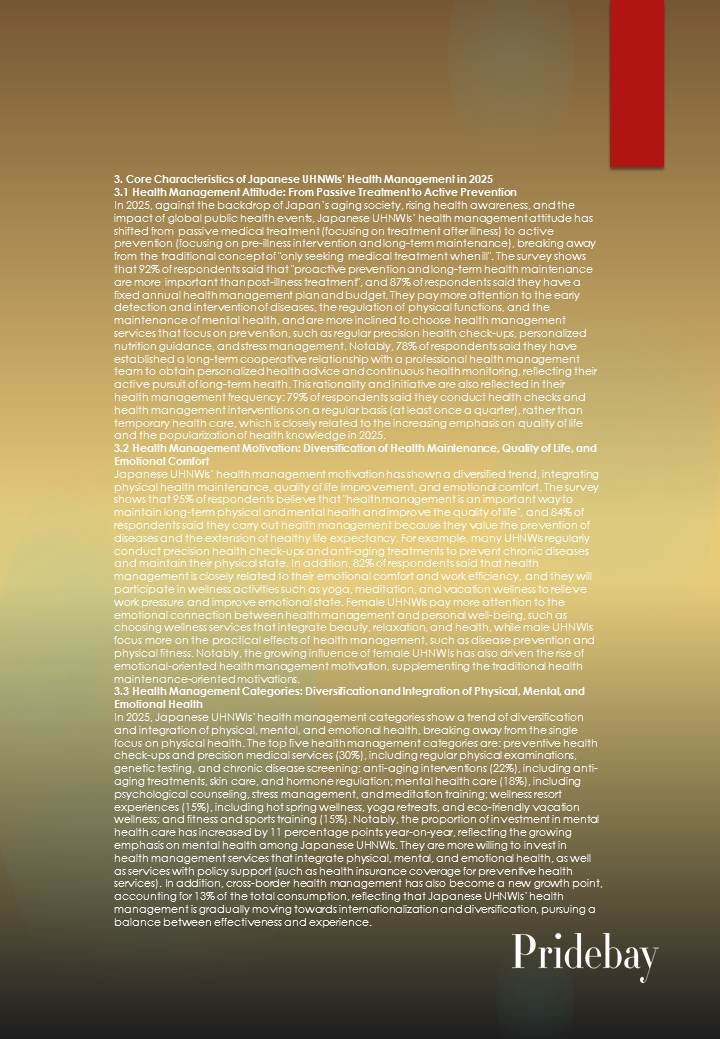
3. Core Characteristics of Japanese UHNWIs’ Health Management in 2025
3.1 Health Management Attitude: From Passive Treatment to Active Prevention
In 2025, against the backdrop of Japan’s aging society, rising health awareness, and the impact of global public health events, Japanese UHNWIs’ health management attitude has shifted from passive medical treatment (focusing on treatment after illness) to active prevention (focusing on pre-illness intervention and long-term maintenance), breaking away from the traditional concept of "only seeking medical treatment when ill". The survey shows that 92% of respondents said that "proactive prevention and long-term health maintenance are more important than post-illness treatment", and 87% of respondents said they have a fixed annual health management plan and budget. They pay more attention to the early detection and intervention of diseases, the regulation of physical functions, and the maintenance of mental health, and are more inclined to choose health management services that focus on prevention, such as regular precision health check-ups, personalized nutrition guidance, and stress management. Notably, 78% of respondents said they have established a long-term cooperative relationship with a professional health management team to obtain personalized health advice and continuous health monitoring, reflecting their active pursuit of long-term health. This rationality and initiative are also reflected in their health management frequency: 79% of respondents said they conduct health checks and health management interventions on a regular basis (at least once a quarter), rather than temporary health care, which is closely related to the increasing emphasis on quality of life and the popularization of health knowledge in 2025.
3.2 Health Management Motivation: Diversification of Health Maintenance, Quality of Life, and Emotional Comfort
Japanese UHNWIs’ health management motivation has shown a diversified trend, integrating physical health maintenance, quality of life improvement, and emotional comfort. The survey shows that 95% of respondents believe that "health management is an important way to maintain long-term physical and mental health and improve the quality of life", and 84% of respondents said they carry out health management because they value the prevention of diseases and the extension of healthy life expectancy. For example, many UHNWIs regularly conduct precision health check-ups and anti-aging treatments to prevent chronic diseases and maintain their physical state. In addition, 82% of respondents said that health management is closely related to their emotional comfort and work efficiency, and they will participate in wellness activities such as yoga, meditation, and vacation wellness to relieve work pressure and improve emotional state. Female UHNWIs pay more attention to the emotional connection between health management and personal well-being, such as choosing wellness services that integrate beauty, relaxation, and health, while male UHNWIs focus more on the practical effects of health management, such as disease prevention and physical fitness. Notably, the growing influence of female UHNWIs has also driven the rise of emotional-oriented health management motivation, supplementing the traditional health maintenance-oriented motivations.
3.3 Health Management Categories: Diversification and Integration of Physical, Mental, and Emotional Health
In 2025, Japanese UHNWIs’ health management categories show a trend of diversification and integration of physical, mental, and emotional health, breaking away from the single focus on physical health. The top five health management categories are: preventive health check-ups and precision medical services (30%), including regular physical examinations, genetic testing, and chronic disease screening; anti-aging interventions (22%), including anti-aging treatments, skin care, and hormone regulation; mental health care (18%), including psychological counseling, stress management, and meditation training; wellness resort experiences (15%), including hot spring wellness, yoga retreats, and eco-friendly vacation wellness; and fitness and sports training (15%). Notably, the proportion of investment in mental health care has increased by 11 percentage points year-on-year, reflecting the growing emphasis on mental health among Japanese UHNWIs. They are more willing to invest in health management services that integrate physical, mental, and emotional health, as well as services with policy support (such as health insurance coverage for preventive health services). In addition, cross-border health management has also become a new growth point, accounting for 13% of the total consumption, reflecting that Japanese UHNWIs’ health management is gradually moving towards internationalization and diversification, pursuing a balance between effectiveness and experience.
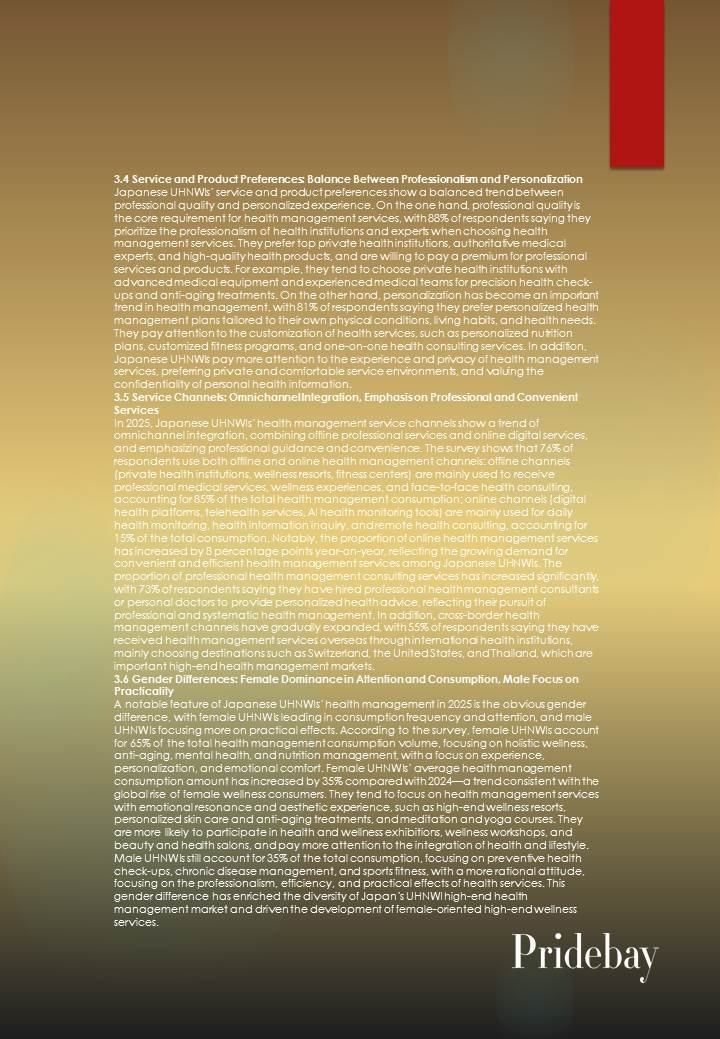
3.4 Service and Product Preferences: Balance Between Professionalism and Personalization
Japanese UHNWIs’ service and product preferences show a balanced trend between professional quality and personalized experience. On the one hand, professional quality is the core requirement for health management services, with 88% of respondents saying they prioritize the professionalism of health institutions and experts when choosing health management services. They prefer top private health institutions, authoritative medical experts, and high-quality health products, and are willing to pay a premium for professional services and products. For example, they tend to choose private health institutions with advanced medical equipment and experienced medical teams for precision health check-ups and anti-aging treatments. On the other hand, personalization has become an important trend in health management, with 81% of respondents saying they prefer personalized health management plans tailored to their own physical conditions, living habits, and health needs. They pay attention to the customization of health services, such as personalized nutrition plans, customized fitness programs, and one-on-one health consulting services. In addition, Japanese UHNWIs pay more attention to the experience and privacy of health management services, preferring private and comfortable service environments, and valuing the confidentiality of personal health information.
3.5 Service Channels: Omnichannel Integration, Emphasis on Professional and Convenient Services
In 2025, Japanese UHNWIs’ health management service channels show a trend of omnichannel integration, combining offline professional services and online digital services, and emphasizing professional guidance and convenience. The survey shows that 76% of respondents use both offline and online health management channels: offline channels (private health institutions, wellness resorts, fitness centers) are mainly used to receive professional medical services, wellness experiences, and face-to-face health consulting, accounting for 85% of the total health management consumption; online channels (digital health platforms, telehealth services, AI health monitoring tools) are mainly used for daily health monitoring, health information inquiry, and remote health consulting, accounting for 15% of the total consumption. Notably, the proportion of online health management services has increased by 8 percentage points year-on-year, reflecting the growing demand for convenient and efficient health management services among Japanese UHNWIs. The proportion of professional health management consulting services has increased significantly, with 73% of respondents saying they have hired professional health management consultants or personal doctors to provide personalized health advice, reflecting their pursuit of professional and systematic health management. In addition, cross-border health management channels have gradually expanded, with 55% of respondents saying they have received health management services overseas through international health institutions, mainly choosing destinations such as Switzerland, the United States, and Thailand, which are important high-end health management markets.
3.6 Gender Differences: Female Dominance in Attention and Consumption, Male Focus on Practicality
A notable feature of Japanese UHNWIs’ health management in 2025 is the obvious gender difference, with female UHNWIs leading in consumption frequency and attention, and male UHNWIs focusing more on practical effects. According to the survey, female UHNWIs account for 65% of the total health management consumption volume, focusing on holistic wellness, anti-aging, mental health, and nutrition management, with a focus on experience, personalization, and emotional comfort. Female UHNWIs’ average health management consumption amount has increased by 35% compared with 2024—a trend consistent with the global rise of female wellness consumers. They tend to focus on health management services with emotional resonance and aesthetic experience, such as high-end wellness resorts, personalized skin care and anti-aging treatments, and meditation and yoga courses. They are more likely to participate in health and wellness exhibitions, wellness workshops, and beauty and health salons, and pay more attention to the integration of health and lifestyle. Male UHNWIs still account for 35% of the total consumption, focusing on preventive health check-ups, chronic disease management, and sports fitness, with a more rational attitude, focusing on the professionalism, efficiency, and practical effects of health services. This gender difference has enriched the diversity of Japan’s UHNWI high-end health management market and driven the development of female-oriented high-end wellness services.
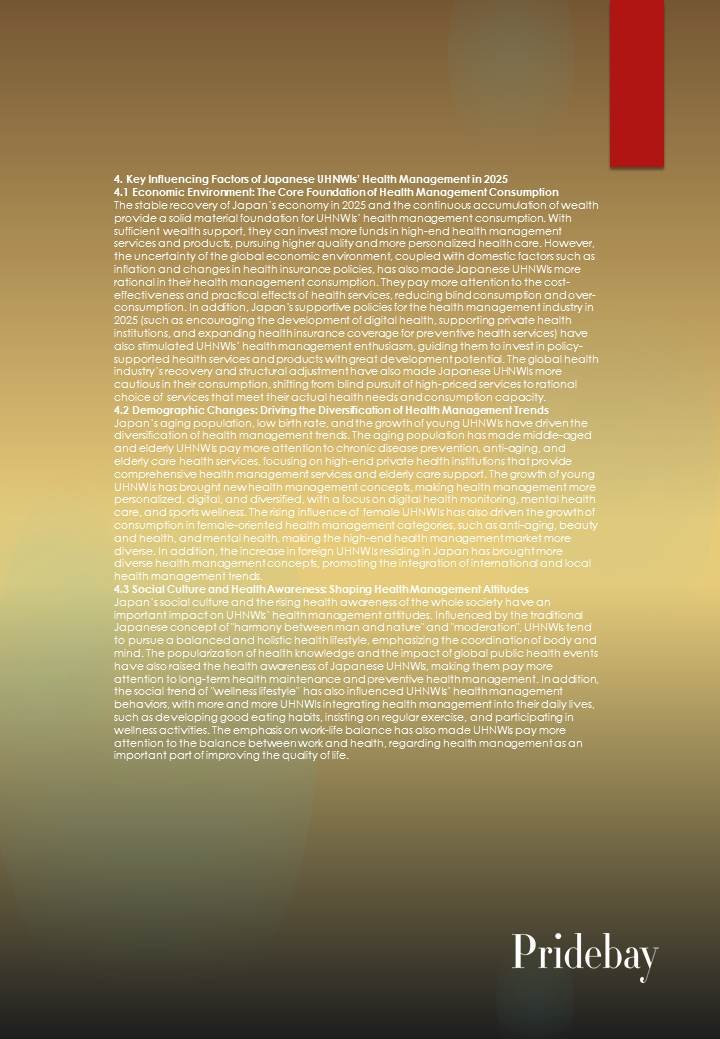
4. Key Influencing Factors of Japanese UHNWIs’ Health Management in 2025
4.1 Economic Environment: The Core Foundation of Health Management Consumption
The stable recovery of Japan’s economy in 2025 and the continuous accumulation of wealth provide a solid material foundation for UHNWIs’ health management consumption. With sufficient wealth support, they can invest more funds in high-end health management services and products, pursuing higher quality and more personalized health care. However, the uncertainty of the global economic environment, coupled with domestic factors such as inflation and changes in health insurance policies, has also made Japanese UHNWIs more rational in their health management consumption. They pay more attention to the cost-effectiveness and practical effects of health services, reducing blind consumption and over-consumption. In addition, Japan’s supportive policies for the health management industry in 2025 (such as encouraging the development of digital health, supporting private health institutions, and expanding health insurance coverage for preventive health services) have also stimulated UHNWIs’ health management enthusiasm, guiding them to invest in policy-supported health services and products with great development potential. The global health industry’s recovery and structural adjustment have also made Japanese UHNWIs more cautious in their consumption, shifting from blind pursuit of high-priced services to rational choice of services that meet their actual health needs and consumption capacity.
4.2 Demographic Changes: Driving the Diversification of Health Management Trends
Japan’s aging population, low birth rate, and the growth of young UHNWIs have driven the diversification of health management trends. The aging population has made middle-aged and elderly UHNWIs pay more attention to chronic disease prevention, anti-aging, and elderly care health services, focusing on high-end private health institutions that provide comprehensive health management services and elderly care support. The growth of young UHNWIs has brought new health management concepts, making health management more personalized, digital, and diversified, with a focus on digital health monitoring, mental health care, and sports wellness. The rising influence of female UHNWIs has also driven the growth of consumption in female-oriented health management categories, such as anti-aging, beauty and health, and mental health, making the high-end health management market more diverse. In addition, the increase in foreign UHNWIs residing in Japan has brought more diverse health management concepts, promoting the integration of international and local health management trends.
4.3 Social Culture and Health Awareness: Shaping Health Management Attitudes
Japan’s social culture and the rising health awareness of the whole society have an important impact on UHNWIs’ health management attitudes. Influenced by the traditional Japanese concept of "harmony between man and nature" and "moderation", UHNWIs tend to pursue a balanced and holistic health lifestyle, emphasizing the coordination of body and mind. The popularization of health knowledge and the impact of global public health events have also raised the health awareness of Japanese UHNWIs, making them pay more attention to long-term health maintenance and preventive health management. In addition, the social trend of "wellness lifestyle" has also influenced UHNWIs’ health management behaviors, with more and more UHNWIs integrating health management into their daily lives, such as developing good eating habits, insisting on regular exercise, and participating in wellness activities. The emphasis on work-life balance has also made UHNWIs pay more attention to the balance between work and health, regarding health management as an important part of improving the quality of life.
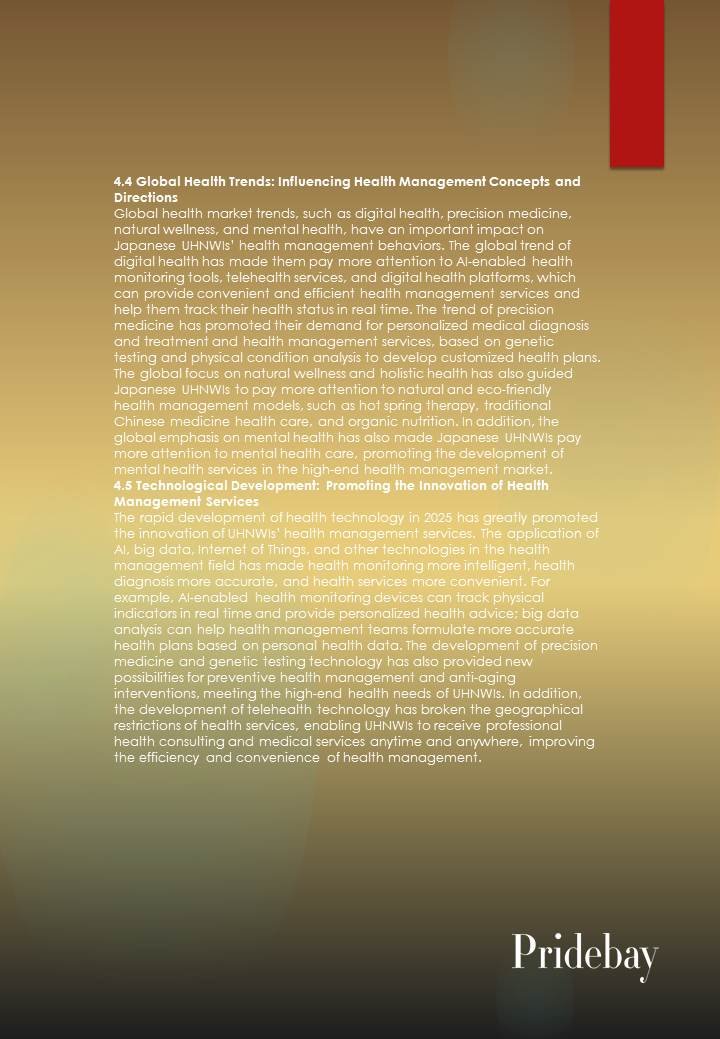
4.4 Global Health Trends: Influencing Health Management Concepts and Directions
Global health market trends, such as digital health, precision medicine, natural wellness, and mental health, have an important impact on Japanese UHNWIs’ health management behaviors. The global trend of digital health has made them pay more attention to AI-enabled health monitoring tools, telehealth services, and digital health platforms, which can provide convenient and efficient health management services and help them track their health status in real time. The trend of precision medicine has promoted their demand for personalized medical diagnosis and treatment and health management services, based on genetic testing and physical condition analysis to develop customized health plans. The global focus on natural wellness and holistic health has also guided Japanese UHNWIs to pay more attention to natural and eco-friendly health management models, such as hot spring therapy, traditional Chinese medicine health care, and organic nutrition. In addition, the global emphasis on mental health has also made Japanese UHNWIs pay more attention to mental health care, promoting the development of mental health services in the high-end health management market.
4.5 Technological Development: Promoting the Innovation of Health Management Services
The rapid development of health technology in 2025 has greatly promoted the innovation of UHNWIs’ health management services. The application of AI, big data, Internet of Things, and other technologies in the health management field has made health monitoring more intelligent, health diagnosis more accurate, and health services more convenient. For example, AI-enabled health monitoring devices can track physical indicators in real time and provide personalized health advice; big data analysis can help health management teams formulate more accurate health plans based on personal health data. The development of precision medicine and genetic testing technology has also provided new possibilities for preventive health management and anti-aging interventions, meeting the high-end health needs of UHNWIs. In addition, the development of telehealth technology has broken the geographical restrictions of health services, enabling UHNWIs to receive professional health consulting and medical services anytime and anywhere, improving the efficiency and convenience of health management.
5. Regional Differences in Japanese UHNWIs’ Health Management
5.1 Tokyo: International, High-End, and Tech-Driven Health Management
UHNWIs in Tokyo have an international health management vision, and their behaviors are characterized by internationalization, high-end, and tech-driven health management. They are more inclined to choose international private health institutions, high-end wellness centers, and imported health management services, and are willing to participate in international health forums and wellness exhibitions. Their health management categories are diverse, covering preventive health, anti-aging, mental health, and cross-border health management, with a high acceptance of emerging health trends such as digital health and precision medicine. They pay great attention to the professionalism and personalization of health services, prefer to cooperate with top health management experts and teams, and often hire personal doctors to provide one-stop health management services. Due to the high pace of life in Tokyo, their health management is more efficient, and they are more willing to use digital health tools to track their health status and manage their health plans.
5.2 Kyoto: Traditional, Natural, and Holistic Health Management
UHNWIs in Kyoto pay more attention to the integration of health management with traditional Japanese culture and natural wellness, and their behaviors are characterized by tradition, naturalness, and holistic health management. They prefer natural wellness models such as hot spring therapy, traditional Chinese medicine health care, Zen meditation, and organic nutrition, and their health management style is peaceful and moderate, focusing on the balance between body and mind. They are more inclined to choose local wellness resorts and traditional health institutions, cooperate with local health experts and cultural institutions, and pay attention to the integration of health management and traditional culture. They often participate in traditional wellness activities such as tea ceremony, meditation, and hot spring recuperation, regarding health management as a way to pursue inner peace and physical health.
5.3 Osaka: Practical, Efficient, and Cost-Effective Health Management
UHNWIs in Osaka have a practical and rational health management style, and their behaviors are characterized by practicality, efficiency, and cost-effectiveness. They pay more attention to the effectiveness and cost-performance of health management services, prefer local high-end private health institutions and fitness centers, and avoid blind pursuit of high-priced international services. Their health management is mainly concentrated in preventive health check-ups, chronic disease management, and sports fitness, which can bring practical health effects. They are less affected by short-term health trends, and their health management decisions are more rational, focusing on whether the service meets their actual health needs and consumption capacity. In addition, they pay more attention to the convenience of health services, preferring health institutions that are close to their residences or workplaces, and valuing the efficiency of health services.
6. Future Trends of Japanese UHNWIs’ Health Management (2026-2030)
6.1 Digital and Tech-Enabled Health Management Will Become Mainstream
In the future, the integration of digital technology and health management will continue to deepen in the high-end health management market, and digital and tech-enabled health management will become mainstream among Japanese UHNWIs. With the continuous maturity of AI, big data, Internet of Things, and other technologies, Japanese UHNWIs will pay more attention to intelligent health monitoring, telehealth services, and AI-enabled health assessment, which can provide convenient, efficient, and personalized health management services. Health technology companies will also increase investment in product research and development, launching more intelligent health devices and digital health platforms to meet their needs. In addition, the combination of digital technology and precision medicine will also become a new trend, enabling personalized health management plans based on real-time health data, promoting the transformation of health management from "generalized" to "precision".
6.2 The Influence of Female Wellness Consumers Will Continue to Grow
With the continuous growth of female UHNWIs’ wealth and influence, their role in the high-end health management market will become more prominent. The trend of female UHNWIs’ health management consumption growth will continue, and they will drive the growth of female-oriented health management categories, such as holistic wellness, anti-aging, mental health, and beauty and health. Health institutions and wellness brands will launch more health management services and products targeted at female investors, such as personalized anti-aging plans, mental health counseling services, and wellness resorts tailored for women, to cater to their preferences and consumption habits. This will further enrich the diversity of Japan’s UHNWI high-end health management market and promote the development of female-oriented high-end wellness services.
6.3 Holistic Health Management Will Become a Core Trend
The pursuit of physical, mental, and emotional balance will make holistic health management a core trend among Japanese UHNWIs. They will pay more attention to the integration of physical health, mental health, and emotional comfort, and avoid one-sided focus on a single aspect of health. Health institutions will also adjust their service models, launching more holistic health management services that integrate preventive health, mental health, wellness experience, and nutrition management, to meet their demand for comprehensive health care. In addition, the integration of health management and lifestyle will become closer, with more UHNWIs integrating health concepts into their daily lives, such as healthy eating, regular exercise, and stress management.
6.4 Cross-Border Health Management Will Continue to Expand
In the future, with the deepening of globalization and the improvement of transportation and communication technologies, cross-border health management will continue to expand among Japanese UHNWIs. They will pay more attention to high-end health management services in international markets, such as anti-aging treatments in Switzerland, precision medical services in the United States, and wellness experiences in Thailand, pursuing higher quality and more professional health care. International health institutions will also strengthen their layout in Japan, providing more convenient cross-border health management services for Japanese UHNWIs, promoting the integration of the global high-end health management market.
6.5 Health Management Will Be More Personalized and Customized
Against the background of the growing demand for personalized services, Japanese UHNWIs’ health management will be more personalized and customized. Health institutions will use genetic testing, big data analysis, and other technologies to fully understand the physical conditions, living habits, and health needs of UHNWIs, and develop tailored health management plans. The demand for personalized health services such as personal doctors, customized nutrition plans, and one-on-one fitness coaching will continue to increase, and more UHNWIs will choose to establish long-term cooperative relationships with professional health management teams to obtain continuous and personalized health care. In addition, the customization of health products will also become a new trend, such as personalized nutritional supplements and customized anti-aging skincare products.
7. Conclusion and Insights
In 2025, Japanese UHNWIs’ health management has entered a new stage of "personalization, integration, prevention-oriented, and tech-driven", breaking away from the traditional health management model of passive treatment and single physical health focus, and showing a more active and mature attitude. Their health management behaviors are deeply influenced by economic environment, demographic changes, social culture, and global health trends, with obvious regional differences and gender characteristics—most notably the leading role of female UHNWIs in consumption and attention, with digital and holistic health management becoming the core trends. From health management attitude, motivation, categories, to service and product preferences, all aspects reflect their pursuit of balance between effectiveness and experience, professionalism and personalization, and physical health and mental well-being. Against the backdrop of Japan’s aging society and the rapid development of health technology in 2025, Japanese UHNWIs have become an important driving force for the transformation and development of the global high-end health management market, with their rational and personalized health management concepts leading the new trend of the industry.
For private health institutions, wellness brands, health technology companies, and related enterprises, the following insights can be obtained from this report:
- Focus on the integration of digital technology and health management, launch intelligent and personalized health management services and products, such as AI-enabled health monitoring devices, digital health platforms, and precision health management plans, to meet the tech-driven health needs of Japanese UHNWIs, especially young UHNWIs.
- Attach importance to the growing influence of female UHNWIs, launch health management services and products targeted at female consumers, such as holistic wellness, anti-aging, and mental health services, highlight the experience, personalization, and emotional comfort of services, and cater to their preferences and consumption habits.
- Respect the regional differences in health management, formulate targeted market strategies according to the characteristics of UHNWIs in different regions (Tokyo, Kyoto, Osaka). For example, launch high-end, tech-driven health services in Tokyo, traditional and natural wellness services in Kyoto, and practical, cost-effective health services in Osaka. Strengthen cooperation with local governments and institutions to grasp the policy opportunities of the health management industry.
- Adapt to the trend of holistic health management, adjust service models, launch comprehensive health management services that integrate physical, mental, and emotional health, and attach importance to the combination of health management and lifestyle, to meet the demand of UHNWIs for comprehensive health care.
- Strengthen professional services, improve the professionalism of health institutions and experts, provide one-stop health management services, and establish long-term cooperative relationships with UHNWIs to meet their demand for professional and systematic health management. Strengthen cooperation with international health institutions to expand cross-border health management services and meet the international health needs of UHNWIs.
In the future, with the continuous changes of economic and social environment, demographic structure, and health technology, Japanese UHNWIs’ health management will continue to evolve, showing more personalized, digital, holistic, and international characteristics. The influence of female wellness consumers will continue to grow, and digital and tech-enabled health management will become the mainstream trend. Pridebay will continue to pay attention to the changes in Japanese UHNWIs’ health management behaviors, conduct in-depth research, and provide more valuable insights for the industry, promoting the healthy development of Japan’s high-end health management industry and the global high-end wellness market.
Pridebay Research Team
2025