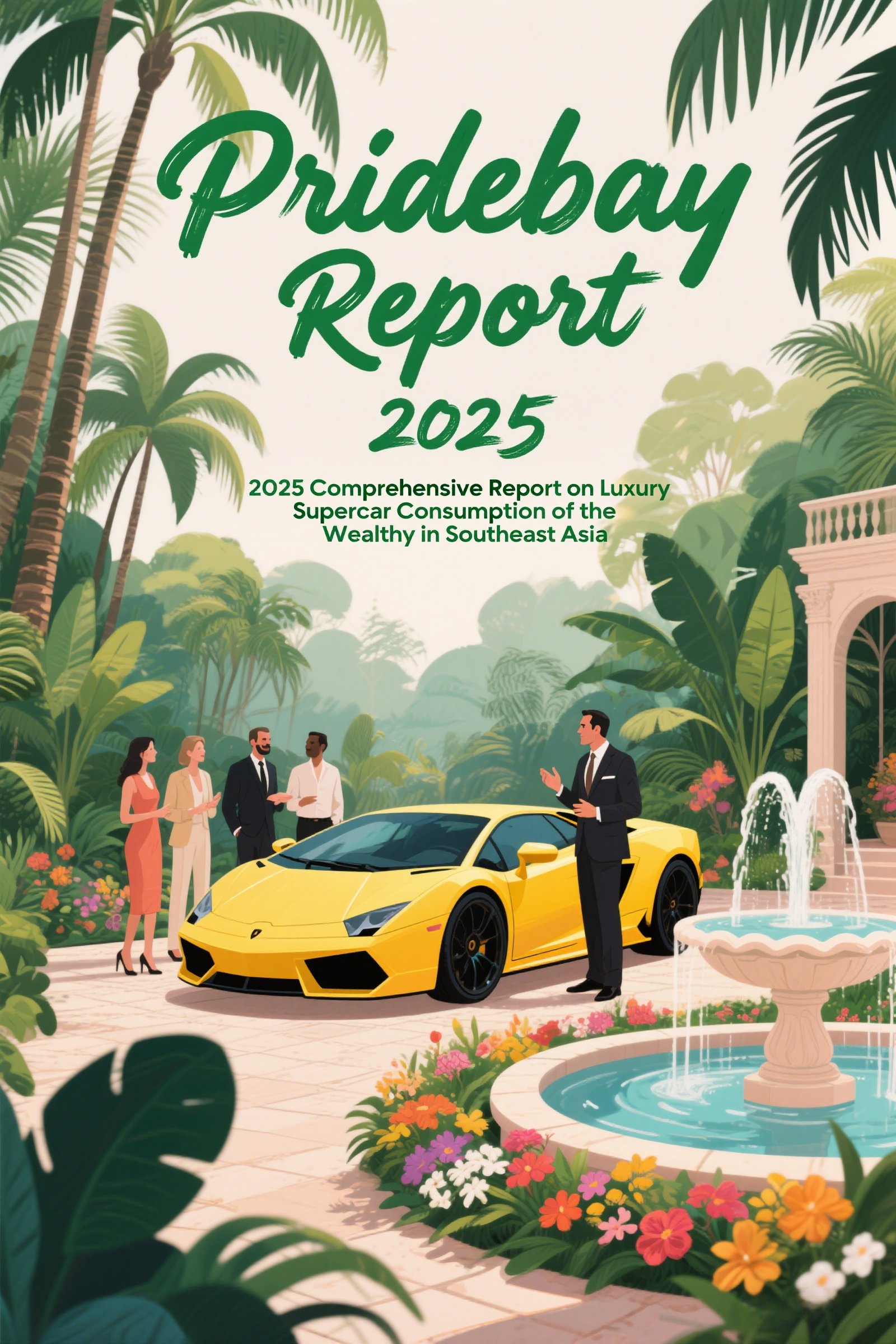
2025 Comprehensive Report on Luxury Supercar Consumption of the Wealthy in Southeast Asia
Issued by: Pridebay Asia
Executive Summary
In 2025, the luxury supercar consumption market of the wealthy in Southeast Asia has entered a critical period of electrification transition and experience upgrading, characterized by the coexistence of traditional high-performance supercars and new energy supercars, the deep integration of customization demand and circle culture, and the coordinated development of regional markets. As an important part of the Asia-Pacific supercar market, which is the world’s fastest-growing supercar market segment, Southeast Asia’s supercar consumption is driven by the expanding high-net-worth population, improving luxury automotive infrastructure, and supportive government policies, showing strong growth vitality.
Key data highlights: The global supercar market is valued at USD 26.5 billion in 2025 and is expected to grow to USD 52.8 billion by 2033 with a compound annual growth rate (CAGR) of 8.8%, with Southeast Asian countries making significant contributions to this growth. Indonesia’s premium and luxury car market recorded a 43% increase in sales volume in 2025; Malaysia’s Proton e.MAS 7 maintained its position as the best-selling EV model for seven consecutive months, with 4,959 units delivered by the end of July 2025; Porsche’s "Das Treffen X", the largest supercar gathering in Southeast Asia, attracted enthusiasts from across the region to Bangkok. For Pridebay Asia’s high-net-worth clients, this market presents diversified cooperation opportunities in customized supercar experiences, cross-regional supercar travel, personalized modification services, and sustainable supercar lifestyle projects.
1. Market Overview: Scale, Drivers and Regional Characteristics
1.1 Market Scale and Economic Impact
Southeast Asia’s luxury supercar market, as a core part of the Asia-Pacific high-performance automotive consumption sector, has shown steady growth amid global economic recovery. Benefiting from the surge in affluent populations and the growing fascination with luxury goods, the region has become a key growth engine for the global supercar market. While specific regional market size data is yet to be fully released, the strong performance of key markets reflects the overall vitality: Indonesia’s premium and luxury car market achieved a 43% year-on-year growth in sales volume, driven by rising consumer affluence and urbanization; Singapore, as a regional luxury automotive hub, witnessed the debut of multiple new supercar models in 2025, including Lamborghini’s hybrid supercar Temerario and IM Motors’ electric supercar lineup; Thailand’s supercar market is boosted by large-scale enthusiast gatherings and improved racing infrastructure.
The supercar consumption market has also driven spillover effects in related industries, including high-end automotive services, customization and modification, racing events, tourism, and luxury lifestyle consumption. For example, Porsche’s "Das Treffen X" event in Bangkok not only attracted thousands of supercar owners but also drove consumption in local catering, accommodation, and cultural tourism. The development of charging infrastructure for electric supercars has also promoted investment in the new energy industry chain in Southeast Asia.
1.2 Core Driving Factors
Growth of High-Net-Worth Population and Disposable Income: Southeast Asia’s economic development has nurtured a rapidly expanding group of high-net-worth individuals (HNWIs) who regard supercars as symbols of identity, status, and taste. Their strong purchasing power and demand for personalized luxury experiences have become the core driving force for the growth of the supercar market.
Improvement of Luxury Automotive Infrastructure: Countries such as Singapore, Thailand, and Malaysia have continuously improved high-end automotive supporting facilities, including professional racing tracks, high-end maintenance centers, and charging networks for electric supercars. Malaysia’s charging network covers over 90% of the country with more than 3,400 charging points, facilitating the popularization of electric supercars.
Policy Incentives for New Energy Vehicles: Governments in Southeast Asian countries have introduced subsidies, tax benefits, and other incentives to promote the development of electric vehicles. For example, Vietnam’s VinFast offers free charging services to electric vehicle owners until 2028, while Singapore provides preferential policies for imported electric supercars, accelerating the transition to electrification in the supercar market.
Rise of Supercar Culture and Enthusiast Communities: The formation and development of supercar clubs and enthusiast gatherings have strengthened the social attributes of supercar consumption. Events such as Porsche’s "Das Treffen X" have evolved into annual regional automotive cultural festivals, attracting supercar owners and enthusiasts to participate, thereby stimulating consumption demand for related products and services.
1.3 Regional Consumption Characteristics
Due to differences in economic development levels, policy environments, and cultural preferences, Southeast Asian countries show distinct characteristics in luxury supercar consumption:
Singapore: As an international luxury automotive hub, it focuses on high-end and cutting-edge models. The market is dominated by top-tier supercar brands such as Lamborghini, Porsche, and emerging electric supercar brands like IM Motors. Local consumers value technological innovation, exclusivity, and after-sales service, with a strong demand for personalized customization and limited-edition models.
Thailand: A gathering place for supercar enthusiasts in Southeast Asia, with a vibrant supercar culture. Large-scale supercar events such as Porsche’s "Das Treffen X" are regularly held, and the market has a high demand for both traditional high-performance supercars and electrified models. The country’s tourism resources also drive the development of supercar rental and experience consumption.
Malaysia: The market is characterized by the coexistence of international luxury brands and local new energy brands. Proton’s electric model e.MAS 7 has maintained its position as the best-selling EV model for seven consecutive months, reflecting strong local acceptance of electric vehicles. At the same time, the supercar modification culture is prosperous, with local teams participating in international modification exhibitions.
Indonesia & Vietnam: Emerging growth markets for luxury supercars. Indonesia’s premium car market has grown rapidly by 43% due to rising affluence, while Vietnam’s VinFast has expanded its market share by exporting electric vehicles to Indonesia, with the VF 3 model becoming a popular choice among local consumers. The market is currently dominated by mid-to-high-end supercars and electric supercars that are cost-effective and suitable for local road conditions.
2. Core Dimensions of Luxury Supercar Consumption by Southeast Asian Wealthy Individuals
2.1 Brand and Model Preferences
Southeast Asian wealthy individuals show diversified preferences in supercar brand and model selection: – Traditional Luxury Supercar Brands: Italian and German brands such as Lamborghini, Porsche, and McLaren remain the first choice for most wealthy individuals. Lamborghini’s new hybrid supercar Temerario, which debuted in Singapore in 2025, has attracted widespread attention for its high performance and electrified technology. Porsche’s 911 and 718 series are popular in Thailand and Singapore due to their excellent handling and brand heritage.
– Emerging Electric Supercar Brands: With the acceleration of electrification, brands such as IM Motors (China) and VinFast (Vietnam) have entered the Southeast Asian market. IM Motors’ im5 sedan and im6 coupe SUV were unveiled at the Singapore Motor Show 2025, featuring ultra-fast charging and long-range capabilities, which are favored by tech-savvy wealthy individuals. VinFast’s VF series electric vehicles have achieved good sales in Indonesia, supported by preferential policies.
– Model Types: Hybrid supercars and supercar SUVs are becoming mainstream. Lamborghini’s Urus SE, a plug-in hybrid super SUV, combines performance and practicality. Supercar SUVs are popular among wealthy families for their versatility. In addition, classic vintage supercars are also sought after by collectors, becoming an important part of supercar investment.
2.2 Consumption Behavior and Service Demand
The supercar consumption of Southeast Asian wealthy individuals is no longer limited to vehicle purchases but extends to the entire life cycle of services: – Personalized Customization: There is a strong demand for customized services such as personalized paint colors, interior materials, and exclusive logos. Malaysian supercar modification teams have participated in international modification exhibitions, showcasing customized supercars with local cultural elements.
– High-End After-Sales Service: Wealthy individuals pay great attention to after-sales service quality, including professional maintenance, parts replacement, and vehicle storage. Luxury supercar brands have established professional service centers in Southeast Asia to provide 24/7 emergency support and customized maintenance plans.
– Experience-Oriented Consumption: Supercar rental, track experience days, and cross-border driving tours are popular. Thailand’s professional racing tracks offer customized track training services for wealthy individuals, while supercar rental services in tourist destinations such as Phuket cater to the needs of high-end tourists.
2.3 Circle Culture and Social Attributes
Supercars have become an important carrier of social interaction for Southeast Asian wealthy individuals: – Supercar Club Activities: Local supercar clubs regularly organize gatherings, drives, and charity events. Porsche’s "Das Treffen X" in Bangkok, which celebrates its 10th anniversary in 2025, attracts supercar owners from across the region, featuring themed zones, racing simulators, and legendary car displays, becoming an important platform for elite networking.
– Charity and Public Welfare Linkages: Many supercar events are combined with charity activities, such as supercar parades for charity and auction of limited-edition supercar accessories, enhancing the social value of supercar consumption and shaping a positive image of wealthy individuals.
3. Key Trends Reshaping the Market in 2025
3.1 Electrification and Hybridization: The New Direction of Supercar Development
Electrification has become an irreversible trend in the global supercar market, and Southeast Asia is no exception. Luxury supercar brands are accelerating the electrification transformation of their product lineups: Lamborghini has completed the hybridization of its entire product range, with the new Temerario hybrid supercar making its debut in Southeast Asia; IM Motors, a Chinese electric supercar brand, has entered the Singapore market, bringing advanced electric driving technology. At the same time, local brands such as Malaysia’s Proton and Vietnam’s VinFast are also expanding their electric supercar product lines, driven by policy incentives and market demand. The improvement of charging infrastructure will further promote the popularization of electric supercars in Southeast Asia.
3.2 Digitalization Enhances the Luxury Consumption Experience
Digital technology is reshaping the entire chain of supercar consumption, from purchasing to after-sales service. Virtual showrooms and AI-powered customization tools allow wealthy individuals to browse and customize supercars online; advanced in-car technologies such as IM Motors’ "rainy night mode" and "one-touch traceback" enhance driving safety and convenience. In addition, digital platforms facilitate communication among supercar enthusiasts, while online booking of track experiences and maintenance services improves consumption efficiency.
3.3 Integration of Personalization and Localization
Southeast Asian wealthy individuals are increasingly pursuing personalized and localized supercar experiences. On the one hand, they demand exclusive customization services to reflect their unique tastes; on the other hand, they pay more attention to the integration of supercars with local culture. For example, local modification teams incorporate Southeast Asian cultural elements into supercar modifications, creating unique customized models. Luxury supercar brands are also adjusting their product strategies to adapt to local road conditions and consumer preferences, launching models that are more suitable for the Southeast Asian market.
3.4 Deepening of Supercar Culture and Circle Consumption
Supercar culture in Southeast Asia is becoming more mature, with enthusiast gatherings and events evolving into large-scale cultural festivals. These events not only showcase supercars but also integrate elements such as music, food, and art, creating a comprehensive lifestyle experience. Supercar clubs are also strengthening their influence, organizing cross-border driving tours and international exchange activities, which further stimulate the demand for supercar consumption and related services.
4. Key Players in the Luxury Supercar Ecosystem
4.1 Supercar Brands and Manufacturers
International Luxury Supercar Brands: Lamborghini, Porsche, McLaren, and other brands have a strong presence in Southeast Asia, continuously launching new models and expanding their sales and service networks. Lamborghini’s debut of the Temerario in Singapore and Porsche’s hosting of "Das Treffen X" in Bangkok demonstrate their emphasis on the regional market.
Emerging Electric Supercar Brands: IM Motors (China) and VinFast (Vietnam) are emerging forces in the Southeast Asian market, relying on technological innovation and policy advantages to gain market share. IM Motors’ entry into Singapore and VinFast’s exports to Indonesia mark the expansion of electric supercar brands in the region.
Local Automobile Manufacturers: Malaysia’s Proton has achieved success in the electric vehicle market with its e.MAS 7 model, while Indonesia’s local manufacturers are also exploring the high-end supercar market, promoting the localization of the supercar industry chain.
4.2 Distributors and After-Sales Service Providers
Authorized Distributors: Companies such as Eurokars Group, the official distributor of IM Motors in Singapore, play an important role in connecting brands and consumers, providing sales, customization, and after-sales services. These distributors have rich experience in the luxury automotive market and a sound service network.
High-End Maintenance and Modification Centers: Professional maintenance centers and modification teams provide technical support for supercar owners. Malaysian modification teams have gained international recognition for their exquisite craftsmanship, participating in international modification exhibitions and meeting the personalized needs of wealthy individuals.
4.3 Event Organizers and Enthusiast Communities
Event Organizers: Organizations that host large-scale supercar events such as Porsche’s "Das Treffen X" have rich experience in event planning and resource integration capabilities, promoting the development of supercar culture in the region.
Supercar Clubs: Regional supercar clubs connect supercar owners and enthusiasts, organizing various social and experience activities, and becoming an important part of the supercar ecosystem.
4.4 Infrastructure and Service Providers
Charging Infrastructure Providers: Companies such as Malaysia’s Live Integrated Charging Network and Vietnam’s V-Green are accelerating the construction of charging networks, providing convenience for the popularization of electric supercars.
Track and Experience Venues: Professional racing tracks in Thailand and Singapore provide track training and experience services for supercar owners, while luxury hotels and resorts cooperate with supercar brands to launch "supercar + travel" packages.
5. Cross-Regional Cooperation Opportunities for Pridebay Asia
5.1 Customized Supercar Experience Services
Leveraging its global network resources, Pridebay Asia can provide customized supercar experience services for high-net-worth clients: 1. Exclusive Test Drive and Track Experience: Organize private test drives of the latest supercar models (such as Lamborghini Temerario and IM Motors electric supercars) in Singapore, Thailand, and other countries, and arrange customized track training at professional racing tracks with international certified coaches.
2. Cross-Border Supercar Travel: Design cross-border supercar driving tours covering multiple Southeast Asian countries, including route planning, vehicle transportation, accommodation arrangements, and local cultural experience activities, allowing clients to enjoy the fun of supercar driving while experiencing regional customs.
5.2 Personalized Customization and Modification Services
Connect high-net-worth clients with top international and local supercar customization and modification resources: 1. Exclusive Customization Consultation: Cooperate with supercar brands and customization studios to provide clients with one-stop personalized customization services, including exterior paint, interior materials, and in-car technology configuration, creating unique supercars that reflect their personal tastes.
2. Local Cultural Modification Projects: Assist clients in cooperating with local modification teams in Southeast Asia to integrate regional cultural elements into supercar modifications, such as Malaysian traditional patterns and Thai art elements, creating supercars with unique regional characteristics.
5.3 Supercar Circle and Elite Social Activities
Organize exclusive supercar-themed elite social activities for high-net-worth clients: 1. Private Supercar Gatherings: Host small-scale private supercar gatherings in Southeast Asia, inviting supercar owners, industry experts, and celebrities to participate, providing a platform for clients to network and exchange ideas.
2. Charity Supercar Events: Cooperate with supercar clubs and charitable organizations to organize charity supercar parades and auctions, with proceeds donated to public welfare projects, enhancing clients’ social influence while fulfilling social responsibilities.
5.4 Sustainable Supercar Lifestyle Projects
Seize the trend of electrification and sustainable development to launch related cooperation projects: 1. Electric Supercar Experience and Investment Consultation: Provide clients with consultation on electric supercar models, charging infrastructure, and policy incentives, and organize test drives of the latest electric supercars, helping clients understand the development trend of sustainable supercars.
2. Green Supercar Travel Projects: Design environmentally friendly supercar travel routes, combining electric supercar driving with visits to ecological scenic spots and sustainable development projects, promoting the concept of low-carbon luxury lifestyle.
6. Challenges and Future Outlook (2025-2030)
6.1 Key Challenges
Policy and Regulatory Uncertainties: Differences in import tariffs, emission standards, and electric vehicle policies among Southeast Asian countries may increase the cost of supercar sales and operation. Changes in policies may also affect market demand and brand investment strategies.
Uneven Development of Infrastructure: Although charging infrastructure is improving, there are still gaps in coverage and quality in some regions, which restricts the popularization of electric supercars. In addition, the number of professional racing tracks and maintenance centers is insufficient to meet the growing demand for high-end services.
Economic Fluctuations and Purchasing Power Risks: Global economic uncertainties may affect the disposable income and purchasing confidence of high-net-worth individuals, leading to fluctuations in the supercar market. In addition, the high price of supercars makes the market sensitive to economic changes.
Intensified Market Competition: With the entry of more international and local supercar brands, market competition is becoming increasingly fierce. Brands need to continuously innovate in technology, products, and services to maintain their competitive advantages.
6.2 Future Outlook
The luxury supercar consumption market of the wealthy in Southeast Asia is expected to maintain a CAGR of 9-11% from 2025 to 2030, with the following key development directions: 1. Accelerated Electrification Transformation: Electric and hybrid supercars will account for an increasing proportion of the market, with more brands launching electrified models and the continuous improvement of charging infrastructure. By 2030, electrified supercars are expected to become the mainstream of the Southeast Asian supercar market.
2. Deepened Digitalization and Intelligence: Digital technologies such as AI, big data, and virtual reality will be more widely applied in supercar design, production, sales, and after-sales services, enhancing the personalization and intelligence of the consumption experience.
3. Strengthened Regional Market Integration: With the deepening of economic integration in Southeast Asia, the circulation of supercars and related services across borders will become more convenient, promoting the integrated development of the regional supercar market.
4. Diversification of Supercar Lifestyle: The supercar consumption will be further integrated with tourism, culture, sports, and other fields, forming a diversified supercar lifestyle ecosystem, and providing more comprehensive and in-depth experience services for high-net-worth individuals.
7. Conclusion
In 2025, the luxury supercar consumption market of the wealthy in Southeast Asia is in a critical period of transformation and upgrading, driven by factors such as the growth of high-net-worth population, policy incentives, and the popularization of supercar culture. The market shows distinct regional characteristics, with electrification, digitalization, and personalization becoming the core trends reshaping the industry.
For Pridebay Asia, this market presents broad cross-regional cooperation opportunities. By leveraging its professional advantages and global network resources, Pridebay Asia can provide high-net-worth clients with customized supercar experience, personalized customization, elite social activities, and sustainable lifestyle projects, helping clients explore the unique value of the Southeast Asian supercar consumption market.
Looking ahead, despite challenges such as policy uncertainties and uneven infrastructure development, the long-term growth trend of the Southeast Asian luxury supercar market remains positive. With the continuous innovation of brands and the deepening of market integration, the region will become an increasingly important part of the global supercar market, bringing new development opportunities for high-net-worth individuals, industry players, and service providers like Pridebay Asia.