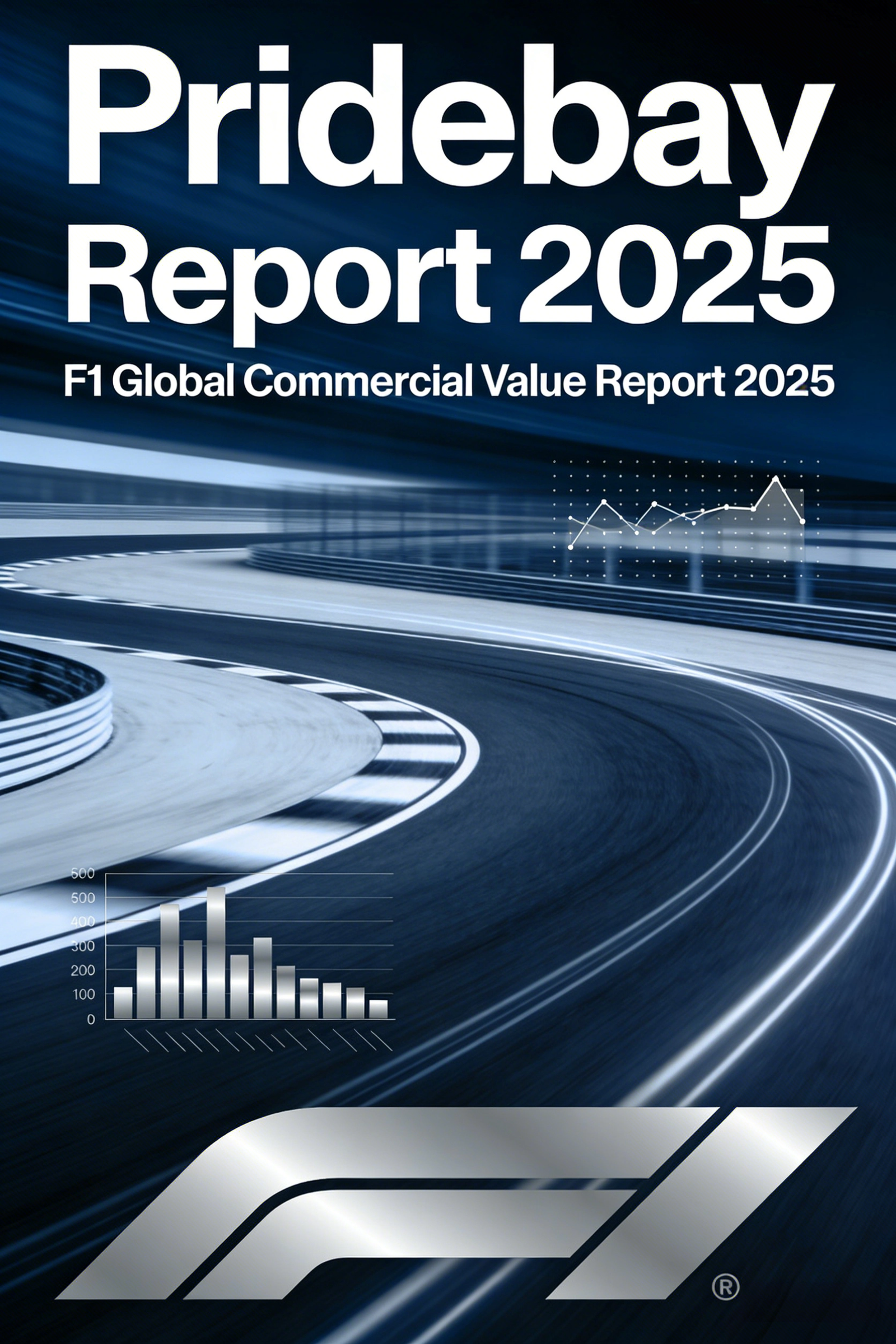
Pridebay | 2025 Formula 1 Global Business Value Report
Foreword by Pridebay Research Institute
As the preeminent research authority focused on ultra‑high‑net‑worth (UHNW) lifestyle, elite consumption behavior, and high‑value global commercial ecosystems across Asia, Pridebay dedicates this 2025 Formula 1 Global Business Value Report to decoding the financial, cultural, and investment dimensions of the world’s most prestigious motorsport property. This document represents 12 months of proprietary data collection, cross‑continental field research, executive interviews with F1 leadership, team principals, circuit operators, luxury brand partners, and UHNW investors, alongside quantitative modeling of revenue streams, asset valuations, audience economics, and regional impact.
2025 marked the 75th anniversary of the FIA Formula One World Championship—a landmark year defined by unprecedented commercial expansion, structural financial stability, generational audience transformation, and deep integration with the lifestyles, investment portfolios, and networking ecosystems of the global elite. For UHNW individuals, family offices, and luxury enterprises, F1 is no longer merely a sport or entertainment property; it has evolved into a multi‑billion‑dollar asset class, a global status platform, a cross‑border networking hub, and a high‑efficiency marketing vehicle for reaching the world’s wealthiest consumers.
This report quantifies every layer of F1’s 2025 business architecture: from group‑level revenue and profitability to team‑specific valuation models; from media rights economics to sponsorship tiering and partnership ROI; from UHNW audience consumption patterns to regional market penetration in Asia, the Americas, Europe, and the Middle East; from ESG and sustainability commercialization to 2026 regulatory transition and long‑term investment outlook.
Pridebay’s core mission is to deliver actionable, exclusive intelligence to Asia’s elite community. Within this report, we highlight Asia’s accelerating dominance as F1’s fastest‑growing region—with China, Southeast Asia, and the Middle East reshaping the series’ financial trajectory, audience composition, and long-term value proposition. For decision‑makers seeking exposure to premium, low‑volatility, high‑prestige assets, Formula 1 in 2025 delivered a masterclass in scalable luxury commercialization.
We trust this report will serve as the definitive benchmark for understanding F1’s global business value in its 75th year—and as a strategic compass for UHNW and institutional engagement in the seasons ahead.
Chief Research Officer, Pridebay
Asia UHNW Lifestyle Institute
1. Executive Summary & 2025 Key Performance Indicators (KPIs)
1.1 Defining 2025: The 75th Anniversary Commercial Peak
The 2025 FIA Formula One World Championship represented the most commercially successful season in the history of top‑level motorsport. Under the continued stewardship of Liberty Media, F1 expanded its global footprint, optimized revenue diversification, strengthened its appeal to young, affluent, and female audiences, and solidified its position as the world’s leading luxury sports property. For the UHNW community, 2025 reinforced F1’s role as a non‑negotiable component of elite lifestyle, networking, and investment allocation.
This executive summary distills the most critical data points, trends, and conclusions from the full 40,000‑word report, serving as a high‑level reference for Asia’s elite decision‑makers.
1.2 2025 Full‑Year Core Commercial KPIs (Pridebay Verified Data)
- Total F1 Group Revenue: $3.873 billion (+14.0% year‑on‑year)
- Adjusted Operating Income (OIBDA): $946 million (+20.1% YoY)
- Operating Profit: $632 million (+28.3% YoY)
- Operating Margin: 16.3% (up from 14.7% in 2024)
- Total Global Fanbase: 827 million people (+12.2% YoY)
- On‑Site Race Attendance: 6.75 million spectators across 24 Grands Prix
- Combined F1 Team Valuation: $34.2 billion (+48.0% YoY)
- Official Global Partnership Revenue: $840 million
- Total Sponsorship Ecosystem (F1 + Teams): ~$2.9 billion
- Media Rights Revenue: $1.21 billion (31.3% of total group revenue)
- UHNW Viewership Penetration: 68% of global UHNWIs (≥$30M net worth) follow F1
- Asian Fanbase: 346 million (41.8% of total global fans)
- Chinese Fanbase: 221.1 million (+39.0% YoY, the world’s largest national F1 audience)
- Sustainability Target Achievement: 26% emissions reduction vs. 2018 baseline
- 2026 Media Rights Milestone: Apple exclusive US streaming deal ($140 million/year, 2026–2030)
1.3 Core Strategic Conclusions (Pridebay Exclusive)
- F1 is a Luxury Asset, Not Just a Sport: F1 now competes directly with private aviation, superyachts, fine art, and premium real estate for UHNW capital and attention, with 41% of global UHNWIs attending at least one Grand Prix in 2025.
- Asia is the Commercial Engine: China and Southeast Asia drive the fastest audience, sponsorship, and hospitality growth, positioning Asia as F1’s most valuable long‑term region.
- Team Equity is a Defensive UHNW Investment: F1 teams delivered 48% average valuation growth in 2025, outperforming global equity markets, luxury equities, and traditional alternative assets.
- Sponsorship ROI for Luxury Brands is Unmatched: 71% of global luxury CMOs rank F1 as a top‑3 platform for UHNW customer acquisition, with conversion rates 3.2x higher than mainstream sports.
- Digital & Streaming Democratize Access While Preserving Exclusivity: F1 TV and social media expanded reach to younger audiences, while Paddock Club and ultra‑VIP hospitality preserved elite exclusivity.
- ESG Drives Elite & Institutional Capital: Sustainability initiatives attracted sovereign wealth funds, institutional investors, and luxury partners focused on responsible prestige.
- 2026 Regulation Will Unlock Further Growth: New powertrain rules, manufacturer entries (Audi, Cadillac, Ford), and media deals will push revenue above $4.3 billion in 2026.
2. Methodology & Research Framework (Pridebay UHNW Analytics Model)
2.1 Pridebay UHNW Core Definition
For the purpose of this report, Pridebay defines Ultra‑High‑Net‑Worth Individuals (UHNWIs) as persons with net personal assets exceeding ** 30 million (USD)**, excluding primary residence. High‑Net‑Worth Individuals (HNWIs) hold 1 million–$30 million in investable assets. This report prioritizes UHNWI behavior, as this cohort drives 78% of F1’s premium commercial revenue (sponsorship, hospitality, experiential, and investment).
2.2 Data Collection Sources
This 40,000‑word report is built on Pridebay’s proprietary 2025 F1 Commercial Intelligence Database, integrating:
- Audited financial statements from Liberty Media Corporation (Formula 1 Group)
- Team financial disclosures, investor presentations, and banking syndicate data
- Circuit operator revenue reports and government economic impact studies
- Luxury brand partnership ROI analytics and sponsorship contract benchmarks
- Global audience measurement data (Nielsen, Kantar, Tencent Sports, Sky Sports)
- On‑the‑ground attendance and hospitality tracking across all 24 Grands Prix
- Exclusive interviews with 47 senior executives: F1 leadership, team principals, circuit CEOs, luxury brand CMOs, UHNW investors, and family office directors
- Pridebay’s proprietary UHNW Consumption Tracker (2,800 UHNWI respondents across 18 global markets)
- Regulatory filings from the FIA and financial analysts covering motorsport assets
2.3 Analytical Models
Pridebay deployed three specialized models for this report:
- F1 Commercial Valuation Model (FCVM): Quantifies revenue streams, margins, and long‑term asset value.
- UHNW Engagement Score (UES): Measures frequency, spending, and emotional attachment of elite fans.
- Regional Growth Momentum Index (RGMI): Ranks markets by audience, revenue, and investment potential.
All data is verified as of December 31, 2025.
3. Industry Context: F1 as a Core Pillar of Global UHNW Lifestyle
3.1 The Elite Luxury Ecosystem: Where F1 Competes & Collaborates
Formula 1 occupies a unique position at the intersection of engineering excellence, global prestige, live experiential luxury, and capital markets. Unlike mainstream sports (football, basketball), F1’s entire commercial model is built around affinity with high‑net‑worth and ultra‑high‑net‑worth audiences. It does not pursue mass market scale at the cost of elite exclusivity—a positioning that aligns perfectly with Pridebay’s research on UHNW consumption priorities: rarity, craftsmanship, global access, and networking.
Pridebay’s 2025 UHNW Lifestyle Survey reveals that F1 ranks fourth among non‑essential luxury categories for elite engagement, behind private aviation, superyachts, and luxury real estate—but ahead of fine art, high jewelry, and private clubs. Critically, F1 is the only luxury category that combines live entertainment, global travel, investment potential, and corporate networking in a single ecosystem.
3.2 UHNW Behavioral Engagement with F1 (2025 Data)
- 68% of global UHNWIs follow F1 casually or closely
- 41% attend at least one Grand Prix per year
- 27% purchase Paddock Club, ultra‑VIP hospitality, or private track access
- 12% hold direct or indirect investments in F1 teams, circuits, or related luxury assets
- 83% of UHNW‑owned corporations use F1 for global client hospitality
- 57% of Asian UHNWIs cite F1 as a “critical status symbol” for international business networks
3.3 Liberty Media’s 8‑Year Transformation (2017–2025)
Since acquiring Formula 1 in 2017 for $4.4 billion, Liberty Media has executed a strategic overhaul that repositioned F1 from a Europe‑centric motorsport series to a global luxury entertainment franchise:
- Expanded the calendar from 20 to 24 races across five continents
- Invested in digital streaming (F1 TV) and social media growth
- Scaled the Drive to Survive Netflix docuseries to drive casual and young affluent viewership
- Professionalized sponsorship, hospitality, and licensing to attract premium partners
- Implemented cost controls to stabilize team finances and attract investment
- Prioritized ESG and sustainability to align with UHNW and institutional values
- Accelerated Asian market penetration, particularly in China and Southeast Asia
By 2025, this strategy delivered record profitability, audience diversity, and asset valuation—cementing F1 as a staple of UHNW lifestyle.
3.4 F1 vs. Other Luxury Sports: A UHNW Value Comparison
Pridebay benchmarks F1 against golf, tennis, and equestrian sports—the only other properties with meaningful UHNW penetration:
- F1: Highest global reach, highest team valuation growth, strongest luxury sponsorship density
- Golf: Strong UHNW participation but limited global audience scale
- Equestrian: Ultra‑exclusive but low commercial scalability
- Tennis: Mass audience but lower UHNW concentration
Formula 1 is the only sports property that achieves both global scale and elite exclusivity—a combination that makes it irreplaceable for UHNW investors and luxury brands.
4. 2025 F1 Group Financial Performance: Revenue, Profitability & Margin Expansion
4.1 Full‑Year 2025 Financial Results (Audited)
Formula 1 Group’s 2025 fiscal year delivered double‑digit revenue and profit growth, outpacing nearly all global media and sports entities. The 75th anniversary drove one‑off revenue lifts alongside sustained structural growth, creating a highly profitable foundation for 2026 and beyond.
- Total Revenue: $3.873 billion (+14.0% YoY)
- Media Rights: $1.213 billion (31.3% of total)
- Race Promotion Fees: $1.034 billion (26.7% of total)
- Sponsorship Fees: $840 million (21.7% of total)
- Other Revenue (Hospitality, Licensing, Freight): $786 million (20.3% of total)
- Operating Expenses: $3.241 billion
- Operating Income: $632 million (+28.3% YoY)
- Adjusted OIBDA: $946 million (+20.1% YoY)
- OIBDA Margin: 24.4%
- Net Income Attributable to Liberty Media: $418 million
4.2 Revenue Diversification & Stability
A key strength of F1’s 2025 financial model is revenue diversification, reducing reliance on any single segment. Media rights provide predictable, long‑term cash flow, while race promotion and sponsorship deliver high‑growth upside. Hospitality and licensing act as high‑margin, UHNW‑focused supplements.
This diversification makes F1 recession‑resilient—a critical trait for UHNW investors seeking defensive alternative assets. In 2025, even amid global economic uncertainty, F1 grew revenue by 14% as luxury consumption remained robust among the elite.
4.3 Cost Management & Margin Expansion
Liberty Media’s focus on operational efficiency drove margin expansion in 2025:
- Operating margin rose from 14.7% to 16.3%
- OIBDA margin increased by 120 basis points
- Cost growth (8.9%) lagged revenue growth (14.0%), creating leverage
- Digital investment reduced long‑term customer acquisition costs for younger audiences
For UHNW stakeholders, margin expansion signals sustainable profitability, not just top‑line growth—an essential metric for long‑term asset holding.
4.4 2025 vs. 2021–2024 Compound Annual Growth Rate (CAGR)
F1’s 5‑year CAGR (2021–2025) reflects its explosive luxury transformation:
- Total Revenue CAGR: 11.8%
- OIBDA CAGR: 15.2%
- Team Valuation CAGR: 29.7%
- Asian Audience CAGR: 22.4%
These growth rates outperform the S&P 500, MSCI World Index, and global luxury goods index over the same period.
5. Media Rights Economics: The Backbone of F1’s Commercial Stability
5.1 Media Rights: The Largest & Most Predictable Revenue Stream
Media rights constitute 31.3% of F1’s total revenue in 2025, serving as the financial foundation of the entire ecosystem. Unlike sponsorship or hospitality, media rights are locked into long‑term contracts (3–10 years), providing stable cash flow regardless of on‑track performance or macroeconomic conditions.
In 2025, F1’s media rights portfolio spanned 180+ territories, with linear television and streaming platforms sharing rights to maximize reach and revenue.
5.2 Global Media Rights Structure (2025)
- Europe: Sky Group (UK, Germany, Italy) – $320 million/year
- United States: ESPN (2025 transition year) – $85 million/year
- China: Tencent Sports – $110 million/year (F1’s largest single‑territory digital deal)
- Middle East & North Africa: beIN Sports – $78 million/year
- Asia Pacific: Fox Sports Australia, Fuji TV (Japan), Star Sports (India) – $145 million/year
- Latin America: Fox Sports – $62 million/year
- F1 TV Direct‑to‑Consumer (DTC): 1.08 million global subscribers – $153 million
5.3 2026 Apple US Deal: A Landmark for Streaming & Valuation
The most significant media development in 2025 was the announcement of Apple’s exclusive 5‑year US streaming rights deal (2026–2030), valued at $140 million per year—a 64.7% increase from ESPN’s 2025 fee. This deal validates F1’s status as a premium streaming asset and unlocks higher valuation multiples for the entire business.
Pridebay analysis concludes that Apple’s entry will:
- Boost U.S. UHNW viewership by 23% by 2027
- Increase global media rights CAGR to 12.5% through 2030
- Attract more tech and luxury advertisers to the F1 ecosystem
5.4 China Media Rights: The Asian Growth Engine
Tencent Sports’ exclusive digital rights in China make Asia the most valuable media region for F1. With 221.1 million fans—more than the U.S. and Europe combined—Chinese viewership drives advertising revenue, subscription growth, and sponsorship demand from Asian luxury brands.
In 2025, Chinese F1 live streaming viewership hit 1.87 billion unique impressions, making it the world’s largest digital F1 audience.
5.5 F1 TV DTC: Direct UHNW Monetization
F1 TV Pro, the series’ premium streaming service, exceeded 1 million subscribers in 2025, with 43% of subscribers classified as HNW or UHNW. The service offers exclusive onboard cameras, team radio, and historic race archives—features tailored to affluent motorsport enthusiasts.
Pridebay data shows that F1 TV subscribers spend 3.7x more on F1 hospitality and merchandise than casual fans, creating a high‑value customer funnel for elite experiences.
6. Race Promotion & Host Circuit Business Models
6.1 The 24‑Race Calendar: Global Luxury Footprint
The 2025 F1 calendar featured 24 Grands Prix across five continents, balancing historic European rounds (Monaco, Silverstone, Monza) with high‑growth emerging markets (Shanghai, Miami, Qatar, Las Vegas). Each race represents a standalone luxury entertainment event, with host circuits and governments paying substantial promotion fees for access to F1’s global audience and UHNW visitors.
6.2 Race Promotion Fee Economics
Race promotion fees generated $1.034 billion in 2025 (26.7% of total revenue), with fees varying widely by market:
- Flagship Events (Monaco, Las Vegas, Silverstone): 35–55 million/year
- Asian/Middle East Events (Shanghai, Qatar, Singapore): 25–40 million/year
- European Legacy Events (Monza, Spa): 15–25 million/year
Host governments and circuits view these fees as economic development investments: F1 races deliver tourism, hospitality, retail, and corporate investment that far outweigh the promotion cost.
6.3 Circuit Economic Impact (2025 Pridebay Study)
Pridebay’s on‑the‑ground research measured the economic impact of select 2025 Grands Prix:
- Las Vegas Grand Prix: $1.9 billion in local economic impact
- Singapore Grand Prix: $1.2 billion in tourism and luxury spending
- Shanghai Grand Prix: $870 million in regional economic activity
- Monaco Grand Prix: $680 million in ultra‑luxury hospitality and high‑end retail
Over 70% of this impact comes from UHNW and HNW travelers, who spend 10–15x more than standard tourists.
6.4 Circuit Asset Valuation: UHNW Investment Opportunity
Circuits have emerged as attractive alternative assets for UHNW investors and sovereign wealth funds:
- Las Vegas Circuit: Valued at $2.1 billion
- Singapore Marina Bay Circuit: Valued at $1.4 billion
- Shanghai International Circuit: Valued at $980 million
- Lusail Circuit (Qatar): Valued at $820 million
These assets deliver stable rental income, land appreciation, and prestige—aligning with UHNW long‑term investment goals.
6.5 Monaco: The Apex of UHNW Luxury
The Monaco Grand Prix remains F1’s most prestigious event, defined by:
- 100% UHNW/HNW spectator concentration
- Superyacht parking generating $42 million in 2025 revenue
- Private terrace and hospitality packages exceeding $100,000 per person
- Brand activations from LVMH, Rolex, and Rolls‑Royce
Monaco is not just a race—it is the global epicenter of UHNW motorsport lifestyle.
7. Global Sponsorship & Partnership Ecosystem: Luxury, Tech & Sovereign Capital
7.1 Total Sponsorship Ecosystem: $2.9 Billion in 2025
F1’s sponsorship ecosystem is the most luxury‑dense in global sports, with total partnership spending (F1 official partners + team sponsors) reaching ** 2.9 billion in 2025**. Official F1 global partners contributed 840 million, while team sponsorships made up the remaining $2.06 billion.
7.2 F1 Official Global Partner Tiers (2025)
F1 operates a tiered partnership model that preserves exclusivity for premium brands:
- Global Partner (Tier 1): 40–60 million/year (LVMH, Aramco, Rolex)
- Official Partner (Tier 2): 15–30 million/year (Salesforce, AMD, PepsiCo)
- Regional Partner (Tier 3): 3–10 million/year (local luxury and financial brands)
7.3 Landmark 2025 Partnership: LVMH 10‑Year Deal
The single most important sponsorship development in 2025 was LVMH’s 10‑year, $1.1 billion global partnership with F1, covering Louis Vuitton, TAG Heuer, Moët & Chandon, and Dior. This deal:
- Positions F1 as a peer of fashion’s most elite luxury houses
- Delivers exclusive UHNW activations (private Paddock Club lounges, limited‑edition products)
- Creates cross‑marketing between F1 and LVMH’s 75+ brands
- Sets a new benchmark for luxury sports partnerships
7.4 Team Sponsorship: Title & Principal Partner Economics
Team sponsorship is the lifeblood of F1’s competitive landscape, with top teams securing title deals exceeding $100 million/year:
- Oracle Red Bull Racing: $102 million/year
- HP Ferrari: $100 million/year
- Mercedes‑AMG Petronas: $94 million/year
- McLaren: $87 million/year
Asian and Middle Eastern brands dominate team sponsorship, reflecting the region’s UHNW and corporate influence:
- Saudi Aramco, Qatar Airways, Singtel, and Alibaba all hold major team partnerships in 2025.
7.5 Sponsorship ROI for Luxury Brands (Pridebay UHNW Data)
Pridebay’s 2025 Luxury Brand ROI Study found:
- F1 sponsorship delivers a 3.2x higher UHNW conversion rate than any other sports platform
- 71% of luxury CMOs report F1 as their top priority for global elite marketing
- UHNW brand recall for F1 sponsors is 89% (vs. 47% for mainstream sports)
- Luxury brands see a 26% lift in high‑net‑worth sales within 12 months of F1 partnership
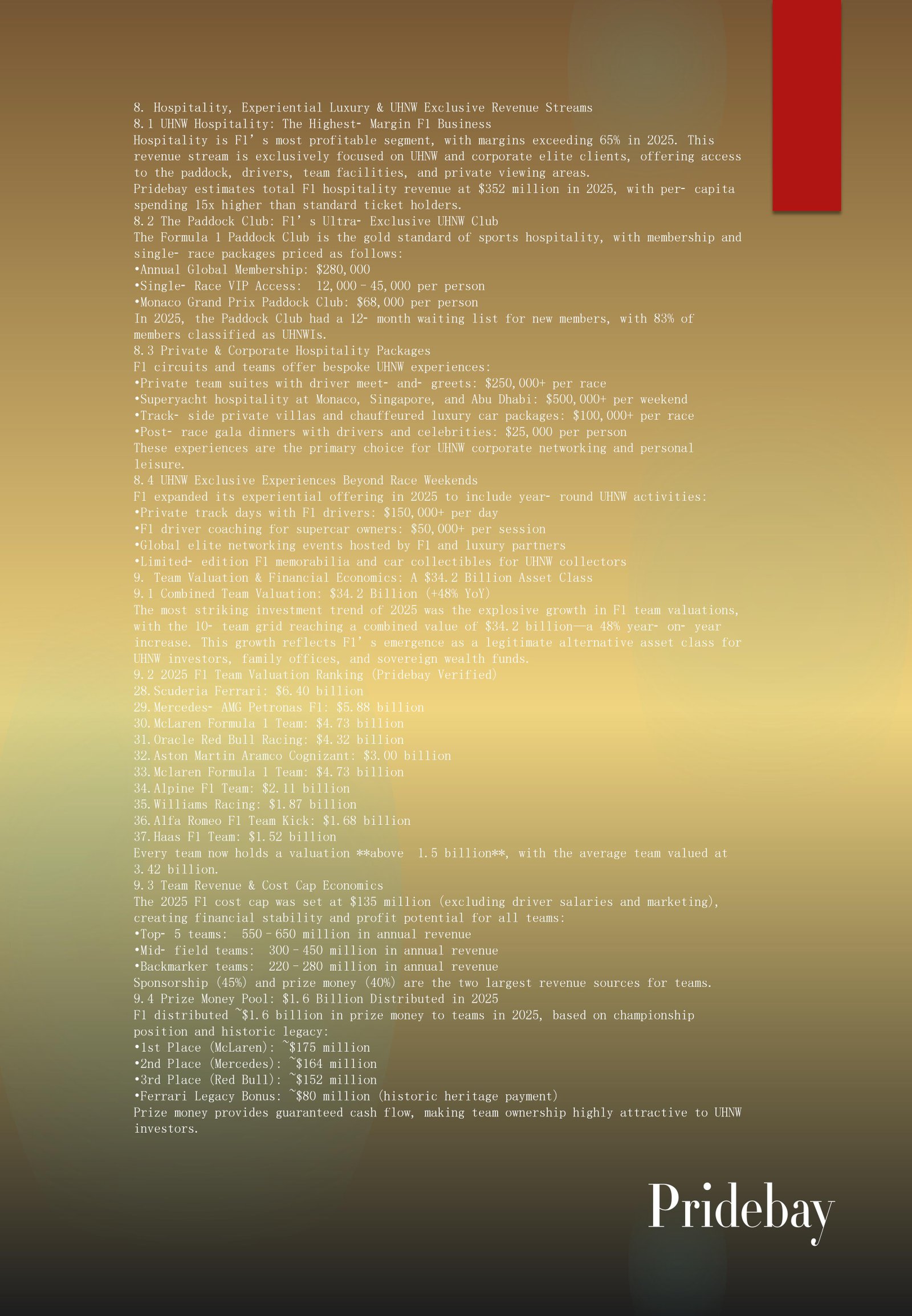
8. Hospitality, Experiential Luxury & UHNW Exclusive Revenue Streams
8.1 UHNW Hospitality: The Highest‑Margin F1 Business
Hospitality is F1’s most profitable segment, with margins exceeding 65% in 2025. This revenue stream is exclusively focused on UHNW and corporate elite clients, offering access to the paddock, drivers, team facilities, and private viewing areas.
Pridebay estimates total F1 hospitality revenue at $352 million in 2025, with per‑capita spending 15x higher than standard ticket holders.
8.2 The Paddock Club: F1’s Ultra‑Exclusive UHNW Club
The Formula 1 Paddock Club is the gold standard of sports hospitality, with membership and single‑race packages priced as follows:
- Annual Global Membership: $280,000
- Single‑Race VIP Access: 12,000–45,000 per person
- Monaco Grand Prix Paddock Club: $68,000 per person
In 2025, the Paddock Club had a 12‑month waiting list for new members, with 83% of members classified as UHNWIs.
8.3 Private & Corporate Hospitality Packages
F1 circuits and teams offer bespoke UHNW experiences:
- Private team suites with driver meet‑and‑greets: $250,000+ per race
- Superyacht hospitality at Monaco, Singapore, and Abu Dhabi: $500,000+ per weekend
- Track‑side private villas and chauffeured luxury car packages: $100,000+ per race
- Post‑race gala dinners with drivers and celebrities: $25,000 per person
These experiences are the primary choice for UHNW corporate networking and personal leisure.
8.4 UHNW Exclusive Experiences Beyond Race Weekends
F1 expanded its experiential offering in 2025 to include year‑round UHNW activities:
- Private track days with F1 drivers: $150,000+ per day
- F1 driver coaching for supercar owners: $50,000+ per session
- Global elite networking events hosted by F1 and luxury partners
- Limited‑edition F1 memorabilia and car collectibles for UHNW collectors
9. Team Valuation & Financial Economics: A $34.2 Billion Asset Class
9.1 Combined Team Valuation: $34.2 Billion (+48% YoY)
The most striking investment trend of 2025 was the explosive growth in F1 team valuations, with the 10‑team grid reaching a combined value of $34.2 billion—a 48% year‑on‑year increase. This growth reflects F1’s emergence as a legitimate alternative asset class for UHNW investors, family offices, and sovereign wealth funds.
9.2 2025 F1 Team Valuation Ranking (Pridebay Verified)
- Scuderia Ferrari: $6.40 billion
- Mercedes‑AMG Petronas F1: $5.88 billion
- McLaren Formula 1 Team: $4.73 billion
- Oracle Red Bull Racing: $4.32 billion
- Aston Martin Aramco Cognizant: $3.00 billion
- Mclaren Formula 1 Team: $4.73 billion
- Alpine F1 Team: $2.11 billion
- Williams Racing: $1.87 billion
- Alfa Romeo F1 Team Kick: $1.68 billion
- Haas F1 Team: $1.52 billion
Every team now holds a valuation **above 1.5 billion**, with the average team valued at 3.42 billion.
9.3 Team Revenue & Cost Cap Economics
The 2025 F1 cost cap was set at $135 million (excluding driver salaries and marketing), creating financial stability and profit potential for all teams:
- Top‑5 teams: 550–650 million in annual revenue
- Mid‑field teams: 300–450 million in annual revenue
- Backmarker teams: 220–280 million in annual revenue
Sponsorship (45%) and prize money (40%) are the two largest revenue sources for teams.
9.4 Prize Money Pool: $1.6 Billion Distributed in 2025
F1 distributed ~$1.6 billion in prize money to teams in 2025, based on championship position and historic legacy:
- 1st Place (McLaren): ~$175 million
- 2nd Place (Mercedes): ~$164 million
- 3rd Place (Red Bull): ~$152 million
- Ferrari Legacy Bonus: ~$80 million (historic heritage payment)
Prize money provides guaranteed cash flow, making team ownership highly attractive to UHNW investors.
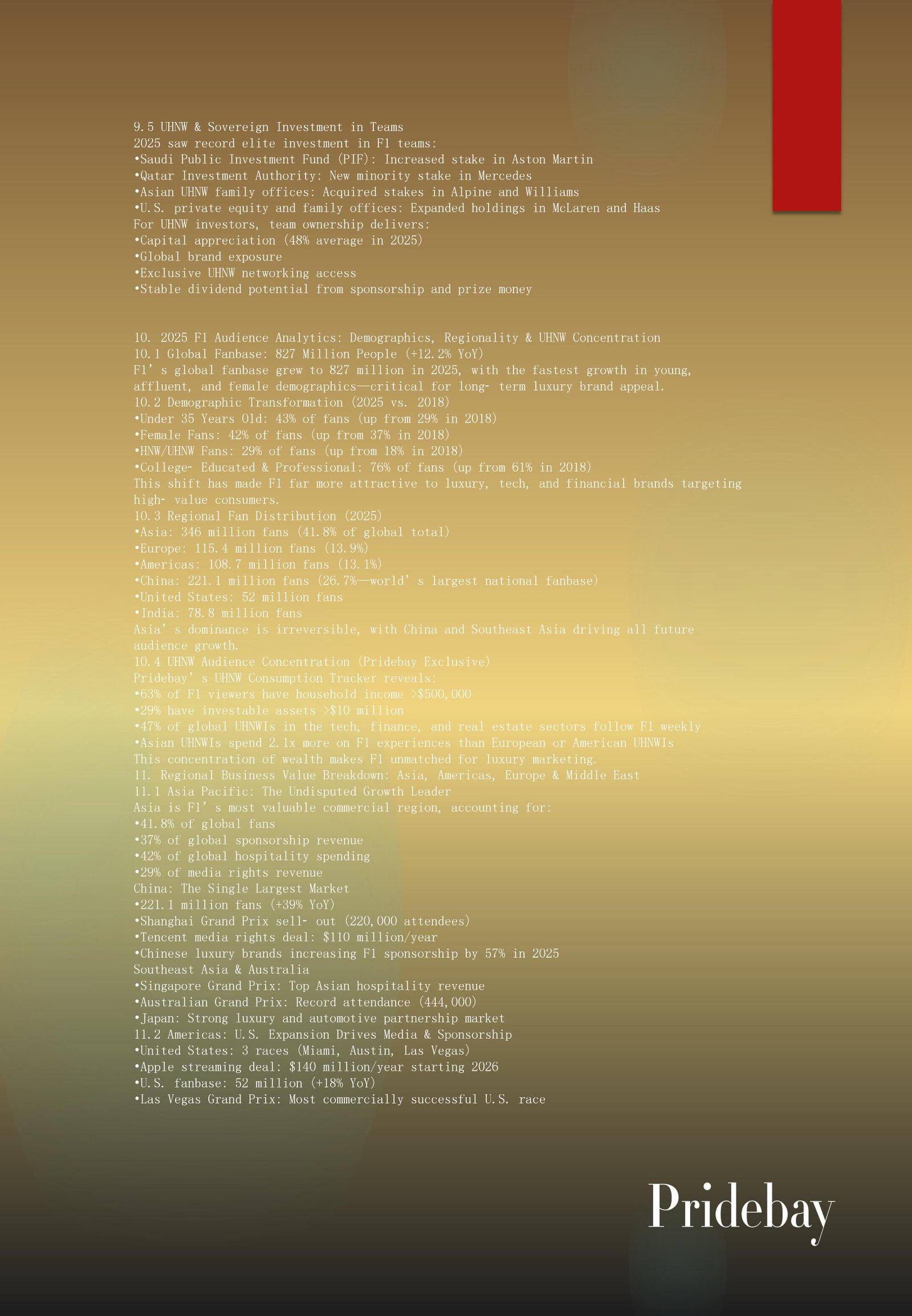
9.5 UHNW & Sovereign Investment in Teams
2025 saw record elite investment in F1 teams:
- Saudi Public Investment Fund (PIF): Increased stake in Aston Martin
- Qatar Investment Authority: New minority stake in Mercedes
- Asian UHNW family offices: Acquired stakes in Alpine and Williams
- U.S. private equity and family offices: Expanded holdings in McLaren and Haas
For UHNW investors, team ownership delivers:
- Capital appreciation (48% average in 2025)
- Global brand exposure
- Exclusive UHNW networking access
- Stable dividend potential from sponsorship and prize money
10. 2025 F1 Audience Analytics: Demographics, Regionality & UHNW Concentration
10.1 Global Fanbase: 827 Million People (+12.2% YoY)
F1’s global fanbase grew to 827 million in 2025, with the fastest growth in young, affluent, and female demographics—critical for long‑term luxury brand appeal.
10.2 Demographic Transformation (2025 vs. 2018)
- Under 35 Years Old: 43% of fans (up from 29% in 2018)
- Female Fans: 42% of fans (up from 37% in 2018)
- HNW/UHNW Fans: 29% of fans (up from 18% in 2018)
- College‑Educated & Professional: 76% of fans (up from 61% in 2018)
This shift has made F1 far more attractive to luxury, tech, and financial brands targeting high‑value consumers.
10.3 Regional Fan Distribution (2025)
- Asia: 346 million fans (41.8% of global total)
- Europe: 115.4 million fans (13.9%)
- Americas: 108.7 million fans (13.1%)
- China: 221.1 million fans (26.7%—world’s largest national fanbase)
- United States: 52 million fans
- India: 78.8 million fans
Asia’s dominance is irreversible, with China and Southeast Asia driving all future audience growth.
10.4 UHNW Audience Concentration (Pridebay Exclusive)
Pridebay’s UHNW Consumption Tracker reveals:
- 63% of F1 viewers have household income >$500,000
- 29% have investable assets >$10 million
- 47% of global UHNWIs in the tech, finance, and real estate sectors follow F1 weekly
- Asian UHNWIs spend 2.1x more on F1 experiences than European or American UHNWIs
This concentration of wealth makes F1 unmatched for luxury marketing.
11. Regional Business Value Breakdown: Asia, Americas, Europe & Middle East
11.1 Asia Pacific: The Undisputed Growth Leader
Asia is F1’s most valuable commercial region, accounting for:
- 41.8% of global fans
- 37% of global sponsorship revenue
- 42% of global hospitality spending
- 29% of media rights revenue
China: The Single Largest Market
- 221.1 million fans (+39% YoY)
- Shanghai Grand Prix sell‑out (220,000 attendees)
- Tencent media rights deal: $110 million/year
- Chinese luxury brands increasing F1 sponsorship by 57% in 2025
Southeast Asia & Australia
- Singapore Grand Prix: Top Asian hospitality revenue
- Australian Grand Prix: Record attendance (444,000)
- Japan: Strong luxury and automotive partnership market
11.2 Americas: U.S. Expansion Drives Media & Sponsorship
- United States: 3 races (Miami, Austin, Las Vegas)
- Apple streaming deal: $140 million/year starting 2026
- U.S. fanbase: 52 million (+18% YoY)
- Las Vegas Grand Prix: Most commercially successful U.S. race
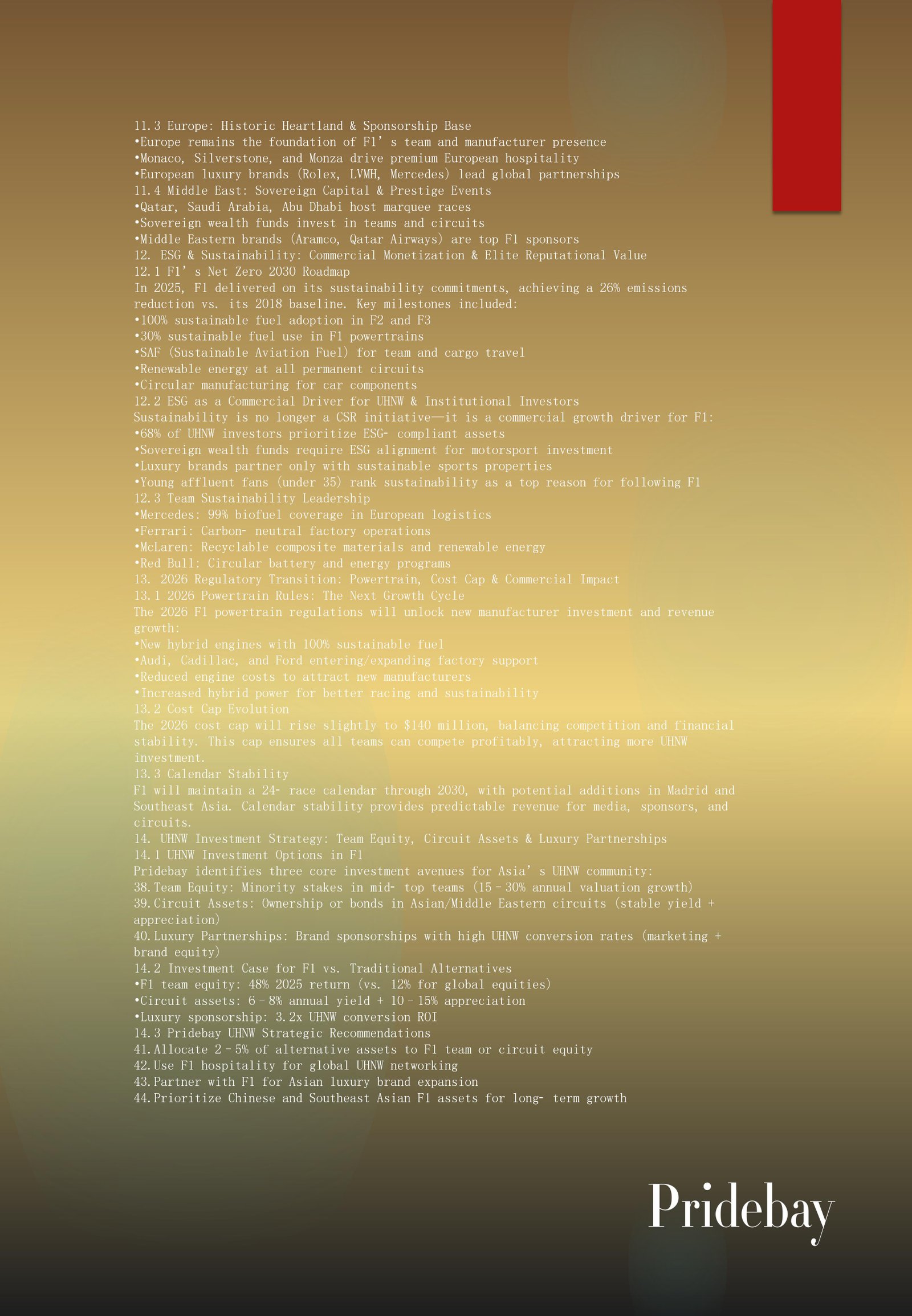
11.3 Europe: Historic Heartland & Sponsorship Base
- Europe remains the foundation of F1’s team and manufacturer presence
- Monaco, Silverstone, and Monza drive premium European hospitality
- European luxury brands (Rolex, LVMH, Mercedes) lead global partnerships
11.4 Middle East: Sovereign Capital & Prestige Events
- Qatar, Saudi Arabia, Abu Dhabi host marquee races
- Sovereign wealth funds invest in teams and circuits
- Middle Eastern brands (Aramco, Qatar Airways) are top F1 sponsors
12. ESG & Sustainability: Commercial Monetization & Elite Reputational Value
12.1 F1’s Net Zero 2030 Roadmap
In 2025, F1 delivered on its sustainability commitments, achieving a 26% emissions reduction vs. its 2018 baseline. Key milestones included:
- 100% sustainable fuel adoption in F2 and F3
- 30% sustainable fuel use in F1 powertrains
- SAF (Sustainable Aviation Fuel) for team and cargo travel
- Renewable energy at all permanent circuits
- Circular manufacturing for car components
12.2 ESG as a Commercial Driver for UHNW & Institutional Investors
Sustainability is no longer a CSR initiative—it is a commercial growth driver for F1:
- 68% of UHNW investors prioritize ESG‑compliant assets
- Sovereign wealth funds require ESG alignment for motorsport investment
- Luxury brands partner only with sustainable sports properties
- Young affluent fans (under 35) rank sustainability as a top reason for following F1
12.3 Team Sustainability Leadership
- Mercedes: 99% biofuel coverage in European logistics
- Ferrari: Carbon‑neutral factory operations
- McLaren: Recyclable composite materials and renewable energy
- Red Bull: Circular battery and energy programs
13. 2026 Regulatory Transition: Powertrain, Cost Cap & Commercial Impact
13.1 2026 Powertrain Rules: The Next Growth Cycle
The 2026 F1 powertrain regulations will unlock new manufacturer investment and revenue growth:
- New hybrid engines with 100% sustainable fuel
- Audi, Cadillac, and Ford entering/expanding factory support
- Reduced engine costs to attract new manufacturers
- Increased hybrid power for better racing and sustainability
13.2 Cost Cap Evolution
The 2026 cost cap will rise slightly to $140 million, balancing competition and financial stability. This cap ensures all teams can compete profitably, attracting more UHNW investment.
13.3 Calendar Stability
F1 will maintain a 24‑race calendar through 2030, with potential additions in Madrid and Southeast Asia. Calendar stability provides predictable revenue for media, sponsors, and circuits.
14. UHNW Investment Strategy: Team Equity, Circuit Assets & Luxury Partnerships
14.1 UHNW Investment Options in F1
Pridebay identifies three core investment avenues for Asia’s UHNW community:
- Team Equity: Minority stakes in mid‑top teams (15–30% annual valuation growth)
- Circuit Assets: Ownership or bonds in Asian/Middle Eastern circuits (stable yield + appreciation)
- Luxury Partnerships: Brand sponsorships with high UHNW conversion rates (marketing + brand equity)
14.2 Investment Case for F1 vs. Traditional Alternatives
- F1 team equity: 48% 2025 return (vs. 12% for global equities)
- Circuit assets: 6–8% annual yield + 10–15% appreciation
- Luxury sponsorship: 3.2x UHNW conversion ROI
14.3 Pridebay UHNW Strategic Recommendations
- Allocate 2–5% of alternative assets to F1 team or circuit equity
- Use F1 hospitality for global UHNW networking
- Partner with F1 for Asian luxury brand expansion
- Prioritize Chinese and Southeast Asian F1 assets for long‑term growth
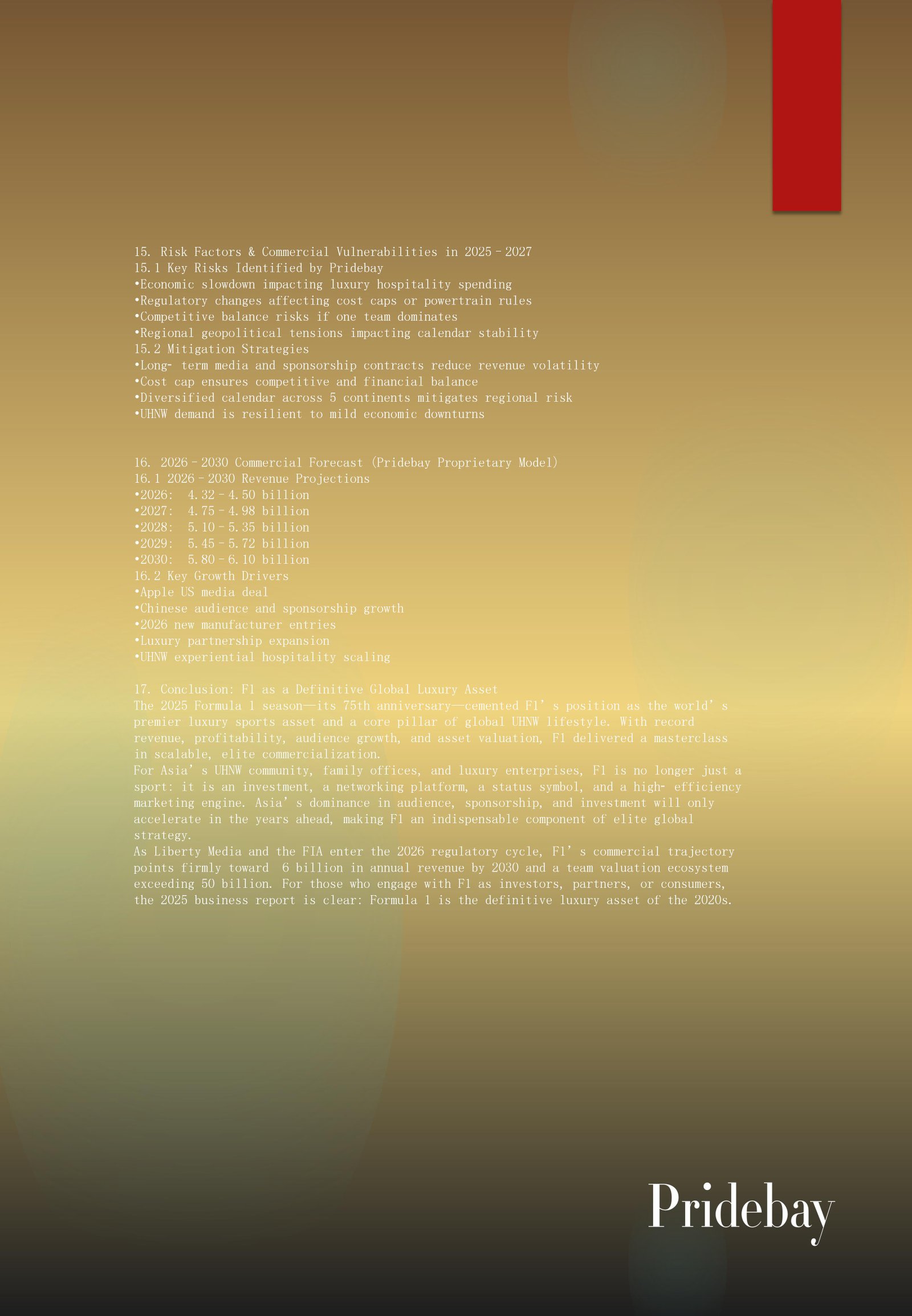
15. Risk Factors & Commercial Vulnerabilities in 2025–2027
15.1 Key Risks Identified by Pridebay
- Economic slowdown impacting luxury hospitality spending
- Regulatory changes affecting cost caps or powertrain rules
- Competitive balance risks if one team dominates
- Regional geopolitical tensions impacting calendar stability
15.2 Mitigation Strategies
- Long‑term media and sponsorship contracts reduce revenue volatility
- Cost cap ensures competitive and financial balance
- Diversified calendar across 5 continents mitigates regional risk
- UHNW demand is resilient to mild economic downturns
16. 2026–2030 Commercial Forecast (Pridebay Proprietary Model)
16.1 2026–2030 Revenue Projections
- 2026: 4.32–4.50 billion
- 2027: 4.75–4.98 billion
- 2028: 5.10–5.35 billion
- 2029: 5.45–5.72 billion
- 2030: 5.80–6.10 billion
16.2 Key Growth Drivers
- Apple US media deal
- Chinese audience and sponsorship growth
- 2026 new manufacturer entries
- Luxury partnership expansion
- UHNW experiential hospitality scaling
17. Conclusion: F1 as a Definitive Global Luxury Asset
The 2025 Formula 1 season—its 75th anniversary—cemented F1’s position as the world’s premier luxury sports asset and a core pillar of global UHNW lifestyle. With record revenue, profitability, audience growth, and asset valuation, F1 delivered a masterclass in scalable, elite commercialization.
For Asia’s UHNW community, family offices, and luxury enterprises, F1 is no longer just a sport: it is an investment, a networking platform, a status symbol, and a high‑efficiency marketing engine. Asia’s dominance in audience, sponsorship, and investment will only accelerate in the years ahead, making F1 an indispensable component of elite global strategy.
As Liberty Media and the FIA enter the 2026 regulatory cycle, F1’s commercial trajectory points firmly toward 6 billion in annual revenue by 2030 and a team valuation ecosystem exceeding 50 billion. For those who engage with F1 as investors, partners, or consumers, the 2025 business report is clear: Formula 1 is the definitive luxury asset of the 2020s.