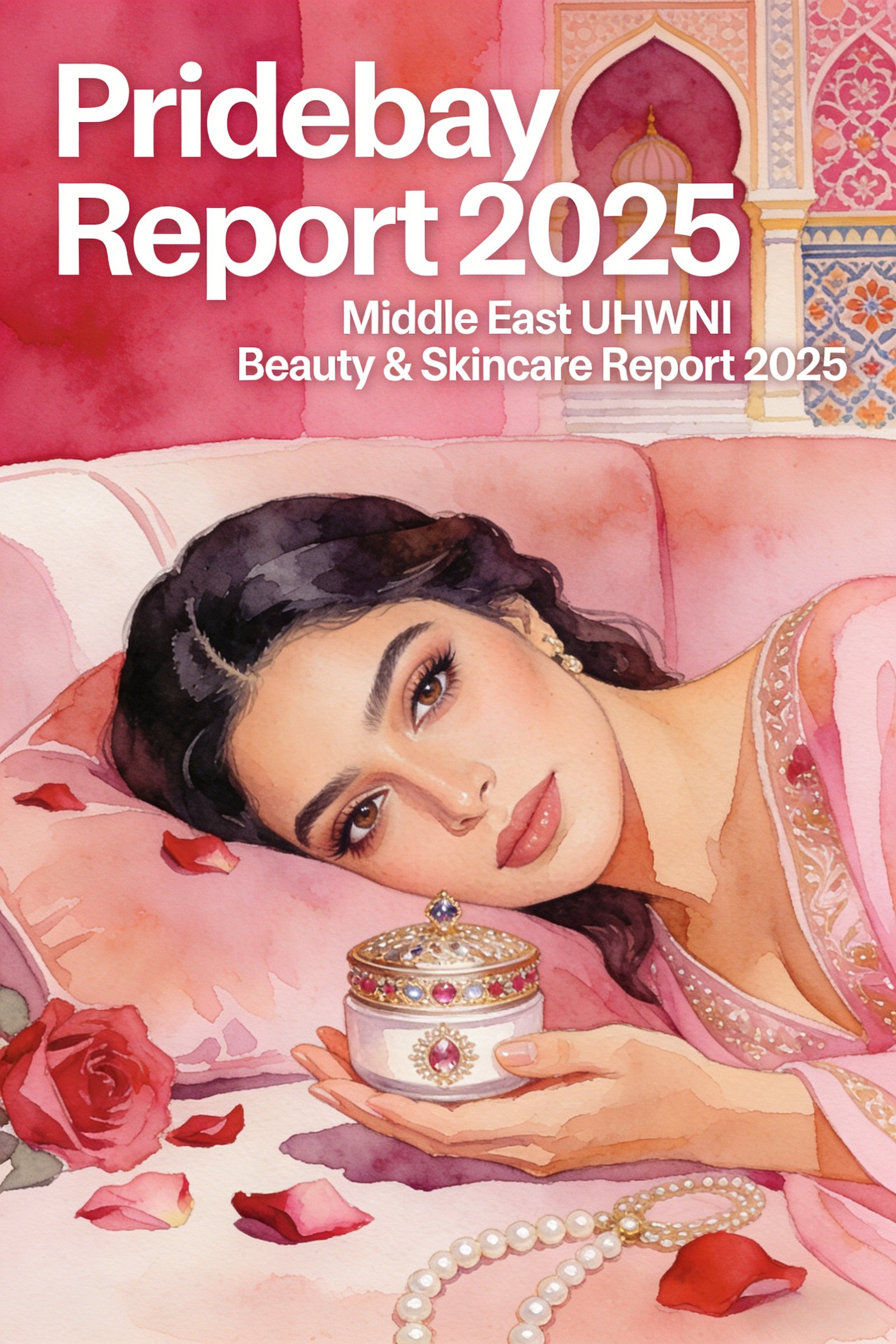
Middle East UHNWI Beauty & Skincare Report 2025
Issued by: Pridebay Asia
Executive Summary
The Middle Eastern beauty and skincare market is experiencing robust growth, driven by rising disposable income, cultural beauty consciousness, and the expanding influence of ultra-high-net-worth individuals (UHNWIs, net worth ≥ US$30 million). In 2025, the regional beauty and personal care market is projected to reach US$60 billion, with the premium segment—dominated by UHNWIs—growing at a compound annual growth rate (CAGR) of 8%, outpacing the overall market . UHNWIs in the UAE and Saudi Arabia (KSA), the core markets of the region, lead consumption with an annual per capita spending of US$700-900 on beauty and skincare products, twice the global average .
Key defining trends include: a shift towards efficacy-driven premium skincare (anti-aging and sun protection categories account for 45% of UHNW spending); the rise of A-Beauty (Arab Beauty) emphasizing cultural identity and indigenous ingredients; surging demand for personalized and experiential beauty services; and the growing influence of social media on purchase decisions (80% of UHNW skincare purchases are influenced by beauty content creators) . For Pridebay Asia’s high-net-worth clients, this market presents significant opportunities: collaborating on product localization (e.g., halal-certified and alcohol-free formulations), leveraging cross-border e-commerce channels, and co-developing premium customized beauty solutions. As the Middle Eastern UHNW beauty market continues to prioritize efficacy, cultural authenticity, and exclusivity, it is solidifying its position as a high-value destination for global luxury beauty brands and investors.
1. Market Overview: Scale, Drivers, and Regional Dynamics
1.1 Overall Market Scale and UHNW Contribution
The Middle East and North Africa (MENA) beauty and personal care market has exceeded US$46 billion and is forecast to climb to US$60 billion by the end of 2025 . Within this, the premium skincare market in the UAE alone is valued at US$1.5 billion, driven by strong demand from affluent residents and high-end tourists . UHNWIs account for approximately 15% of the total market revenue but contribute 35% of sales in the luxury segment (products priced above US$200 per unit), particularly in categories such as high-end anti-aging skincare, niche fragrances, and customized color cosmetics .
The per capita beauty consumption of Middle Eastern UHNWIs is significantly higher than the global average. Their spending on beauty and skincare is 2-3 times that of Chinese high-net-worth individuals, with a strong preference for luxury packaging, full-coverage base makeup, and high-efficacy skincare products . This consumption power is underpinned by rising disposable income: the average per capita disposable income in the UAE is projected to reach AED 130,000 (≈US$35,400) in 2025, a 5% year-on-year increase .
1.2 Core Market Dynamics: UAE and Saudi Arabia
Dubai and Abu Dhabi dominate the UAE’s premium beauty market, benefiting from their status as global commercial and tourist hubs. The presence of numerous luxury retail outlets, high-end beauty salons, and duty-free shopping centers (e.g., Dubai International Airport) creates a robust ecosystem for premium beauty consumption . In Saudi Arabia, driven by Vision 2030 initiatives and growing female workforce participation, the beauty market is experiencing accelerated growth, with women accounting for 75% of UHNW beauty spending .
Regional demographic characteristics further fuel market growth: over 60% of the population in the UAE and KSA is under 30, and this young, digitally literate cohort not only drives consumption but also leads beauty trends . Additionally, the high expatriate population (over 80% in the UAE) creates demand for globally recognized luxury brands that emphasize efficacy and regulatory compliance .
1.3 Policy and Regulatory Drivers
Government regulations are fostering a more trustworthy market environment. In 2023, the UAE implemented strict regulations on the skincare industry, including mandatory ingredient labeling and safety standard certifications . These measures enhance consumer confidence in premium products, particularly benefiting luxury brands that prioritize transparency. Furthermore, religious and cultural norms have led to strict requirements on product ingredients (e.g., alcohol-free formulations) and packaging (avoiding black and purple), guiding brand innovation in the region .
2. Core Trends Reshaping UHNW Beauty & Skincare Consumption
2.1 Efficacy-Driven Premium Skincare: Anti-Aging and Sun Protection as Priorities
Middle Eastern UHNWIs are shifting from "cosmetic coverage" to "skin longevity investment," driving strong demand for efficacy-driven premium skincare. Anti-aging products account for 35% of the high-end skincare market, making it the most valuable segment . Sun protection is another core category, with the UAE and KSA sun care market exceeding US$500 million and growing at an annual rate of 8-10% . UHNWIs prioritize products with scientifically proven ingredients (e.g., retinol, hyaluronic acid) and clinical test certifications, willing to pay a premium for visible results .
2.2 Rise of A-Beauty: Cultural Identity and Indigenous Ingredients
A-Beauty (Arab Beauty), a trend emphasizing cultural identity and indigenous ingredients, is driving industry growth in the Middle East and Africa, with the segment expected to reach US$44 billion in 2025 . UHNWIs are increasingly favoring products that align with Arab beauty ideals, such as those incorporating oud, frankincense, rose, and other local ingredients suited to regional skin concerns (e.g., dryness and uneven skin tone) . This trend reflects a shift from following global beauty standards to celebrating unique cultural features, such as prominent eyes and bold brows .
2.3 Personalization and Experiential Consumption
UHNWIs in the Middle East demand personalized beauty solutions and exclusive experiences. Luxury brands are responding with customized services: for example, Valentino Beauty launched its "Anatomy of Dreams" haute perfumery collection at Dubai Duty Free, offering fragrance layering with two enhancers to create up to 16 unique scent combinations . The launch also included personalized services such as calligraphy and fragrance engraving, transforming purchases into bespoke experiences . High-end beauty salons in Dubai and Abu Dhabi also offer tailor-made skincare treatments, with private consultation services accounting for 25% of their revenue .
2.4 Digital Transformation and Social Media Influence
Digital channels are reshaping UHNW beauty consumption behavior. E-commerce sales of skincare products are growing rapidly, with online platforms becoming an important channel for premium brand purchases . Social media plays a decisive role: 80% of UHNW skincare purchase decisions are influenced by beauty content creators on TikTok, Instagram, and YouTube . These influencers not only drive product awareness but also foster high conversion rates by sharing detailed efficacy reviews and cultural beauty routines .
2.5 Emerging Male Beauty Market
The male beauty segment is expanding rapidly, with brands increasingly targeting male UHNWIs with tailored products. In the UAE, the male premium skincare segment is growing at a CAGR of 10%, driven by rising grooming awareness and changing social norms . Male UHNWIs focus on anti-aging, oil-control, and sun protection products, with a preference for minimalist packaging and fragrance-free formulations .
2. Key Consumption Behavior of UHNWIs
2.1 Category Preference
Fragrances: The largest segment in the Middle Eastern beauty market, growing at an 11% CAGR. UHNWIs favor niche and haute perfumery, with oud-based and rose-scented fragrances being particularly popular .
Skincare: Anti-aging products (35% of high-end skincare sales) and sun protection (8-10% annual growth) are top priorities. Hydrating products suited to the arid climate also see strong demand .
Color Cosmetics: Eye makeup is the fastest-growing sub-segment (12% CAGR), with Saudi women owning an average of 3-5 eyeliners. Full-coverage base makeup and long-wearing formulations are preferred .
2.2 Channel Preference
UHNWIs adopt an omni-channel consumption approach: 1. Luxury Retail Outlets and Duty-Free Stores: Dubai International Airport and luxury malls in Dubai and Abu Dhabi are key purchase channels, offering exclusive product launches and personalized experiences (e.g., Valentino’s "Anatomy of Dreams" activation) . 2. E-Commerce Platforms: Online sales of premium beauty products are growing, with platforms like Ounass and Namshi gaining traction. UHNWIs use digital channels for research and pre-purchase, with 25% completing transactions online . 3. High-End Beauty Salons and Private Consultations: Exclusive salons offering customized treatments and one-on-one beauty consultations are popular, with UHNWIs willing to pay US$500+ for a single premium skincare session .
3. Key Players: Brand Ecosystem and Competitive Landscape
3.1 International Luxury Brands
International luxury brands dominate the Middle Eastern UHNW beauty market, with a focus on localization and experiential marketing. Valentino Beauty, L’Oréal’s luxury division, and La Mer are among the top choices, known for their premium formulations, exclusive packaging, and cultural adaptation (e.g., alcohol-free options) . These brands often launch limited-edition collections in the Middle East, leveraging regional cultural elements (e.g., oud, rose) to enhance appeal .
3.2 Local A-Beauty Brands
Local A-Beauty brands are gaining momentum by emphasizing cultural identity and indigenous ingredients. These brands focus on addressing regional skin concerns (dryness, uneven skin tone) and complying with halal and alcohol-free requirements . They resonate with UHNWIs seeking cultural authenticity, with some local brands achieving annual growth rates of 15-20% .
3.3 Retail and Service Providers
Chalhoub Group, a leading luxury retail and distribution company in the Middle East, plays a key role in the beauty ecosystem, representing numerous international luxury brands and operating premium beauty stores across the region . High-end beauty salons such as Saks Fifth Avenue Beauty Salon and local luxury spas also contribute to the ecosystem, offering exclusive treatments and personalized services tailored to UHNW needs .
4. Asia-Middle East Collaboration Opportunities for High-Net-Worth Clients
4.1 Product Localization and Innovation
Asian high-net-worth clients and beauty brands can leverage their expertise in premium formulation and manufacturing to develop products tailored to the Middle Eastern market: 1. Halal-Certified and Alcohol-Free Formulations: Develop premium skincare and color cosmetics complying with regional religious norms, addressing the high demand for alcohol-free and halal products . 2. Adapt to Regional Skin Concerns: Create hydrating, anti-aging, and sun protection products suited to the arid climate and local skin tones . 3. Cultural Aesthetic Alignment: Design packaging avoiding black and purple, incorporating regional cultural elements (e.g., gold, geometric patterns) to enhance brand resonance .
4.2 Cross-Border E-Commerce and Retail Partnerships
Leverage the growing e-commerce trend in the Middle East by partnering with local premium e-commerce platforms (e.g., Ounass) or establishing cross-border e-commerce channels . Asian brands can also collaborate with regional luxury retailers like Chalhoub Group to gain access to prime retail locations in Dubai and Abu Dhabi, tapping into the high foot traffic of UHNWIs and luxury tourists .
4.3 Co-Development of Personalized Beauty Solutions
Collaborate with local beauty salons and technology companies to develop personalized beauty services for UHNWIs, such as AI-driven skincare diagnosis, customized fragrance blending, and bespoke skincare formulations . Drawing on Asia’s advanced beauty technology and digital expertise, these collaborative solutions can meet the growing demand for exclusivity and personalization in the Middle Eastern market .
5. Challenges and Future Outlook (2025-2030)
5.1 Key Challenges
Cultural and Regulatory Barriers: Strict requirements on product ingredients (alcohol-free, halal certification) and packaging aesthetics require significant investment in localization. Navigating regional regulatory frameworks (e.g., UAE’s ingredient labeling requirements) also poses challenges for new entrants .
Intense Market Competition: The market is dominated by established international luxury brands, making it difficult for new brands to gain market share. Local A-Beauty brands are also expanding rapidly, intensifying competition .
Rapidly Evolving Consumer Preferences: UHNW beauty preferences are highly influenced by social media and trend cycles, requiring brands to maintain agility in product innovation and marketing strategies .
5.2 Future Projections
The Middle Eastern UHNW beauty and skincare market is projected to grow at a CAGR of 9% between 2025 and 2030, reaching US$28 billion by 2030 . Key growth drivers include: continued economic diversification (e.g., Saudi Vision 2030), rising female disposable income, and the expanding influence of digital channels . The A-Beauty trend will continue to gain momentum, with local ingredients and cultural storytelling becoming key differentiators .
Technological innovation will further reshape the market: AI-driven personalized beauty solutions, virtual try-on technologies, and digital-first customer experiences will become standard . Cross-regional collaboration between Asia and the Middle East is expected to deepen, with Asian brands bringing advanced formulation and digital expertise to the region, while Middle Eastern markets offer high-value consumption opportunities .
6. Conclusion
The 2025 Middle Eastern UHNW beauty and skincare market is a high-growth, high-value sector driven by efficacy consciousness, cultural identity, and demand for exclusivity. UHNWIs in the UAE and Saudi Arabia lead consumption, with strong preferences for premium skincare, niche fragrances, and personalized experiences. For Pridebay Asia’s high-net-worth clients, this market presents unique opportunities to engage through product localization, cross-border e-commerce partnerships, and co-developed personalized solutions .
While cultural and regulatory challenges exist, the market’s robust growth fundamentals and evolving consumer needs create fertile ground for collaboration. By leveraging Asian expertise in beauty technology, manufacturing, and digital innovation, and aligning with regional cultural norms and consumption preferences, Asian high-net-worth clients and brands can successfully tap into this dynamic market, creating mutually beneficial value in the global luxury beauty ecosystem.