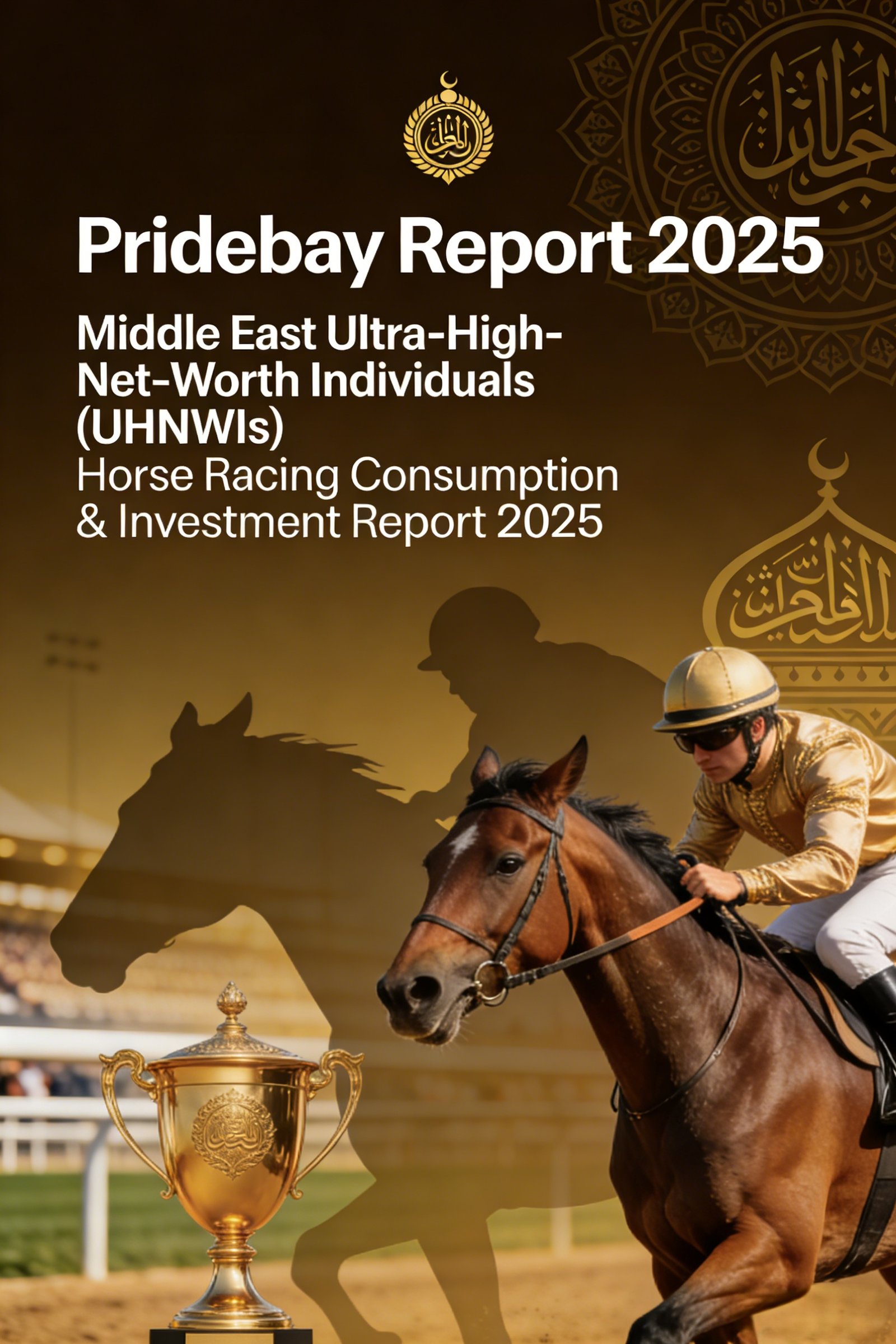
Middle East Ultra-High-Net-Worth Individuals (UHNWIs) Horse Racing Consumption & Investment Report 2025
Issued by: Pridebay Asia
Executive Summary
The Middle East has emerged as a global powerhouse in the luxury equestrian sector, with UHNWIs driving unprecedented growth through record-breaking (events), strategic cross-border investments, and sovereign-backed infrastructure development. The GCC equestrian market is valued at USD 4.2 billion in 2025, projected to expand at a CAGR of 12.5% through 2030—fueled by Saudi Arabia’s Vision 2030, Dubai’s status as a global racing hub, and Qatar’s strategic partnerships with Asian investors . Middle Eastern UHNWIs (over 8,100 in the GCC) allocate 3-7% of their investment portfolios to equestrian assets, with average annual spending on horse purchases, training, and participation exceeding USD 1.5 million per individual . Key trends shaping the market include: the rise of billion-dollar prize pools (exemplified by the $20 million Saudi Cup and $30.5 million Dubai World Cup), cross-continental breeding and racing partnerships (notably between Middle Eastern and Asian entities), sovereign wealth fund investments in equestrian real estate (e.g., Abu Dhabi’s Modon Holding’s Florida acquisition), and the integration of equestrian sports with luxury lifestyle ecosystems (fashion, tourism, high-end real estate). Visionary patrons such as Dubai’s Al Maktoum family (founders of Godolphin, the world’s largest thoroughbred operation) and Qatar’s Sheikh Fahad Al Thani are redefining the global equestrian landscape, while initiatives like Saudi Arabia’s JAX District equestrian developments solidify the region’s position as a leader in the sport. For Pridebay Asia’s clients, this dynamic ecosystem offers unparalleled opportunities to access exclusive racing circuits, forge cross-border investment partnerships, and align with a legacy-rich industry that blends cultural prestige, athletic excellence, and robust returns.
1. Market Overview: Size, Growth, and Strategic Drivers
1.1 Market Scale and Wealth Dynamics
- UHNW Investment Power: The GCC’s 8,100+ UHNWIs control combined assets of USD 2.4 trillion, with 3-7% dedicated to equestrian investments—translating to annual sector spending of USD 7.2-16.8 billion . Dubai alone is home to 81,200 millionaires (a 12% YoY increase in 2025), with 33% of regional UHNWIs actively seeking equestrian-related investments . The average cost of acquiring a competitive racehorse exceeds USD 1 million, with top-tier yearlings fetching up to USD 400,000 at auction and elite breeding stock commanding seven-figure sums .
- Sovereign-Backed Growth: Saudi Arabia’s Vision 2030 has identified equestrian sports as a cornerstone of its cultural and economic diversification strategy, with government funding supporting the development of world-class facilities, training academies, and international 赛事 . The Saudi equestrian market, valued at tens of millions USD in 2023, is projected to expand significantly through 2030, driven by policy support and private sector investment . In the UAE, the government has invested over USD 30 billion in iconic facilities like Dubai’s Meydan Racecourse (620 hectares, 60,000 spectator capacity), which hosts the annual Dubai World Cup—now the world’s richest racing event with USD 30.5 million in total prize money .
- Tourism and Economic Impact: Equestrian 赛事 acts as a powerful economic catalyst. The 2023 Dubai World Cup generated over USD 4 billion in ancillary economic activity, driving tourism, luxury retail, and hospitality spending . Race week sees five-star hotel prices in Dubai surge by 240% (average rates reaching USD 760/night), with 45+ international broadcast partners covering 150 countries—amplifying the region’s global profile .
1.2 Key Growth Engines
- Record-Breaking Prize Pools: The Middle East dominates the global racing circuit with unrivaled prize money. The 2025 Saudi Cup offers a USD 20 million purse (USD 10 million to the winner), surpassing the Dubai World Cup’s USD 12 million headline race prize . Even 10th-place finishers in the Saudi Cup earn USD 200,000, creating strong incentives for UHNWIs to invest in competitive bloodlines .
- Infrastructure Expansion: Saudi Arabia is developing dedicated equestrian districts (e.g., JAX District in Diriyah) as part of its Vision 2030, while the UAE’s Modon Holding has made its first US equestrian investment—partnering to transform Florida’s Wellington International into a luxury mixed-use equestrian destination . This USD 500 million+ project attracts 250,000 annual visitors and exemplifies the region’s cross-border expansion strategy .
- Cultural and Social Prestige: Equestrian sports hold deep cultural significance in the Middle East, with horse ownership long regarded as a symbol of nobility and success. For modern UHNWIs, participation in elite racing circuits serves as a high-status social currency, with events like the Dubai World Cup doubling as fashion showcases (featuring “Style Championships” with USD 50,000 in prizes) and networking hubs for global wealth .
2. Core Consumption & Investment Trends Among UHNWIs
2.1 High-Stakes Horse Acquisition and Ownership
- Elite Bloodline Investment: UHNWIs prioritize thoroughbreds with proven racing or breeding potential. Dubai’s ruler, Sheikh Mohammed bin Rashid Al Maktoum, famously purchased a 1-year-old colt for over USD 400,000, while top-tier yearlings at auctions like Goffs Orby Sale command prices up to €190,000 (USD 205,000) for promising colts . The 2025 Tattersalls December Foal Sale saw a record median price of 30,500 guineas (USD 42,395), with a Frankel colt selling for 1.15 million guineas (USD 1.6 million)—reflecting strong demand for premium bloodlines .
- Ownership Models: UHNWIs adopt diverse ownership structures, including sole ownership (for elite racehorses), syndications (reducing risk while maintaining prestige), and joint ventures with international partners. Qatar Racing’s ongoing partnership with China Horse Club (CHC) exemplifies cross-continental collaboration—jointly purchasing yearlings and competing in global 赛事 like the Dubai World Cup .
- Operational Expenditure: Beyond acquisition, UHNWIs incur substantial annual costs: training fees (USD 50,000-100,000/horse), international transport (USD 10,000+ per trip), veterinary care, insurance, and jockey fees (10% of prize money for winning rides—up to USD 1 million for Saudi Cup victories) .
2.2 Cross-Border Investment and Global Expansion
- International Real Estate and Facilities: Middle Eastern investors are expanding beyond regional borders. Abu Dhabi’s Modon Holding’s investment in Florida’s Wellington International (the “global epicenter of equestrian sport”) signals a strategic shift toward experience-led real estate assets . This move follows Dubai UHNWIs’ growing interest in global equestrian properties, with 68% of surveyed wealthy investors expressing interest in Dubai’s equestrian-linked real estate (e.g., Palm Jumeirah, Emirates Hills) .
- Breeding and Training Networks: UHNWIs are building global breeding portfolios, combining Middle Eastern expertise in Arabian horses with thoroughbred breeding operations in Europe, the US, and Asia. Godolphin’s global network of stud farms (including in Ireland, the US, and Australia) serves as a model, producing champion racehorses that compete internationally while maintaining brand prestige .
- Asian-Middle Eastern Partnerships: Collaborations between Middle Eastern and Asian entities are on the rise. Qatar Racing and China Horse Club’s longstanding partnership has yielded successful racehorses and profitable sales (e.g., a Dubawi yearling colt sold for €1.4 million in 2018) . These alliances leverage Asian capital and Middle Eastern racing expertise, creating win-win opportunities for UHNWIs in both regions .
2.3 Equestrian as Luxury Lifestyle Ecosystem
- Fashion and Social Integration: Elite racing events are premier fashion occasions. The Dubai World Cup’s Style Championships offer prizes for best attire (including “Most Creative Hat”), with designs inspired by regional projects like Saudi Arabia’s The Line . UHNW attendees spend an average of USD 20,000+ on race-day couture, accessories, and private styling—blending athletic spectacle with luxury display .
- Hospitality and Experiential Luxury: Private hospitality is a key consumption driver. Meydan Racecourse’s Sky Bubble VIP lounge (4,500 capacity) offers exclusive viewing, gourmet dining, and networking opportunities, with corporate hospitality packages costing up to USD 50,000 . UHNWIs also invest in equestrian-themed travel, including private tours of breeding farms, training facilities, and international 赛事 .
- Collectibles and Memorabilia: Rare equestrian collectibles (jockey silks, winning trophies, vintage racing art) have emerged as alternative assets. Limited-edition items from iconic races like the Saudi Cup or Dubai World Cup command premium prices at auction, appealing to UHNWIs seeking to preserve racing legacy .
2.4 Technology and Innovation Adoption
- Data-Driven Training: UHNWIs are integrating smart technologies into horse care and training. Saudi Arabia’s equestrian sector is adopting intelligent training systems and data analytics tools to optimize performance, reduce injury risk, and enhance breeding outcomes . Wearable devices for horses (tracking heart rate, movement, and health metrics) are becoming standard for elite stables .
- Blockchain for Provenance: Blockchain technology is addressing a critical industry challenge—verifying bloodlines and ownership history. Middle Eastern racing authorities are exploring blockchain solutions to ensure transparency in horse transactions, a key concern for UHNW investors in high-value equine assets .
- Virtual Engagement: Digital platforms are expanding access to the sport. Virtual viewing parties, 3D tours of racecourses, and AI-powered race predictions cater to tech-savvy younger UHNWIs, complementing traditional in-person experiences .
3. Key Players, Partnerships, and Ecosystem
3.1 Visionary UHNW Collectors and Royal Patrons
- Al Maktoum Family (Dubai): Founders of Godolphin, the world’s largest thoroughbred racing and breeding operation. Sheikh Mohammed bin Rashid Al Maktoum’s personal stable includes champion racehorses, and his investment in Meydan Racecourse has redefined global racing standards .
- Sheikh Fahad Al Thani (Qatar): A leading international racing figure, Sheikh Fahad’s Qatar Racing has forged groundbreaking partnerships with Asian entities like China Horse Club, competing in premier 赛事 worldwide and driving cross-continental equestrian collaboration .
- Saudi Royal Family: Key backers of Saudi Arabia’s equestrian expansion, supporting events like the Saudi Cup and infrastructure projects aligned with Vision 2030. Their patronage has elevated Saudi Arabia from a regional player to a global racing powerhouse .
3.2 Sovereign Wealth Funds and Institutional Investors
- Public Investment Fund (PIF, Saudi Arabia): The USD 9.13 trillion fund is investing in equestrian infrastructure as part of Vision 2030, supporting the development of training academies, racecourses, and breeding facilities to grow the sector .
- Modon Holding (Abu Dhabi): The Abu Dhabi-listed entity’s investment in Florida’s Wellington International marks a strategic move into global equestrian real estate, diversifying its portfolio with high-value, experience-led assets .
- Dubai Racing Club: Organizer of the Dubai World Cup, the club drives the emirate’s racing ecosystem through world-class event management, broadcast partnerships, and tourism integration .
3.3 Global Partnerships and Cross-Continental Alliances
- Qatar Racing x China Horse Club: A longstanding collaboration that has jointly purchased yearlings, competed in global 赛事 (including the Dubai World Cup), and achieved record-breaking sales at auctions like Arqana . This partnership serves as a model for Middle Eastern-Asian equestrian collaboration .
- Goffs x Middle Eastern Buyers: Leading auction house Goffs has established strong ties with Middle Eastern UHNWIs, facilitating high-value yearling purchases and breeding stock acquisitions. The 2022 Goffs Orby Sale saw Qatar Racing and China Horse Club jointly acquire a €190,000 colt, highlighting the role of auctions in cross-border deals .
- IFHA and Regional Authorities: The International Federation of Horseracing Authorities (IFHA) collaborates with GCC racing bodies to standardize regulations, enhance horse safety, and promote the region’s 赛事 globally . The Asian Racing Federation (ARF) further connects Middle Eastern and Asian racing ecosystems, with permanent seats for Hong Kong, Japan, and Australia on the IFHA Executive Council .
4. Investment Channels and Consumer Journey
4.1 Auctions and Private Sales
- Premier Auction Houses: Tattersalls, Goffs, and Arqana are primary channels for acquiring elite racehorses and breeding stock. The 2025 Tattersalls December Foal Sale achieved a record median price, with Middle Eastern buyers accounting for 25% of top-tier purchases . Auctions offer transparency, pedigree verification, and access to globally recognized bloodlines .
- Private Transactions: For ultra-exclusive horses, UHNWIs engage in private sales facilitated by specialized brokers. These discreet transactions often involve seven-figure sums and include 附加 services (training contracts, transport arrangements, and insurance packages) .
- Syndications and Clubs: Equestrian syndicates (e.g., Godolphin Syndicates) allow UHNWIs to co-own racehorses, reducing individual risk while maintaining access to elite racing circuits. Syndications also provide networking opportunities with like-minded investors .
4.2 赛事 Participation and Hospitality
- Global Racing Circuits: UHNWIs compete in a year-round calendar of premier 赛事,including the Saudi Cup (January), Dubai World Cup (March), and European classics (June-August). Participation requires significant upfront investment but offers substantial prize money and prestige .
- VIP Hospitality and Networking: Private boxes, exclusive lounges (e.g., Meydan’s Sky Bubble), and post-race events are critical for UHNW engagement. These experiences combine sport with high-level networking, with 70% of attendees citing “business relationship building” as a key motivation .
- Sponsorship and Brand Alignment: UHNWIs and their businesses sponsor races, jockeys, or teams to enhance brand visibility. Sponsorship packages for events like the Dubai World Cup include naming rights, VIP hospitality, and global media exposure .
4.3 Real Estate and Infrastructure Investment
- Equestrian-Linked Properties: UHNWIs invest in luxury real estate with equestrian amenities, including private stables, training tracks, and proximity to racecourses. Dubai’s Emirates Hills and Palm Jumeirah are top markets, with properties commanding premium prices due to their equestrian access .
- Global Equestrian Destinations: Following Modon Holding’s lead, UHNWIs are investing in international equestrian real estate, including Florida’s Wellington International and European breeding estates. These investments offer diversification and access to global racing networks .
5. Challenges and Future Outlook
5.1 Key Challenges
- High Entry Barriers: Equestrian investment requires specialized knowledge (bloodline evaluation, training management) and significant capital, creating barriers for new entrants . The cost of horse acquisition, training, and 赛事 participation can exceed USD 2 million annually per horse .
- Regulatory and Cultural Complexity: Cross-border investments face regulatory hurdles (import/export restrictions, tax implications) and cultural differences in racing practices. Ensuring compliance with international equine health standards (e.g., FEI regulations) is also critical .
- Risk Factors: Injury, poor performance, and market fluctuations pose risks to equestrian investments. Even top-tier horses may fail to deliver expected returns, while breeding success depends on unpredictable factors like fertility and offspring performance .
5.2 Future Projections (2025-2030)
- Market Growth: The GCC equestrian market will reach USD 7.3 billion by 2030, driven by Saudi Arabia’s Vision 2030, Dubai’s tourism expansion, and cross-border investment . The number of UHNW equestrian investors is projected to grow by 30%, with younger investors (under 40) accounting for 25% of the market .
- Trend Amplification:
- Cross-Continental Collaboration: Middle Eastern-Asian partnerships will expand, with more joint ventures in breeding, training, and ownership. Qatar Racing x China Horse Club-style alliances will become a model for global equestrian investment .
- Technology Integration: AI, blockchain, and wearable tech will become standard in elite stables, improving performance outcomes and transparency. Virtual reality training and remote monitoring will further enhance the industry .
- Sustainable Equestrian Practices: Environmental sustainability will gain traction, with UHNWIs investing in eco-friendly stables, renewable energy for facilities, and ethical breeding practices .
- Infrastructure Expansion: Saudi Arabia will open 5 new international-standard racecourses and 10 breeding centers by 2030, while Dubai will expand Meydan Racecourse’s capacity to 80,000 spectators. The region will host 3 of the world’s top 5 richest horse races by 2028 .
6. Conclusion
Middle Eastern UHNWIs are redefining the global equestrian landscape—driven by sovereign-backed growth, record-breaking prize pools, cross-continental partnerships, and a deep cultural connection to horse racing. The region’s equestrian market has evolved from a niche pastime to a multi-billion-dollar industry that blends athletic excellence, luxury lifestyle, and robust investment returns. For Pridebay Asia’s clients, this dynamic ecosystem offers unique opportunities: access to the world’s richest racing circuits, collaboration with visionary Middle Eastern patrons, cross-border investment in equestrian real estate and breeding, and alignment with a sector that values legacy, prestige, and global connectivity. As the GCC continues to invest in infrastructure, forge Asian partnerships, and adopt cutting-edge technology, Middle Eastern UHNWIs will remain at the forefront of global equestrian sports—positioning the region as a leader in the industry for decades to come.