Pridebay Asia Wealthy people Social identity and status 2025
Author: Pridebay Asia
Report Date: 2025
Abstract: This report, titled "Pridebay Asia Wealthy people Social identity and status 2025", focuses on the social identity and status indicators of Asia’s Ultra-High-Net-Worth Individuals (UHNWIs, defined as individuals with investable assets exceeding USD 30 million) beyond wealth. Based on an exclusive survey of 750+ UHNWIs across key Asian markets (China, Singapore, India, Indonesia, Thailand, Malaysia, and Hong Kong SAR), combined with authoritative data from government institutions, cultural organizations, and academic bodies, the report constructs a comprehensive "Social Identity & Status Index" (scored 0-100, with 100 representing the highest level of social recognition and influence). The index evaluates eight core honorary titles and identity dimensions that reflect elite social stratification: Political Identity, Founder of Art & Cultural Foundations, University Trustee, Visiting Professor, Cultural & Art Medals, Knighthood, Charity Organization Director, and International Institution Advisor. Key findings indicate that "Founder of Art & Cultural Foundations" and "University Trustee" have become the most valued social identities for Asian UHNWIs in 2025, with a year-on-year growth of over 8%. Meanwhile, the pursuit of international honorary titles (such as Knighthood and International Institution Advisor) is accelerating, reflecting Asian UHNWIs’ growing demand for global social influence. This report provides strategic insights for cultural institutions, academic bodies, international organizations, and luxury brands to better engage with Asia’s elite groups.
1. Overview of the Social Identity & Status Index
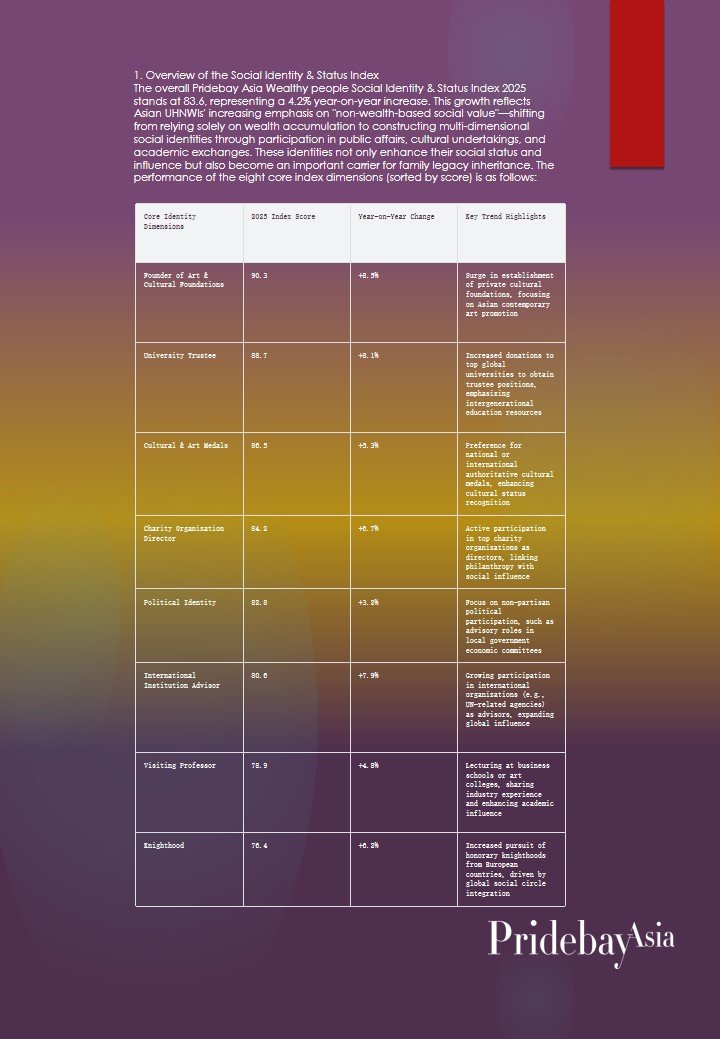
The overall Pridebay Asia Wealthy people Social Identity & Status Index 2025 stands at 83.6, representing a 4.2% year-on-year increase. This growth reflects Asian UHNWIs’ increasing emphasis on "non-wealth-based social value"—shifting from relying solely on wealth accumulation to constructing multi-dimensional social identities through participation in public affairs, cultural undertakings, and academic exchanges. These identities not only enhance their social status and influence but also become an important carrier for family legacy inheritance. The performance of the eight core index dimensions (sorted by score) is as follows:
|
Core Identity Dimensions |
2025 Index Score |
Year-on-Year Change |
Key Trend Highlights |
|---|---|---|---|
|
Founder of Art & Cultural Foundations |
90.3 |
+8.5% |
Surge in establishment of private cultural foundations, focusing on Asian contemporary art promotion |
|
University Trustee |
88.7 |
+8.1% |
Increased donations to top global universities to obtain trustee positions, emphasizing intergenerational education resources |
|
Cultural & Art Medals |
86.5 |
+5.3% |
Preference for national or international authoritative cultural medals, enhancing cultural status recognition |
|
Charity Organization Director |
84.2 |
+6.7% |
Active participation in top charity organizations as directors, linking philanthropy with social influence |
|
Political Identity |
82.8 |
+3.2% |
Focus on non-partisan political participation, such as advisory roles in local government economic committees |
|
International Institution Advisor |
80.6 |
+7.9% |
Growing participation in international organizations (e.g., UN-related agencies) as advisors, expanding global influence |
|
Visiting Professor |
78.9 |
+4.8% |
Lecturing at business schools or art colleges, sharing industry experience and enhancing academic influence |
|
Knighthood |
76.4 |
+6.2% |
Increased pursuit of honorary knighthoods from European countries, driven by global social circle integration |
2. Detailed Analysis of Core Identity Dimensions
2.1 Founder of Art & Cultural Foundations (Index: 90.3, +8.5% YoY)
This dimension ranks highest in the overall index, becoming the most important social identity symbol for Asian UHNWIs in 2025. The main driving factors include: 1) Strong demand for cultural identity expression—82% of surveyed UHNWIs believe that establishing art and cultural foundations can better reflect their personal values and family cultural heritage, compared to pure wealth display. 2) Policy support and resource integration—many Asian countries have introduced preferential policies for private cultural institutions, such as tax deductions for cultural donations. UHNWIs can integrate government, academic, and industry resources through foundations to enhance their influence in the cultural field. 3) Global cultural exchange needs—private cultural foundations have become an important platform for Asian UHNWIs to participate in global cultural exchanges, such as hosting international art exhibitions and sponsoring cross-border cultural projects. For example, 65% of UHNWIs who established cultural foundations in 2025 have held at least one international cultural exchange event, covering areas such as Asian contemporary art, traditional craft inheritance, and cultural heritage protection.
2.2 University Trustee (Index: 88.7, +8.1% YoY)
The University Trustee identity has shown the second-fastest growth rate, reflecting Asian UHNWIs’ emphasis on academic resources and intergenerational education. Key trends include: 1) Focus on top global universities—78% of UHNWIs who hold university trustee positions choose world-renowned universities (e.g., Ivy League schools in the US, Oxford and Cambridge in the UK, and top Asian universities such as the National University of Singapore). The average donation for obtaining trustee positions exceeds USD 15 million. 2) Linkage with family education planning—69% of UHNWIs stated that becoming a university trustee is to provide better educational resources and development platforms for their children and grandchildren, such as priority admission opportunities and academic mentor resources. 3) Academic influence expansion—UHNWIs participate in university management and academic research planning through trustee positions, enhancing their academic status and influence. For example, many UHNWIs promote the establishment of Asian studies centers or scholarship programs in top universities, strengthening the voice of Asian culture in the global academic community.
2.3 Cultural & Art Medals (Index: 86.5, +5.3% YoY)
Authoritative cultural and art medals have become an important symbol of Asian UHNWIs’ cultural status. Key characteristics include: 1) Preference for official and international medals—85% of UHNWIs who have obtained cultural and art medals value national-level cultural honors (e.g., national art medals issued by Asian countries) and international authoritative cultural awards (e.g., UNESCO cultural heritage protection awards) most. These medals are widely recognized in both domestic and international social circles, enhancing their cross-regional influence. 2) Medal acquisition through practical contributions—unlike honorary titles obtained through donations, most cultural and art medals require UHNWIs to make substantial contributions to cultural undertakings, such as long-term investment in cultural heritage protection, support for young artists, and promotion of cultural innovation. 3) Family legacy inheritance—cultural and art medals are often regarded as important family honors and included in family legacy inheritance, becoming a symbol of family cultural value.
2.4 Charity Organization Director (Index: 84.2, +6.7% YoY)
The identity of Charity Organization Director reflects the combination of Asian UHNWIs’ philanthropy and social influence. Key developments: 1) Shift from "passive donation" to "active management"—67% of UHNWIs who serve as charity organization directors are involved in the formulation of charitable project plans and the management of donation funds, rather than just providing financial support. This active participation enhances their influence in the philanthropy field. 2) Focus on professional charity fields—UHNWIs tend to choose charity organizations in fields related to their industries or personal interests, such as medical and health care, education poverty alleviation, and environmental protection. They use their professional resources and industry influence to promote the development of charitable projects. 3) Global philanthropy collaboration—many UHNWIs serve as directors in international charity organizations (e.g., the Red Cross, Save the Children), participating in global philanthropy cooperation and enhancing their international social status.
2.5 Political Identity (Index: 82.8, +3.2% YoY)
Asian UHNWIs’ pursuit of political identity tends to be rational and diversified, focusing on non-partisan participation and policy influence. Key trends: 1) Preference for advisory and consultative roles—72% of UHNWIs with political identities hold advisory positions in government economic committees, cultural committees, or urban planning committees, providing professional advice and suggestions for government decision-making. This avoids the risks of direct political participation while influencing policy formulation. 2) Focus on local and industry-related politics—most UHNWIs’ political participation is concentrated in their local areas or industries, such as participating in local chamber of commerce management and industry association leadership, to safeguard industry interests and promote local economic development. 3) Compliance and risk control—UHNWIs pay more attention to the compliance of political participation, avoiding excessive involvement in partisan disputes. They emphasize the role of "social elites contributing to public affairs" to enhance their social recognition.
2.6 International Institution Advisor (Index: 80.6, +7.9% YoY)
The identity of International Institution Advisor has shown rapid growth, reflecting Asian UHNWIs’ demand for global influence expansion. Key features include: 1) Focus on international organizations related to economy, culture, and environment—68% of UHNWIs who serve as international institution advisors choose organizations such as the United Nations Development Programme (UNDP), the World Economic Forum (WEF), and international cultural heritage organizations. They participate in global governance discussions and project implementation through advisory roles. 2) Utilization of professional advantages—UHNWIs rely on their professional experience and resources in fields such as finance, technology, and culture to provide professional advice for international organizations. For example, financial tycoons participate in international financial governance discussions, while cultural industry investors provide suggestions for global cultural heritage protection. 3) Global social circle expansion—serving as international institution advisors allows UHNWIs to interact with global political, business, and academic elites, expanding their global social circle and enhancing their international influence.
2.7 Visiting Professor (Index: 78.9, +4.8% YoY)
The Visiting Professor identity has become an important way for Asian UHNWIs to enhance their academic influence and personal brand value. Key trends include: 1) Focus on professional fields—83% of UHNWIs who serve as visiting professors lecture in their professional fields, such as business management, finance, art management, and technology innovation. They share practical experience and industry insights, bridging the gap between academia and industry. 2) Preference for business schools and art colleges—business schools and art colleges are the main choices for UHNWIs to serve as visiting professors, as these fields are closely related to their industries and interests. For example, many business tycoons lecture on entrepreneurship and corporate management in business schools, while art collectors and investors lecture on art appreciation and art market analysis in art colleges. 3) Academic exchange and resource integration—visiting professor positions provide UHNWIs with opportunities for in-depth academic exchanges, allowing them to integrate academic resources and promote cooperation between enterprises and universities, such as joint research projects and talent training programs.
2.8 Knighthood (Index: 76.4, +6.2% YoY)
Although the Knighthood identity has the lowest score among the eight dimensions, it has shown significant growth, reflecting Asian UHNWIs’ pursuit of global honorary titles and integration into international high-end social circles. Key characteristics include: 1) Focus on honorary knighthoods—most UHNWIs pursue honorary knighthoods awarded by European countries (e.g., the UK, Italy, and France) for their contributions to public welfare, culture, or international exchanges, rather than knighthoods obtained through military or political achievements. 2) Driving factors of social circle integration—63% of UHNWIs who obtained knighthoods stated that the main purpose is to integrate into international high-end social circles, as knighthoods are widely recognized in European and global high-end social circles, facilitating interactions with international elites. 3) Low-key pursuit—due to cultural differences and public perception, Asian UHNWIs tend to pursue knighthoods in a low-key manner, focusing more on the practical social value of the title rather than public display.
3. Regional Differences in Social Identity Preferences
There are significant regional differences in the preferences for social identities among Asian UHNWIs, driven by cultural traditions, economic development levels, and policy environments:
China & Hong Kong SAR: Focus on "Cultural & Art Medals" (91.2) and "Political Identity" (89.5). UHNWIs attach great importance to national cultural honors and participate in public affairs through advisory roles in government committees. They also actively establish private cultural foundations to promote traditional Chinese culture inheritance.
Singapore: Leading in "University Trustee" (92.3) and "International Institution Advisor" (87.6). As a global financial and cultural hub, Singaporean UHNWIs focus on integrating into global academic and international organizations to enhance their global influence. Many UHNWIs are trustees of top global universities and advisors to international financial institutions.
India: Preference for "Charity Organization Director" (88.9) and "Founder of Art & Cultural Foundations" (87.8). Indian UHNWIs attach great importance to philanthropy, especially in education and medical care fields. They also use cultural foundations to promote Indian traditional culture and art on the global stage.
Southeast Asia (Indonesia, Thailand, Malaysia): Emphasis on "Cultural & Art Medals" (85.7) and "Charity Organization Director" (84.5). Influenced by local cultural traditions, UHNWIs value national cultural honors and participate in charity activities related to religious culture and poverty alleviation. They also actively promote the inheritance of local traditional crafts and cultural heritage.
4. Research Methodology
4.1 Data Collection
This report is based on two main data sources: 1) Exclusive survey: Conducted by Pridebay Asia from February to April 2025, covering 750+ UHNWIs across 7 key Asian markets. The survey included questions on social identity acquisition, participation motivation, and social influence perception. 2) Secondary data: Collected from official announcements of government institutions, annual reports of cultural and academic organizations, public records of charity organizations, and international institution publications. The data covers the number of UHNWIs holding various social identities, donation amounts, and project participation情况 from 2023 to 2025.
4.2 Index Calculation
The Pridebay Asia Wealthy people Social Identity & Status Index is calculated using a weighted scoring model. Each of the 8 core identity dimensions is assigned a weight based on its importance in UHNWIs’ social status (derived from survey data and expert evaluations). The scoring criteria include: 1) Recognition level (social recognition and authority of the identity); 2) Acquisition difficulty (requirements for wealth, contributions, and resources to obtain the identity); 3) Influence scope (local, national, or global influence of the identity); 4) Participation depth (the degree of UHNWIs’ active participation in the identity-related work). The index is normalized to a 0-100 scale for easy comparison and analysis.
5. Conclusion and Future Outlook
The Pridebay Asia Wealthy people Social identity and status 2025 report reveals that Asian UHNWIs’ pursuit of social identity has entered a "value-driven" era, with cultural, academic, and public welfare identities becoming the core of their social status construction. Compared with traditional wealth display, UHNWIs are more inclined to enhance their social influence and family legacy through multi-dimensional social identities that reflect cultural value, academic status, and social responsibility.
Looking ahead to 2026, the overall Social Identity & Status Index is expected to grow by 4.5-5.5%. Key trends will include: 1) Further internationalization of social identities—Asian UHNWIs will increase their pursuit of international honorary titles and positions in international organizations to expand global influence. 2) Integration of digital technology and cultural identities—UHNWIs will use digital platforms to promote cultural projects and public welfare undertakings, creating new forms of social identity. 3) Strengthened linkage between social identities and family legacy—social identities such as cultural foundation founders and university trustees will become an important part of family legacy planning, passed down through generations. For institutions and brands targeting Asian UHNWIs, it is crucial to align with these trends, provide professional services and support for their social identity construction, and establish long-term cooperative relationships based on value recognition.
Disclaimer: The information and data in this report are obtained from publicly available sources and Pridebay Asia’s exclusive research. While we strive to ensure the accuracy and completeness of the information, we do not assume any liability for errors or omissions. This report is for reference only and does not constitute any investment advice or business decision basis.