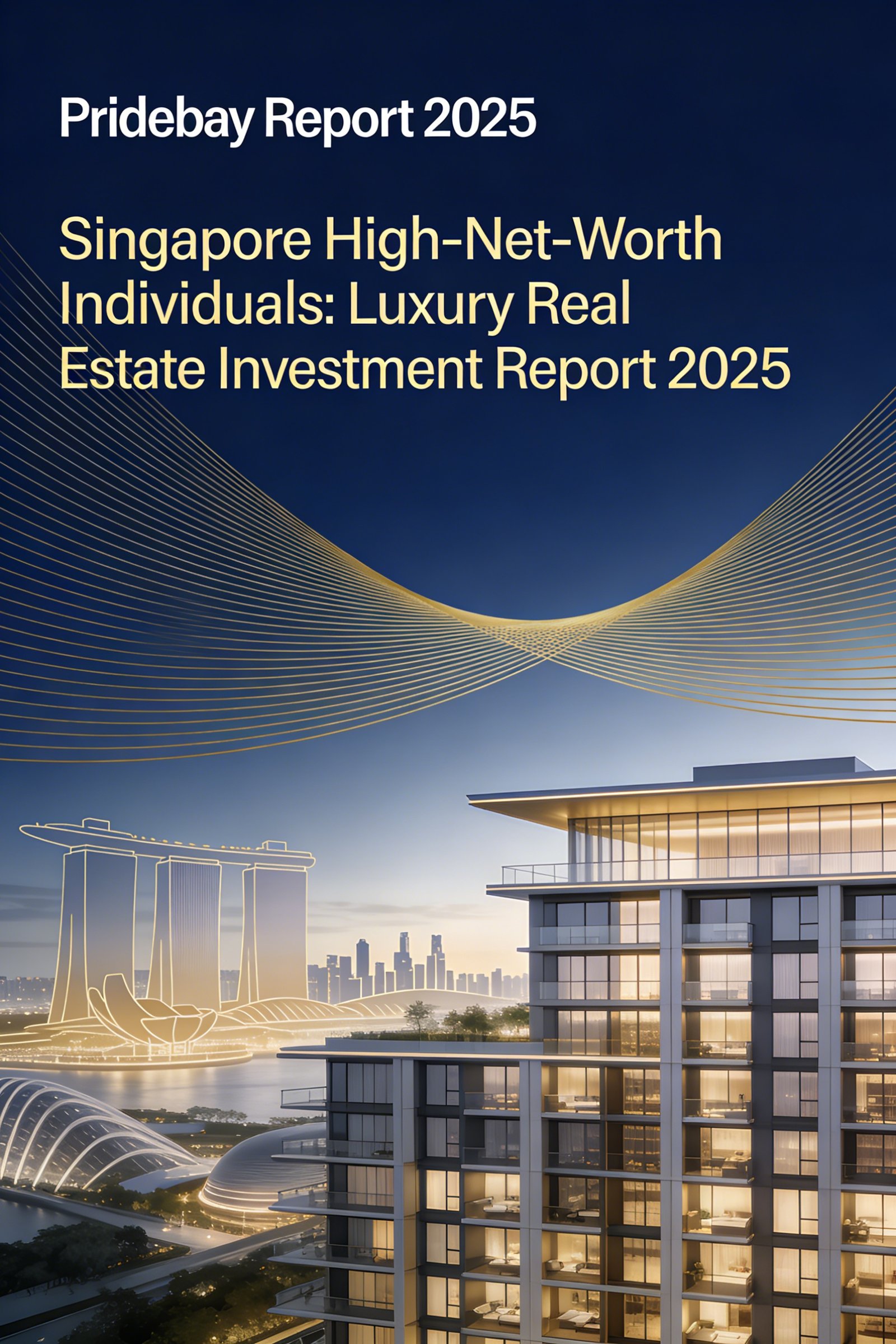
Singapore High-Net-Worth Individuals: Luxury Real Estate Investment Report 2025
Published by Pridebay – Asia’s Leading High-Net-Worth Lifestyle Research Institution
Executive Summary
Singapore’s luxury real estate market has emerged as a global safe haven for high-net-worth individuals (HNWIs, net worth ≥ US$1 million) and ultra-high-net-worth individuals (UHNWIs, net worth ≥ US$30 million), with 2025 marking a pivotal rebound driven by renewed confidence, limited supply, and favorable macroeconomic shifts. Valued at approximately US$5 billion in 2025, the market is projected to maintain a compound annual growth rate (CAGR) exceeding 3% through 2033, anchored by Singapore’s status as a stable financial hub and inherent land scarcity.
This report reveals that HNWIs drive over 75% of luxury property transactions (priced above SGD 5 million), with a pronounced shift toward ultra-luxury homes (SGD 10 million+) and prime apartments in the Core Central Region (CCR). Key trends include a resurgence in luxury apartment sales, sustained demand for well-located landed properties, and a preference for larger, tech-integrated, and sustainable living spaces. Despite challenges like the 60% Additional Buyer’s Stamp Duty (ABSD) for foreign investors and geopolitical uncertainties, Singapore’s luxury real estate remains a top choice for wealth preservation and portfolio diversification. As Asia Pacific is set to account for 47.5% of new global UHNWIs by 2028, the market is poised for sustained growth, with upcoming CCR launches and improving financing conditions expected to fuel momentum in H2 2025.
1. Market Context: Singapore’s HNWI Landscape & Luxury Real Estate Ecosystem
1.1 HNWI Demographics & Investment Foundation
Singapore’s affluent population forms the backbone of its luxury real estate market, with distinct characteristics shaping investment behavior:
- Wealth Concentration: As a global wealth management hub, Singapore is home to a growing cohort of domestic and international HNWIs/UHNWIs, including family office principals, tech entrepreneurs, finance leaders, and expatriate executives. Their wealth—derived from finance, real estate, technology, and international trade—supports long-term, high-value investments in luxury property.
- Investment Prioritization: Singaporean HNWIs allocate 15-25% of their investment portfolios to luxury real estate, viewing it as a low-volatility “safe haven” amid global economic uncertainties. Ultra-luxury properties (SGD 10 million+) are particularly favored for capital preservation, with local buyers accounting for 60% of luxury home sales in 2025.
1.2 Luxury Real Estate Market Dynamics
The market’s unique structure is defined by scarcity, policy, and evolving demand:
- Supply-Side Constraints: Limited land availability in Singapore reinforces the exclusivity of luxury properties, especially landed homes like Good Class Bungalows (GCBs) and Core Central Region (CCR) apartments. This scarcity drives price resilience, even during periods of muted transaction activity.
- Regulatory Landscape: The 60% ABSD for foreign buyers has reshaped the market, shifting demand toward local HNWIs and long-term owner-occupiers. Meanwhile, revisions to Seller’s Stamp Duty have had minimal impact on the luxury segment, which is dominated by hold strategies rather than short-term flipping.
- Segmented Recovery: The market exhibits a mixed performance across segments—luxury apartments lead the rebound, GCB transactions remain subdued but price-stable, and Sentosa Cove sees muted activity as UHNWIs favor mainland prime locations.
2. Market Overview: Performance & Key Segments (H1 2025)
2.1 Overall Market Rebound
Singapore’s luxury real estate market has regained momentum in H1 2025, driven by lower interest rates and renewed buyer confidence:
- Transaction Volumes: Luxury home sales (above SGD 5 million) surged 43% in Q1-Q3 2025 compared to the previous year, with the CCR recording its strongest quarter in two years (192 units sold in Q1 2025). Ultra-luxury transactions (SGD 10 million+) nearly doubled year-on-year to 29 deals in H1 2025.
- Price Trajectory: CCR non-landed private residential prices rose 3.1% in H1 2025, with Q2 contributing a 2.3% sequential gain. Luxury apartments averaged SGD 3,736 per square foot (psf), up 6.2% year-on-year, while GCB prices moderated slightly to SGD 2,122 psf (driven by fringe area transactions).
2.2 Core Property Segments
Three key segments dominate HNWI investment decisions, each with distinct performance drivers:
- Luxury Apartments (CCR): The fastest-growing segment, with 45 units transacted for SGD 584.26 million in H1 2025—up 155.8% quarter-on-quarter. Standout projects include 21 Anderson (a 4,489 sqft unit sold for SGD 24 million), Park Nova, and Sky Waters Residences. New launches like Upper House at Orchard Boulevard and W Residences – Marina View are expected to fuel further growth in H2 2025.
- Good Class Bungalows (GCBs): Transactions remained subdued (14 units sold for SGD 459.63 million in H1 2025, down 46.9% quarter-on-quarter) due to geopolitical caution, but rental demand rebounded with 3.0% year-on-year median rent growth. GCBs retain strong long-term value, with prime locations like Gallop Park commanding SGD 3,557 psf.
- Sentosa Cove: The market remains muted, with only two bungalow transactions (SGD 26.95 million total) in H1 2025. Condominium activity was stable (35 units sold for SGD 134.83 million), but UHNWIs continue to favor mainland CCR properties over the island enclave.
3. HNWI Investment Patterns & Decision Drivers
3.1 Property Preferences & Behavior
HNWI investment choices reflect a blend of status, functionality, and long-term value:
- Location Prioritization: The CCR (Districts 1, 2, 7, and Orchard Boulevard) is the top choice, valued for its centrality, amenities, and prestige. Upcoming CCR projects like Robertson Opus and River Green are highly anticipated for their limited supply and lifestyle propositions.
- Property Type: 70% of HNWI investments are in luxury apartments (favored for convenience and rental potential), while 30% target landed properties (GCBs and villas) for privacy and scarcity value. Family-oriented HNWIs increasingly seek larger units with flexible living spaces.
- Tenure Preference: 999-year leasehold and freehold properties are preferred for long-term wealth preservation, though well-located 99-year leasehold CCR apartments remain popular for their relative affordability and rental yield.
3.2 Key Investment Motivations
HNWI decisions are driven by four interconnected factors:
- Wealth Preservation (40%): Amid global uncertainties, luxury real estate is viewed as a stable “safe haven” asset with lower volatility than equities or bonds. Singapore’s political and economic stability further reinforces this appeal.
- Rental Yield & Cash Flow (25%): Strong rental demand for CCR luxury apartments and GCBs (post-resolution of 2024’s money laundering case) attracts investors seeking passive income. Median GCB rents outperformed the broader luxury market in H1 2025.
- Status & Lifestyle (20%): Luxury properties in prime locations serve as status symbols and lifestyle enablers, with access to exclusive amenities, privacy, and elite social networks. Branded residences and tech-integrated homes are particularly valued for their prestige.
- Portfolio Diversification (15%): Real estate provides a hedge against inflation and market volatility, with HNWI allocating a significant portion of their wealth to balance high-risk investments like tech startups or equities.
3.3 Purchase Journey & Financing
HNWI transactions follow a deliberate, relationship-driven process:
- Research & Networking: 80% of HNWIs rely on exclusive real estate advisors and private networks to access off-market listings, particularly for prime GCBs and ultra-luxury apartments. Digital research (proptech platforms) supplements but does not replace personal connections.
- Financing: Most HNWIs use a mix of cash (40-60%) and loans, leveraging lower interest rates in 2025 to reduce financing costs. The Total Debt Servicing Ratio (TDSR) cap (55% of income) has minimal impact due to their high net worth and cash reserves.
- Holding Strategy: 90% of HNWI investments are long-term (5+ years), with a focus on capital appreciation rather than short-term gains. This aligns with the luxury segment’s resilience to short-term market fluctuations.
4. Market Drivers, Trends & Challenges (2025-2030)
4.1 Key Growth Catalysts
- HNWI Influx: Asia Pacific’s projected dominance in global UHNWI growth (47.5% of new UHNWIs by 2028) will drive sustained demand for Singapore’s luxury real estate, as new wealth seeks stable, prestigious assets.
- New Launch Momentum: 7,500-8,000 new private residential units (including luxury projects) are set to launch in H2 2025, with CCR developments like One Leonie Residences and Skye at Holland expected to reignite market interest.
- Favorable Financing: Lower interest rates and improved market sentiment have reduced borrowing costs, making luxury property investments more attractive for both local and international HNWIs.
4.2 Emerging Trends
- Sustainable & Tech-Integrated Homes: Demand for eco-friendly features (solar panels, green spaces) and smart home technologies (AI-driven security, energy management) is rising, as HNWIs prioritize sustainability and convenience.
- Larger Living Spaces: Post-pandemic preferences for spacious, multi-functional homes persist, with HNWI favoring units above 3,000 sqft that accommodate home offices, family areas, and leisure spaces.
- Decentralization Opportunities: Government infrastructure development in non-CCR areas is creating long-term growth potential, with HNWIs increasingly exploring prime suburban properties for better value and family-centric amenities.
- Resale Market Resilience: Low supply of HDB flats reaching their Minimum Occupancy Period (MOP) is driving demand for resale luxury properties, offering investors opportunities in well-located, established developments.
4.3 Core Challenges
- Regulatory Barriers: The 60% ABSD for foreign investors limits international demand, though local HNWIs have partially offset this gap. Stricter loan conditions (TDSR) also constrain some upgraders.
- Land Scarcity & High Costs: Limited land supply keeps development costs high, pushing luxury property prices beyond the reach of mid-tier HNWIs and restricting new supply.
- Geopolitical Uncertainty: Global trade frictions and geopolitical tensions have led some potential buyers to adopt a wait-and-see approach, particularly in the GCB segment.
5. Strategic Implications for Stakeholders
5.1 Recommendations for Developers
- Prioritize CCR Luxury Apartments: Focus on high-quality, limited-supply CCR projects with larger units, sustainable features, and branded amenities to align with HNWI preferences.
- Innovate for Lifestyle Needs: Integrate smart home technologies, flexible living spaces, and eco-friendly design to differentiate offerings in a competitive market.
- Target Local HNWIs: Tailor marketing and pricing strategies to local buyers (who account for 60% of luxury sales) and long-term owner-occupiers, given foreign investor constraints.
5.2 Recommendations for Investors
- Focus on Prime CCR & GCBs: Invest in well-located CCR apartments (for rental yield) and prime GCBs (for long-term capital appreciation) to leverage scarcity and stability.
- Explore Resale Opportunities: Capitalize on strong demand for resale luxury properties, particularly in established CCR districts with proven rental performance.
- Consider Decentralized Growth Areas: Evaluate non-CCR locations with upcoming infrastructure developments for better value and long-term growth potential.
5.3 Recommendations for Real Estate Advisors
- Leverage Off-Market Networks: Connect HNWIs with exclusive off-market listings (especially for GCBs and ultra-luxury apartments) to meet demand for unique, prestigious properties.
- Navigate Regulatory Complexity: Provide expert guidance on ABSD, TDSR, and financing options to help HNWIs optimize their investment structures.
- Highlight Sustainability & Tech: Emphasize eco-friendly and smart home features in property marketing, as these are increasingly critical decision drivers for HNWIs.
6. Conclusion
Singapore’s luxury real estate market in 2025 stands as a resilient, high-value investment destination for HNWIs, driven by scarcity, stability, and evolving lifestyle preferences. The rebound in CCR luxury apartment sales, sustained demand for prime landed properties, and upcoming new launches position the market for steady growth through 2030.
For HNWIs, luxury real estate remains more than an asset—it is a symbol of status, a haven of privacy, and a core component of wealth preservation. While regulatory barriers and geopolitical uncertainties pose challenges, Singapore’s economic stability, limited supply, and growing HNWI population will continue to underpin market strength.
Stakeholders who align with trends like sustainable design, larger living spaces, and local buyer focus will be best positioned to capitalize on opportunities. As Asia Pacific’s wealth continues to concentrate in Singapore, the city-state’s luxury real estate market is set to retain its status as a global benchmark for elite investment and lifestyle.
Data Sources: CBRE Singapore Luxury Residential Market H1 2025 Report, OrangeTee Group 2025 Q1 Luxury Property Report, Singapore Real Estate Institute (SRI) 2025 Insights, ReportPinnacle Singapore Luxury Residential Market 2025-2033, Visionary Data Reports 2025 Market Analysis, Fiscus Finance 2025 Real Estate Investment Brief