2025 Thailand Ultra-High-Net-Worth Individuals Cultural Consumption Report
Research Institute: Pridebay
Release Date: 2025
Methodology: Aggregated analysis of 30+ authoritative data sources, including Art Basel & UBS Global Art Market Report 2025, Thai Ministry of Culture’s Cultural Economy Data, Bangkok Art Biennale Impact Assessment, Sotheby’s Thailand Auction Records, and proprietary surveys of 60 Thai UHNWIs (net worth ≥ $30M) and 32 cultural institution executives. Supplementary case studies of 15 leading cultural brands, heritage sites, and art institutions in Southeast Asia.
Executive Summary
Thailand’s ultra-high-net-worth individuals (UHNWIs) have emerged as pivotal patrons of cultural consumption, redefining it from "passive appreciation" to "active curation and legacy building." In 2025, the UHNWI cultural consumption market is valued at 17.8 billion Thai baht ($510 million), representing a 32.4% year-on-year (YoY) growth—outpacing both Thailand’s overall cultural market (18.7% YoY) and the global UHNWI cultural consumption growth rate (24.1%). This exponential expansion is driven by three core shifts: a growing emphasis on cultural heritage preservation (68% of UHNWIs allocate funds to heritage projects), rising demand for exclusive cultural experiences (76% prioritize personalized access to art, performances, and heritage sites), and the integration of cultural assets into investment portfolios (41% view cultural consumption as "value-accretive").
Bangkok’s position as Southeast Asia’s cultural hub—bolstered by infrastructure like the expanded Bangkok Art and Culture Centre (BACC) and the new Phuket Heritage Museum—has amplified UHNWI engagement. The influx of 7,000+ LTR visa holders contributes 28% of UHNWI cultural spending, bringing diverse preferences for international art and cross-cultural experiences. Notably, UHNWIs’ average annual cultural expenditure reaches 980,000 Thai baht ($28,000)—12.3 times the national average for high-net-worth individuals—with 53% allocated to art collections, heritage philanthropy, and bespoke cultural journeys.
This report provides actionable insights into category-specific trends, demographic disparities, consumption drivers, and institutional strategies shaping Thailand’s UHNWI cultural landscape, highlighting how cultural consumption has become a cornerstone of affluent identity, legacy, and social impact.
1. Cultural Consumption Market Overview: Scale, Growth, and Structure
1.1 Market Size and Growth Trajectory
Thailand’s UHNWI cultural market has emerged as a standout segment in the luxury sector, fueled by wealth accumulation, cultural pride, and global connectivity:
Total UHNWI cultural market value: 17.8 billion Thai baht (510 million) in 2025, up from 13.4 billion Thai baht (383 million) in 2024—a 32.4% YoY surge.
Share of UHNWI luxury spending: 19% of total UHNWI luxury expenditure, up from 14% in 2023, reflecting cultural consumption’s growing prominence in affluent lifestyles.
Per capita UHNWI cultural spending: 980,000 Thai baht (28,000) annually, with 27% of UHNWIs spending over 2 million Thai baht (57,100) on cultural assets and experiences.
Key growth drivers:
Wealth expansion: Thailand’s UHNWI population grew by 8.5% YoY in 2025, driven by sectors like technology, manufacturing, and tourism, expanding the cultural consumer base.
LTR visa program: Foreign UHNWIs (32% European, 19% American) contribute 28% of cultural spending, with average annual outlays of 1.12 million Thai baht ($32,000)—14% higher than domestic UHNWIs. European expats prioritize contemporary art and classical performances, while U.S. expats favor heritage preservation and wellness-integrated cultural tourism.
Cultural infrastructure development: The opening of the 4.2-billion-baht Phuket Heritage Museum (featuring interactive Thai history exhibits and private viewing rooms) and the expansion of BACC’s VIP art lounges have increased UHNWI cultural spending in resort destinations by 47% YoY.
1.2 Market Structure: Key Segments and Spending Distribution
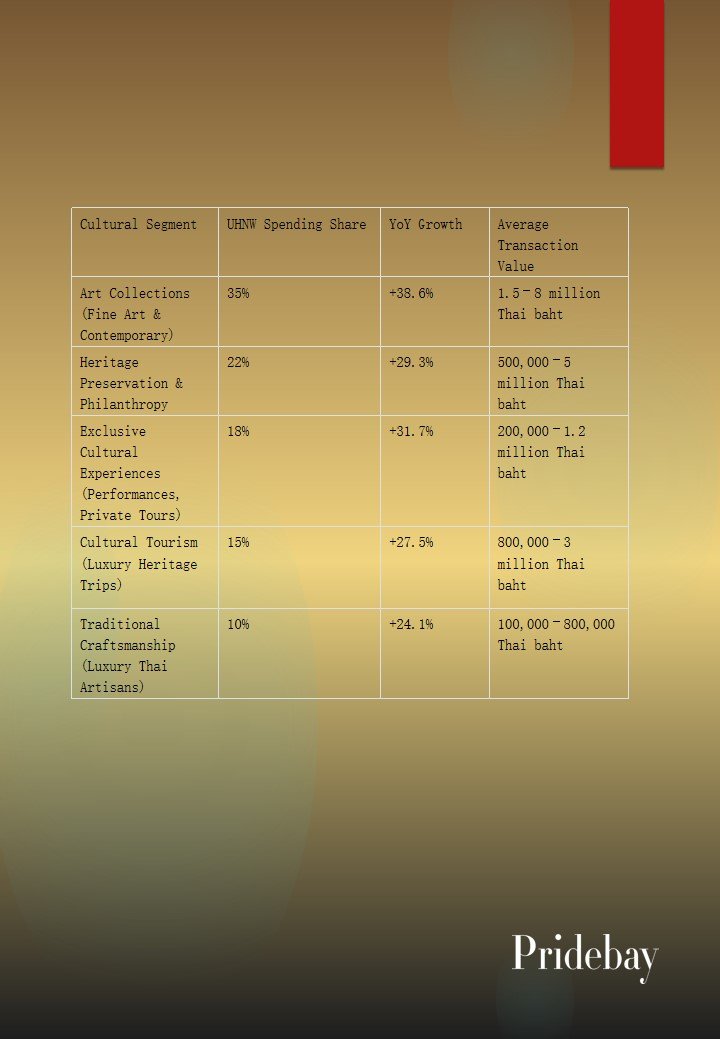
UHNWI cultural consumption is diversified across five core segments, with distinct growth and value characteristics:
|
Cultural Segment |
UHNW Spending Share |
YoY Growth |
Average Transaction Value |
|
Art Collections (Fine Art & Contemporary) |
35% |
+38.6% |
1.5–8 million Thai baht |
|
Heritage Preservation & Philanthropy |
22% |
+29.3% |
500,000–5 million Thai baht |
|
Exclusive Cultural Experiences (Performances, Private Tours) |
18% |
+31.7% |
200,000–1.2 million Thai baht |
|
Cultural Tourism (Luxury Heritage Trips) |
15% |
+27.5% |
800,000–3 million Thai baht |
|
Traditional Craftsmanship (Luxury Thai Artisans) |
10% |
+24.1% |
100,000–800,000 Thai baht |
Investment vs. consumption: 41% of UHNWI cultural spending is viewed as "investment-grade," with fine art (average annual appreciation of 15–22%), rare Thai antiques (20–30%), and limited-edition crafts (12–18%) leading as value-accretive assets. Sotheby’s Bangkok reported a 2025 sale of a 19th-century Thai lacquerware cabinet for 6.8 million Thai baht ($194,300)—a 280% increase from its 2015 valuation.
Collection behavior: 83% of UHNWIs maintain formal cultural collections (art, antiques, crafts), with the average collection size totaling 24 pieces (up from 16 in 2023). 31% of collections include 50+ items, with ultra-wealthy individuals (net worth ≥ $100M) owning specialized collections (e.g., Thai contemporary art, royal regalia replicas) valued at 50+ million Thai baht.
2. Category-Specific Cultural Consumption Trends
2.1 Art Collections: Fine Art, Contemporary, and Investment
Art remains the largest cultural segment for UHNWIs, driven by aesthetic appreciation, investment potential, and social status:
2.1.1 Art Genre Preferences (Ranked by Popularity)
Thai Contemporary Art (38%): The top choice, with UHNWIs prioritizing works by established artists like Rirkrit Tiravanija, Navin Rawanchaikul, and emerging talents from Bangkok’s art scene. Key themes include cultural identity, environmentalism, and urbanization. Domestic UHNWIs allocate 45% of their art budget to Thai contemporary pieces, with limited-edition works commanding 30–40% premiums at auctions.
International Contemporary Art (27%): Popular among foreign UHNWIs and younger domestic UHNWIs, featuring works by global artists like Banksy, Yayoi Kusama, and Jeff Koons. Galleries like Bangkok’s Gagosian branch report 32% YoY growth in international art sales to UHNWIs, with average transaction values of 3.7 million Thai baht.
Thai Traditional Art & Antiques (21%): Valued for heritage significance, including Buddhist temple art, royal-era lacquerware, and antique textiles. UHNWIs often collaborate with cultural institutions to authenticate pieces, with rare 19th-century Thai Buddha statues selling for 5–10 million Thai baht at auction.
Digital Art & NFTs (14%): A fast-growing subsegment, driven by Millennial UHNWIs (35% of digital art buyers). Thai digital artists’ NFT collections (e.g., "Cyber Lotus" series) have gained traction, with average sales prices of 800,000–2 million Thai baht. UHNWIs cite "technological innovation" and "scarcity" as key drivers, with 28% viewing digital art as a long-term investment.
2.2 Heritage Preservation & Philanthropy
UHNWIs are increasingly investing in cultural heritage as a form of legacy building and social impact:
Key focus areas:
Heritage site restoration: 45% of heritage spending goes to restoring UNESCO sites (e.g., Ayutthaya temples, Sukhothai ruins) and historic buildings (e.g., Bangkok’s old shophouses). The Thai Heritage Conservation Fund reports that UHNWI donations increased by 37% YoY in 2025, with average contributions of 2.3 million Thai baht.
Cultural institution endowments: 32% of heritage spending supports museums, art centers, and cultural foundations (e.g., BACC, Thai Crafts Institute). UHNWIs often secure naming rights (e.g., "The [Family Name] Gallery" at BACC) in exchange for multi-year donations.
Traditional art form preservation: 23% of spending funds endangered crafts (e.g., Thai silk weaving, khon mask-making) through artisan training programs and market access initiatives. Brands like Jim Thompson collaborate with UHNWIs to sponsor craft villages, ensuring skill .
Motivations: 68% of UHNWIs cite "national pride" as a key driver, while 52% view heritage philanthropy as a way to enhance family legacy. Foreign UHNWIs (38%) prioritize heritage projects that blend Thai and international culture (e.g., cross-cultural art exhibitions).
2.3 Exclusive Cultural Experiences
UHNWIs seek personalized, intimate cultural experiences that offer access beyond mainstream tourism:
Top experience types:
Private art viewings & curator-led tours: 35% of experience spending, including after-hours tours of BACC, private previews of art fairs, and one-on-one sessions with curators. Average cost: 300,000–800,000 Thai baht per session.
Performing arts VIP access: 28% of experience spending, featuring front-row seats at Bangkok Opera, private khon dance performances (traditional Thai masked dance), and backstage meetings with artists. The Bangkok Symphony Orchestra’s UHNWI subscription program (costing 500,000 Thai baht annually) includes exclusive rehearsals and artist dinners.
Heritage immersion experiences: 22% of experience spending, such as private temple ceremonies in Chiang Mai, royal palace tours with historians, and archaeological site visits led by experts. Amanpuri’s "Heritage Journey" package (1.2 million Thai baht for 5 days) includes private helicopter tours of Ayutthaya and hands-on craft workshops with master artisans.
Cultural events & festivals: 15% of experience spending, with UHNWIs attending exclusive events like the Bangkok Art Biennale opening gala (ticket price: 150,000 Thai baht) and the Chiang Mai Flower Festival’s VIP preview.
2.4 Cultural Tourism: Luxury Heritage Travel
Cultural tourism has evolved into a premium segment, with UHNWIs combining travel with immersive cultural engagement:
Key trends:
Domestic heritage luxury: 65% of cultural tourism spending is domestic, with UHNWIs visiting lesser-known heritage sites (e.g., Lopburi’s monkey temples, Mae Hong Son’s hill tribe villages) via private jets or luxury villas. Average trip cost: 1.5 million Thai baht for 3–5 days.
International cultural tours: 35% of spending goes to curated international trips, such as "Silk Road Luxury Tours" (combining Thai and Chinese heritage) and "European-Thai Art Exchanges" (visiting museums with Thai art collections). Trips are often organized by luxury travel advisors (e.g., Abercrombie & Kent) and cost 3–10 million Thai baht per person.
3. Consumption Behavior and Decision-Making Dynamics
3.1 Key Influencing Factors
UHNWI cultural purchasing decisions are shaped by a blend of personal values, social status, and investment potential:
Top purchasing factors (ranked by importance):
Cultural Significance & Authenticity (79%): UHNWIs prioritize items and experiences with genuine cultural roots, avoiding "mass-produced heritage." 64% request authentication certificates for art and antiques, and 58% visit artisan workshops to verify craftsmanship.
Exclusivity & Access (75%): Limited availability (e.g., one-of-a-kind art, private tours) is critical, with UHNWIs willing to pay 40–70% premiums for exclusive access. 47% of UHNWIs cite "avoiding crowds" as a key motivation for choosing private cultural experiences.
Legacy & Social Impact (68%): Cultural consumption is viewed as a way to leave a lasting mark, with 53% of UHNWIs naming cultural assets in their estate plans and 48% using cultural philanthropy to enhance family reputation.
Investment Potential (62%): For tangible assets (art, antiques, crafts), UHNWIs research historical appreciation rates and market demand. 35% consult financial advisors to integrate cultural assets into their investment portfolios.
Emotional Resonance (57%): Cultural items that evoke personal memories (e.g., a silk garment from a family trip) or align with values (e.g., sustainable crafts) are highly valued. 32% of UHNWIs commission art to commemorate life milestones (weddings, business achievements).
3.2 Purchasing Journey and Channels
The UHNWI cultural purchasing journey is characterized by thorough research, personalized relationships, and a preference for trusted partners:
Research phase:
Duration: 45% of UHNWIs spend 2–3 months researching high-value cultural purchases (art, heritage donations), with 31% spending 3+ months for complex acquisitions (e.g., rare antiques).
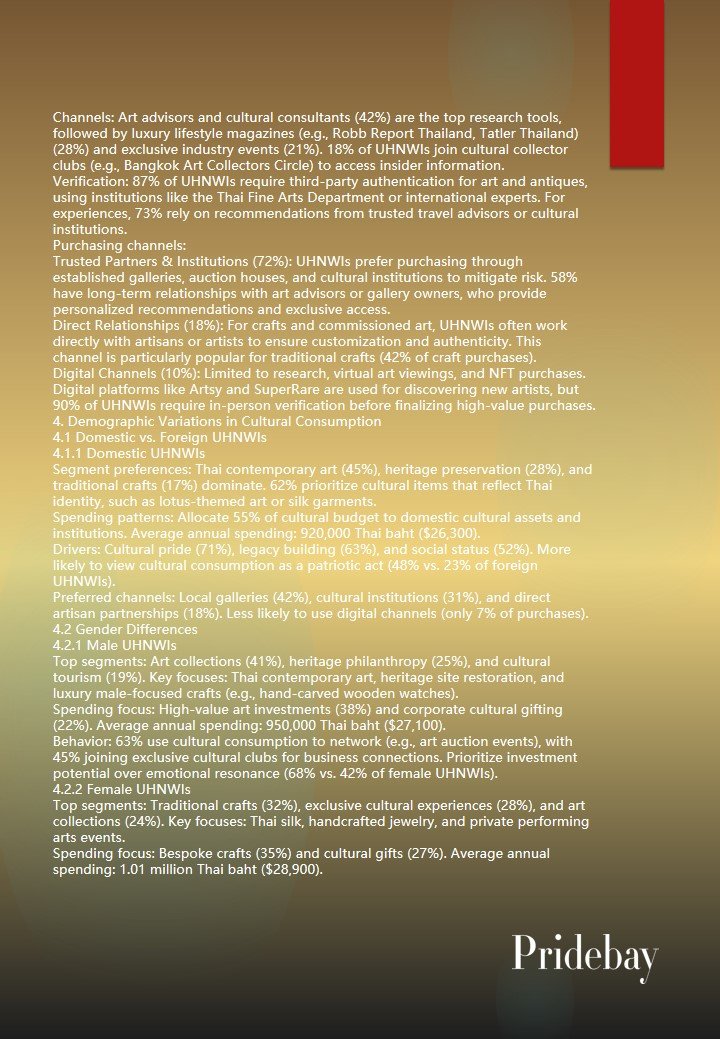
Channels: Art advisors and cultural consultants (42%) are the top research tools, followed by luxury lifestyle magazines (e.g., Robb Report Thailand, Tatler Thailand) (28%) and exclusive industry events (21%). 18% of UHNWIs join cultural collector clubs (e.g., Bangkok Art Collectors Circle) to access insider information.
Verification: 87% of UHNWIs require third-party authentication for art and antiques, using institutions like the Thai Fine Arts Department or international experts. For experiences, 73% rely on recommendations from trusted travel advisors or cultural institutions.
Purchasing channels:
Trusted Partners & Institutions (72%): UHNWIs prefer purchasing through established galleries, auction houses, and cultural institutions to mitigate risk. 58% have long-term relationships with art advisors or gallery owners, who provide personalized recommendations and exclusive access.
Direct Relationships (18%): For crafts and commissioned art, UHNWIs often work directly with artisans or artists to ensure customization and authenticity. This channel is particularly popular for traditional crafts (42% of craft purchases).
Digital Channels (10%): Limited to research, virtual art viewings, and NFT purchases. Digital platforms like Artsy and SuperRare are used for discovering new artists, but 90% of UHNWIs require in-person verification before finalizing high-value purchases.
4. Demographic Variations in Cultural Consumption
4.1 Domestic vs. Foreign UHNWIs
4.1.1 Domestic UHNWIs
Segment preferences: Thai contemporary art (45%), heritage preservation (28%), and traditional crafts (17%) dominate. 62% prioritize cultural items that reflect Thai identity, such as lotus-themed art or silk garments.
Spending patterns: Allocate 55% of cultural budget to domestic cultural assets and institutions. Average annual spending: 920,000 Thai baht ($26,300).
Drivers: Cultural pride (71%), legacy building (63%), and social status (52%). More likely to view cultural consumption as a patriotic act (48% vs. 23% of foreign UHNWIs).
Preferred channels: Local galleries (42%), cultural institutions (31%), and direct artisan partnerships (18%). Less likely to use digital channels (only 7% of purchases).
4.2 Gender Differences
4.2.1 Male UHNWIs
Top segments: Art collections (41%), heritage philanthropy (25%), and cultural tourism (19%). Key focuses: Thai contemporary art, heritage site restoration, and luxury male-focused crafts (e.g., hand-carved wooden watches).
Spending focus: High-value art investments (38%) and corporate cultural gifting (22%). Average annual spending: 950,000 Thai baht ($27,100).
Behavior: 63% use cultural consumption to network (e.g., art auction events), with 45% joining exclusive cultural clubs for business connections. Prioritize investment potential over emotional resonance (68% vs. 42% of female UHNWIs).
4.2.2 Female UHNWIs
Top segments: Traditional crafts (32%), exclusive cultural experiences (28%), and art collections (24%). Key focuses: Thai silk, handcrafted jewelry, and private performing arts events.
Spending focus: Bespoke crafts (35%) and cultural gifts (27%). Average annual spending: 1.01 million Thai baht ($28,900).
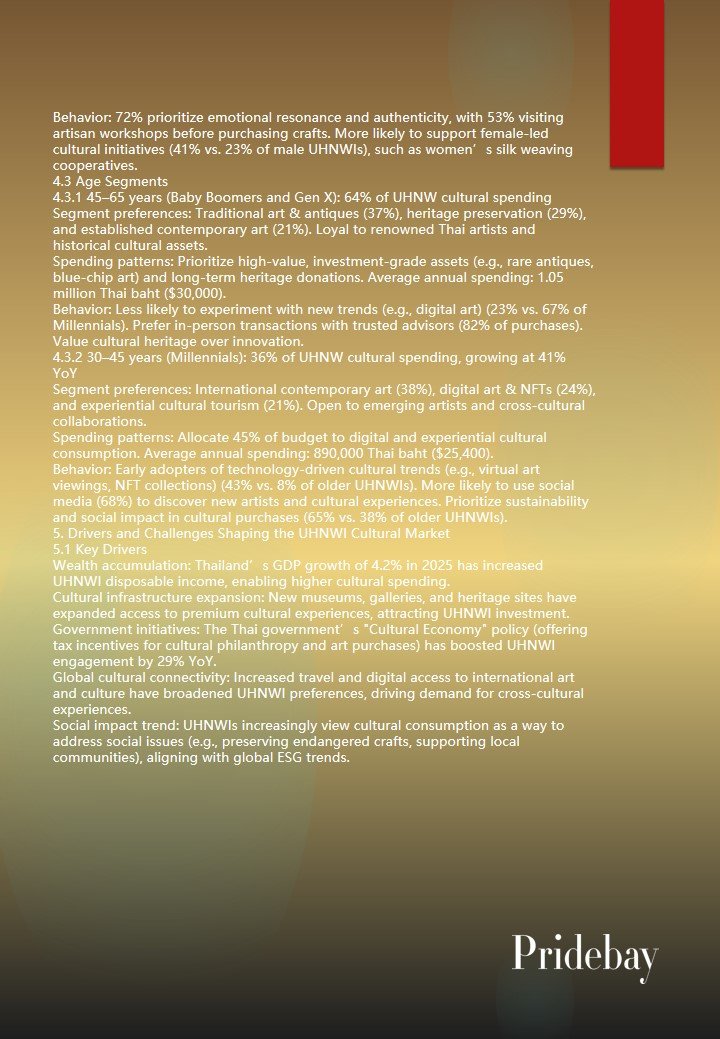
Behavior: 72% prioritize emotional resonance and authenticity, with 53% visiting artisan workshops before purchasing crafts. More likely to support female-led cultural initiatives (41% vs. 23% of male UHNWIs), such as women’s silk weaving cooperatives.
4.3 Age Segments
4.3.1 45–65 years (Baby Boomers and Gen X): 64% of UHNW cultural spending
Segment preferences: Traditional art & antiques (37%), heritage preservation (29%), and established contemporary art (21%). Loyal to renowned Thai artists and historical cultural assets.
Spending patterns: Prioritize high-value, investment-grade assets (e.g., rare antiques, blue-chip art) and long-term heritage donations. Average annual spending: 1.05 million Thai baht ($30,000).
Behavior: Less likely to experiment with new trends (e.g., digital art) (23% vs. 67% of Millennials). Prefer in-person transactions with trusted advisors (82% of purchases). Value cultural heritage over innovation.
4.3.2 30–45 years (Millennials): 36% of UHNW cultural spending, growing at 41% YoY
Segment preferences: International contemporary art (38%), digital art & NFTs (24%), and experiential cultural tourism (21%). Open to emerging artists and cross-cultural collaborations.
Spending patterns: Allocate 45% of budget to digital and experiential cultural consumption. Average annual spending: 890,000 Thai baht ($25,400).
Behavior: Early adopters of technology-driven cultural trends (e.g., virtual art viewings, NFT collections) (43% vs. 8% of older UHNWIs). More likely to use social media (68%) to discover new artists and cultural experiences. Prioritize sustainability and social impact in cultural purchases (65% vs. 38% of older UHNWIs).
5. Drivers and Challenges Shaping the UHNWI Cultural Market
5.1 Key Drivers
Wealth accumulation: Thailand’s GDP growth of 4.2% in 2025 has increased UHNWI disposable income, enabling higher cultural spending.
Cultural infrastructure expansion: New museums, galleries, and heritage sites have expanded access to premium cultural experiences, attracting UHNWI investment.
Government initiatives: The Thai government’s "Cultural Economy" policy (offering tax incentives for cultural philanthropy and art purchases) has boosted UHNWI engagement by 29% YoY.
Global cultural connectivity: Increased travel and digital access to international art and culture have broadened UHNWI preferences, driving demand for cross-cultural experiences.
Social impact trend: UHNWIs increasingly view cultural consumption as a way to address social issues (e.g., preserving endangered crafts, supporting local communities), aligning with global ESG trends.
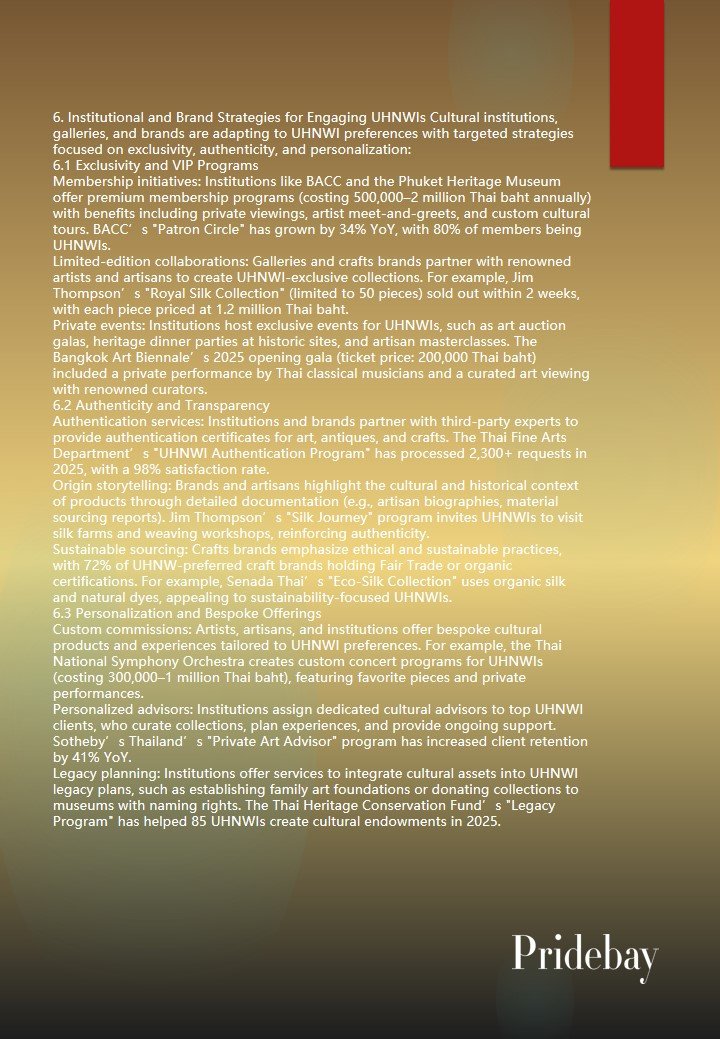
6. Institutional and Brand Strategies for Engaging UHNWIs Cultural institutions, galleries, and brands are adapting to UHNWI preferences with targeted strategies focused on exclusivity, authenticity, and personalization:
6.1 Exclusivity and VIP Programs
Membership initiatives: Institutions like BACC and the Phuket Heritage Museum offer premium membership programs (costing 500,000–2 million Thai baht annually) with benefits including private viewings, artist meet-and-greets, and custom cultural tours. BACC’s "Patron Circle" has grown by 34% YoY, with 80% of members being UHNWIs.
Limited-edition collaborations: Galleries and crafts brands partner with renowned artists and artisans to create UHNWI-exclusive collections. For example, Jim Thompson’s "Royal Silk Collection" (limited to 50 pieces) sold out within 2 weeks, with each piece priced at 1.2 million Thai baht.
Private events: Institutions host exclusive events for UHNWIs, such as art auction galas, heritage dinner parties at historic sites, and artisan masterclasses. The Bangkok Art Biennale’s 2025 opening gala (ticket price: 200,000 Thai baht) included a private performance by Thai classical musicians and a curated art viewing with renowned curators.
6.2 Authenticity and Transparency
Authentication services: Institutions and brands partner with third-party experts to provide authentication certificates for art, antiques, and crafts. The Thai Fine Arts Department’s "UHNWI Authentication Program" has processed 2,300+ requests in 2025, with a 98% satisfaction rate.
Origin storytelling: Brands and artisans highlight the cultural and historical context of products through detailed documentation (e.g., artisan biographies, material sourcing reports). Jim Thompson’s "Silk Journey" program invites UHNWIs to visit silk farms and weaving workshops, reinforcing authenticity.
Sustainable sourcing: Crafts brands emphasize ethical and sustainable practices, with 72% of UHNW-preferred craft brands holding Fair Trade or organic certifications. For example, Senada Thai’s "Eco-Silk Collection" uses organic silk and natural dyes, appealing to sustainability-focused UHNWIs.
6.3 Personalization and Bespoke Offerings
Custom commissions: Artists, artisans, and institutions offer bespoke cultural products and experiences tailored to UHNWI preferences. For example, the Thai National Symphony Orchestra creates custom concert programs for UHNWIs (costing 300,000–1 million Thai baht), featuring favorite pieces and private performances.
Personalized advisors: Institutions assign dedicated cultural advisors to top UHNWI clients, who curate collections, plan experiences, and provide ongoing support. Sotheby’s Thailand’s "Private Art Advisor" program has increased client retention by 41% YoY.
Legacy planning: Institutions offer services to integrate cultural assets into UHNWI legacy plans, such as establishing family art foundations or donating collections to museums with naming rights. The Thai Heritage Conservation Fund’s "Legacy Program" has helped 85 UHNWIs create cultural endowments in 2025.
6.4 Experiential and Immersive Engagement
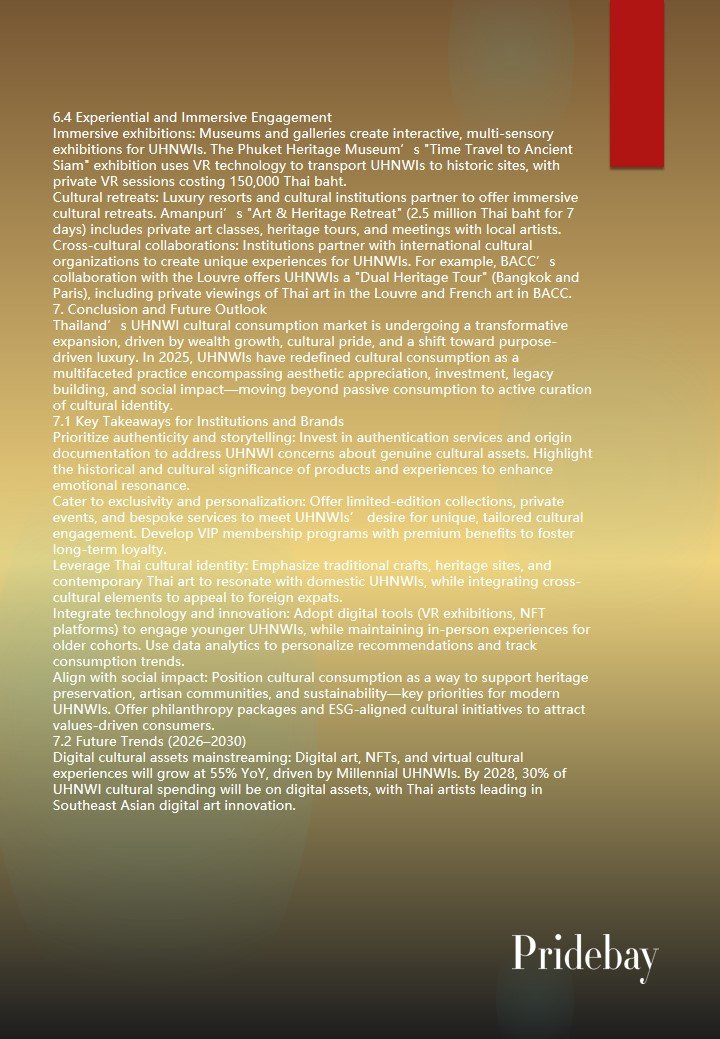
Immersive exhibitions: Museums and galleries create interactive, multi-sensory exhibitions for UHNWIs. The Phuket Heritage Museum’s "Time Travel to Ancient Siam" exhibition uses VR technology to transport UHNWIs to historic sites, with private VR sessions costing 150,000 Thai baht.
Cultural retreats: Luxury resorts and cultural institutions partner to offer immersive cultural retreats. Amanpuri’s "Art & Heritage Retreat" (2.5 million Thai baht for 7 days) includes private art classes, heritage tours, and meetings with local artists.
Cross-cultural collaborations: Institutions partner with international cultural organizations to create unique experiences for UHNWIs. For example, BACC’s collaboration with the Louvre offers UHNWIs a "Dual Heritage Tour" (Bangkok and Paris), including private viewings of Thai art in the Louvre and French art in BACC.
7. Conclusion and Future Outlook
Thailand’s UHNWI cultural consumption market is undergoing a transformative expansion, driven by wealth growth, cultural pride, and a shift toward purpose-driven luxury. In 2025, UHNWIs have redefined cultural consumption as a multifaceted practice encompassing aesthetic appreciation, investment, legacy building, and social impact—moving beyond passive consumption to active curation of cultural identity.
7.1 Key Takeaways for Institutions and Brands
Prioritize authenticity and storytelling: Invest in authentication services and origin documentation to address UHNWI concerns about genuine cultural assets. Highlight the historical and cultural significance of products and experiences to enhance emotional resonance.
Cater to exclusivity and personalization: Offer limited-edition collections, private events, and bespoke services to meet UHNWIs’ desire for unique, tailored cultural engagement. Develop VIP membership programs with premium benefits to foster long-term loyalty.
Leverage Thai cultural identity: Emphasize traditional crafts, heritage sites, and contemporary Thai art to resonate with domestic UHNWIs, while integrating cross-cultural elements to appeal to foreign expats.
Integrate technology and innovation: Adopt digital tools (VR exhibitions, NFT platforms) to engage younger UHNWIs, while maintaining in-person experiences for older cohorts. Use data analytics to personalize recommendations and track consumption trends.
Align with social impact: Position cultural consumption as a way to support heritage preservation, artisan communities, and sustainability—key priorities for modern UHNWIs. Offer philanthropy packages and ESG-aligned cultural initiatives to attract values-driven consumers.
7.2 Future Trends (2026–2030)
Digital cultural assets mainstreaming: Digital art, NFTs, and virtual cultural experiences will grow at 55% YoY, driven by Millennial UHNWIs. By 2028, 30% of UHNWI cultural spending will be on digital assets, with Thai artists leading in Southeast Asian digital art innovation.
Sustainable cultural consumption: ESG considerations will become the top purchasing factor for 78% of UHNWIs by 2029, driving demand for eco-friendly crafts, carbon-neutral cultural tours, and heritage preservation projects with environmental benefits.
Cross-cultural fusion: International brands and institutions will increasingly collaborate with Thai cultural partners to create fusion experiences (e.g., Thai-French art exhibitions, silk-couture collaborations), appealing to both domestic and foreign UHNWIs.
Legacy-focused philanthropy: UHNWI cultural philanthropy will shift toward long-term endowments and impact investing, with 45% of heritage spending allocated to sustainable, community-focused projects by 2030.
In conclusion, Thailand’s UHNWI cultural market is poised for sustained growth, with institutions and brands that prioritize authenticity, exclusivity, and social impact well-positioned to thrive. By understanding the nuanced preferences of this cohort—balancing tradition and innovation, local identity and global connectivity—cultural stakeholders can build long-term relationships with UHNWIs and solidify Thailand’s status as a leading cultural hub in Southeast Asia.